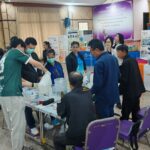

CHIANG RAI – Thai officials delivered portable heavy-metal testing kits to border health authorities in Chiang Rai province on Nov. 15, 2026, accelerating field screening after toxic arsenic spikes forced temporary tap water shutdowns.
Deputy Prime Minister and Minister of Higher Education, Science, Research and Innovation Yoschanan Wongsawat inspected water monitoring operations at the First Thai-Myanmar Friendship Bridge before handing over M-Sense electrochemical detectors to the Chiang Rai Provincial Public Health Office. Developed by the National Nanotechnology Center, the handheld devices cut contamination screening times from days in central laboratories down to three minutes at the riverbank.
Key Takeaways• Toxic Surge: Arsenic in the Sai River reached 0.30 milligrams per liter in early November—30 times the national safety limit—amid extreme sediment turbidity above 10,000 NTU. • Rapid Field Screening: NANOTEC’s M-Sense electrochemical sensor measures arsenic, lead, cadmium, and mercury on-site within three to five minutes. • Water Supply Overhaul: Authorities are pairing village nanofiltration upgrades with groundwater wells and Mekong River water diversions to protect five border subdistricts. |
Upstream Mining Activity Drives Border Water Crisis
The deployment follows months of escalating cross-border pollution along the Sai River, which forms the natural frontier between Thailand’s northernmost district and Myanmar’s Shan State. Heavy seasonal rains have repeatedly washed sediment and chemical runoff from unregulated upstream mining operations in Myanmar’s Tachileik township straight into Thai municipal water intakes.
Data from the Environmental and Pollution Control Office 1 in Chiang Mai revealed that river turbidity surged past 10,000 nephelometric turbidity units on Nov. 5 and Nov. 6, overwhelming conventional filtration plants designed to handle a maximum of 6,000 units. Simultaneously, arsenic concentrations hit 0.30 milligrams per liter, far exceeding Thailand’s 0.01 milligram safety threshold and prompting diplomatic protests from Bangkok.
The Provincial Waterworks Authority temporarily halted tap water production in Mae Sai before restoring treated flows, while the Department of Disease Control warned residents across five subdistricts—Mae Sai, Pong Pha, Si Mueang Chum, Wiang Phang Kham, and Ko Chang—not to drink river water, cook with untreated supplies, or eat local aquatic animals.
Portable Sensors and Nanofiltration Cut Lab Bottlenecks
Joined by Deputy Agriculture Minister Piyarat Tiyapairach and Chiang Rai Gov. Chucheep Phongchai, Yoschanan watched researchers demonstrate M-Sense at the border bridge gauging station. Dr. Weerakanya Maneeprakorn, a research director at NANOTEC under the National Science and Technology Development Agency, explained that the kit pairs portable readers with electrochemical strips to quantify arsenic, lead, cadmium, and mercury down to parts-per-billion levels.
“Clean water is the foundation of quality of life,” Yoschanan said during the handover. “Science and innovation cannot stay locked inside laboratories; they must solve real problems on the ground.” Instant field readings allow local officers to issue immediate public health alerts and reserve slower, high-cost laboratory testing strictly for confirmatory samples.
“Real impact means building tools that work directly in local hands,” said NANOTEC Deputy Director Dr. Wiyong Kangwansupamonkon, noting that researchers are transferring technical training alongside hardware to the Department of Groundwater Resources, the Pollution Control Department, and the Department of Health.
Beyond diagnostics, the initiative operates under the A-QUALITY clean water program led by Dr. Nuttaporn Pimpha, which links field monitoring directly with community treatment systems.
In partnership with the National Research Council of Thailand, NANOTEC has already upgraded village waterworks in the nearby Kok River basin with arsenic-removal systems and point-of-use nanofiltration units serving more than 1,180 households. To insulate Mae Sai from future river spikes, provincial agencies are also preparing backup groundwater wells and planning long-term pipelines to divert cleaner water from the Mekong River.