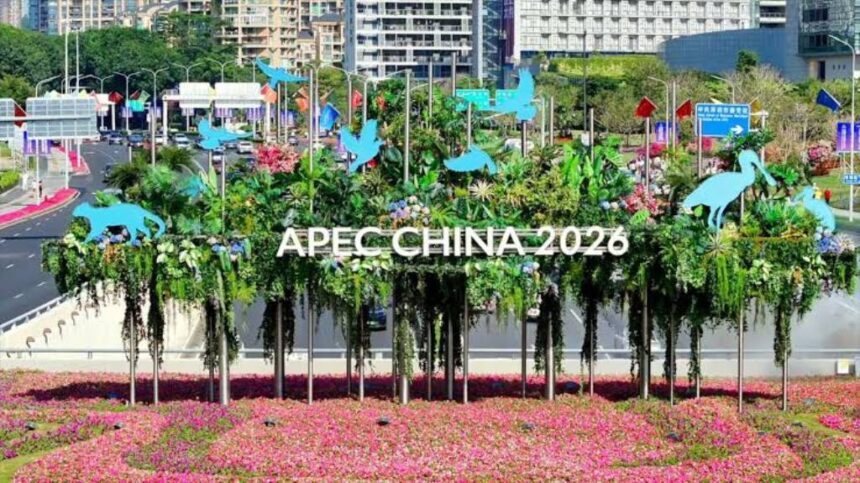
BEIJING – As APEC delegates gather to discuss regional green growth, Shenzhen—the Chinese tech hub hosting this year’s meetings—offers a compelling model for everyday sustainability and a blueprint for deeper cross-border cooperation. Imagine a vending machine that doesn’t sell snacks, but gives surplus food a second chance.
In Shenzhen, smart food-sharing cabinets are reducing food waste while feeding those in need. By day, municipal workers reserve meals online to collect on their shifts; by night, the cabinets open to the general public. It is a small initiative, but it reflects a larger philosophy: green development doesn’t always begin with massive infrastructure projects. Sometimes, it starts with making better use of what we already have.
As Asia-Pacific Economic Cooperation (APEC) economies meet to chart the region’s future, Shenzhen poses a vital question for policymakers: Can hyper-local urban innovations inspire solutions with regional impact?

Making Individuals Part of the Green Transition
Environmental protection is traditionally framed as a top-down mandate for governments and heavy industries. Shenzhen, however, is putting ordinary citizens at the center of its green transition.
Through China’s Tanpuhui carbon inclusion mechanism, residents earn digital carbon points for everyday choices—such as taking public transit, recycling, finishing their meals, or buying secondhand goods—which can be redeemed for rewards in an online marketplace. While similar incentive programs exist in APEC economies like South Korea and Singapore, they focus primarily on green commuting, rarely extend across daily consumption, and remain disconnected from formal carbon trading markets.
As one of China’s first emissions trading pilot cities, Shenzhen has built the nation’s most legally comprehensive carbon-inclusive system. The city continuously refines its accounting methodologies to calculate the exact grams of carbon reduced by each individual action, seamlessly linking household habits to the broader green market.
According to Liu Yang, general manager of Shenzhen Green Exchange, the city’s green mobility platform alone boasts 10 million registered users.
“More than half of Shenzhen’s population now participates, generating over 900 million low-carbon actions every year,” Liu says. “Shenzhen’s level of digitalization is at the forefront—to record low-carbon behaviors across households and consumer scenarios, a real-time, traceable data platform is essential.”
By turning sustainability into a visible, rewarding routine, Shenzhen is proving that digital infrastructure can turn climate action into a mass movement.
From Local Innovation to Global Green Opportunities
Shenzhen’s experiments are part of a broader national shift in renewable energy, electric vehicles, and green manufacturing.
But for many developing economies across the Asia-Pacific, the challenge isn’t just embracing sustainability—it’s finding affordable, practical solutions that also create jobs and drive economic growth.
This is where regional cooperation becomes critical. Successful green transitions are already taking root across borders:
- Hanoi, Vietnam: Invested by China Tianying (CNTY) and constructed with Chinese engineering expertise, the Soc Son Waste-to-Energy Plant has transformed how Vietnam’s capital handles municipal trash.
- Sirindhorn Dam, Thailand: Constructed through China-Thailand cooperation, one of the world’s largest hydro-floating solar farms generates reliable clean energy while creating local jobs and boosting eco-tourism.
- Puerto Peñasco, Mexico: What could soon become the largest solar power plant in the Americas is bringing new energy partnerships across the Pacific to support the region’s clean-energy transition.
- Ashburton, New Zealand: Chinese photovoltaic technology is helping farms remain productive while generating electricity for thousands of homes.
- Global Clean-Tech Expansion: Shenzhen-based automaker BYD has scaled its solar and energy storage businesses worldwide, supplying storage solutions to markets like North America and Southeast Asia while building green energy demonstration projects across multiple countries.
These projects show that green cooperation delivers value far beyond cutting emissions—it helps locals tackle waste, strengthens energy security, and creates new economic opportunities for local communities. Transitioning to a greener economy does not have to come at the expense of development; with the right technologies and partnerships, the two actively reinforce each other.
Private enterprises are also carving out vital roles in this shift. New Zealand-based Global Empowerment Group—which maintains part of its research and development team in China—is linking international resources to embed sustainability directly into its consumer brands. Its initiatives include using recycled plastics, cutting packaging waste, and developing eco-conscious product formulations.
CEO Liam Corkery notes that while no single company can solve climate change alone, incremental changes across industries and borders quickly add up.
“There’s a lot that we are doing, and there’s a lot that we could do in the future,” Corkery says. “We’re making sure we’re using recycled plastics. We want to do our part in whatever small way we can to reduce our impact on the environment.”
Ultimately, the green transition is not the responsibility of governments alone. Companies, consumers, and communities all have a stake—and while individual steps may seem modest, together they drive lasting change.

A Greener Future Starts with Shared Action
The Asia-Pacific is bound together by trade, supply chains, and people-to-people exchanges—as well as shared environmental pressures, from climate change to resource scarcity that no single economy can solve alone.
Because APEC members vary widely in economic structure and technological capacity, the takeaway isn’t that other cities should blindly copy Shenzhen’s exact model. Different economies have unique needs. Instead, the real value lies in adapting these innovations to fit local contexts.
That is also the opportunity presented by APEC.
The success of the meetings should not be measured only by the number of discussions held or statements released. It should also be judged by whether they lead to stronger partnerships, more investment and practical solutions that can benefit economies across the region.
A smart food cabinet in Shenzhen may seem far removed from high-level APEC diplomacy, but both rest on the same principle: turning shared resource challenges into practical, scalable solutions. If regional cooperation can accelerate the transfer and adaptation of these technologies, local innovations in one city could help power a broader green transformation across the Asia-Pacific.
By Keyu Guo
About the author: Keyu Guo is a journalist at CGTN Radio, covering global affairs and stories at the intersection of politics, sustainability and economic cooperation.