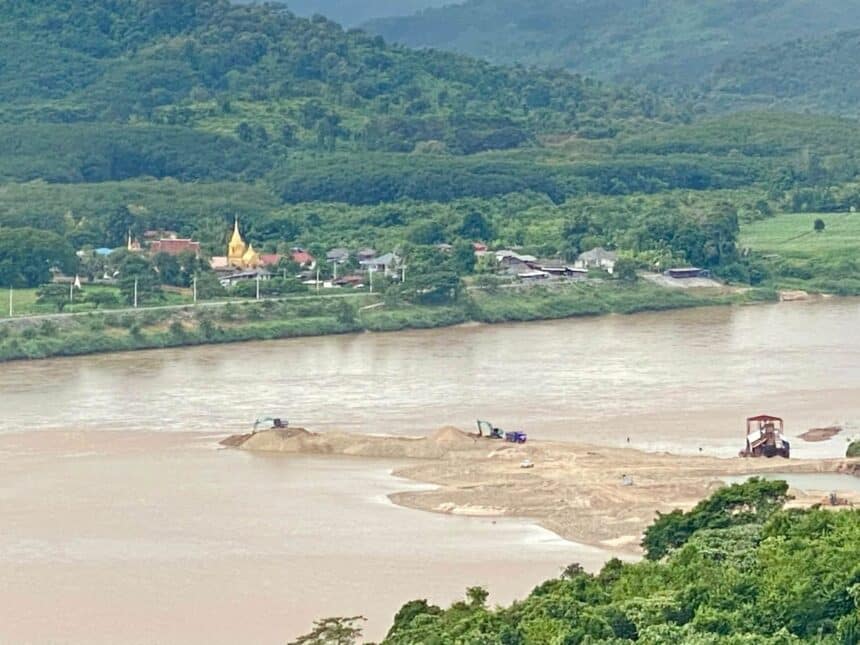
CHIANG RAI – State-aligned media in northern Laos dismissed reports of illegal gold mining along the Mekong River on Thursday, insisting heavy machinery across from Chiang Rai is merely dredging sand for local construction.
Thai conservationists and academics rejected that explanation, pointing to midnight digging, missing haul trucks and sand dumped straight back into the river. The dispute precedes a Saturday border inspection by Thai civic groups worried toxic runoff threatens downstream towns.
Key Takeaways
• Lao Pushback: Bokeo broadcasters claim a Nov. 6 inspection at Ban Pak Ngao found legal sand dredging for public roads, not chemical gold mining.
• Suspicious Operations: Thai scholar Chainarong Sretthachau noted crews dig overnight, build no riverside stockpiles and use no dump trucks.
• Monitoring Push: Advocates plan a Nov. 14 border trip and urge the Mekong River Commission to test water for arsenic and heavy metals.
Dredging Claims Clash With Riverbank Evidence
Thai civic networks recently identified at least 15 small-scale gold extraction sites operating along the Lao bank from opposite Chiang Khong district down to Pakbeng in Oudomxay province. Meta Chat’Al, a radio and television outlet in Bokeo province, accused critics of spreading falsehoods. Broadcasters said Bokeo officials inspected the Ban Pak Ngao site in Houayxay district on Nov. 6 and verified crews were dredging sand without chemicals for provincial roads and security buildings.
Bokeo authorities urged social media users to rely solely on official Lao statements. Yet a Lao official quoted by Radio Free Asia acknowledged licensed riverbank suction operations routinely yield construction sand and placer gold simultaneously, reflecting Laos’s push for state revenue despite ecological risks.
Chainarong Sretthachau, an environmental lecturer at Mahasarakham University, disputed the construction claim on Facebook. Commercial sand operators work daytime shifts, pipe sediment onto massive shore stockpiles and haul loads away by truck, he wrote. At the Bokeo sites, excavators dig through the night, push tailings back into the channel and operate without transport trucks.
Upstream Toxins and Border Blind Spots
The clash follows mounting alarm over heavy metals across northern Thailand’s waterways. Earlier in 2026, Thailand’s Pollution Control Department detected dangerous arsenic levels in Mekong mainstream sediment near Chiang Rai for the first time, tracing contamination to unregulated mines along Myanmar’s Kok and Sai rivers.
Using sand permits to mask alluvial gold extraction is a recurring headache in northern Laos; Vientiane previously expelled a Chinese mining operator in Bokeo caught processing gold under a gravel license. Because the Mekong forms the international boundary here, disturbed sediment and sluicing chemicals drift straight into Thai fishing grounds and municipal water intakes.
On Saturday, Nov. 14, Rivers and Rights, the Hill Area and Community Development Foundation and the Rak Chiang Khong Group will escort reporters to document the barges firsthand. Chainarong urged the Mekong River Commission to conduct independent, multi-party water sampling before dry-season currents concentrate pollutants.