CHIANG RAI — Toxic arsenic from unregulated gold and rare-earth mines in neighboring Myanmar has poisoned four major rivers in northern Thailand this month, forcing authorities to shut off tap water to more than 20,000 households and triggering a public health emergency across Chiang Rai province.
Water tests in November 2026 found arsenic levels in the Sai River at 25 times the safe drinking limit and local waterworks readings at 30 times the national standard, prompting Prime Minister Anutin Charnvirakul to order an urgent search for clean water supplies across the border region.
The chemical crisis stems from a wartime mining boom across the border in Myanmar’s Shan State, where Chinese-backed operators and the ethnic United Wa State Army strip hillsides for gold and critical minerals while dumping untreated waste straight into mountain streams. As poisoned silt flows downstream into the Kok, Sai, Ruak and Mekong rivers, the heavy metal seeps into shallow village wells, taints rice paddies, threatens livestock and drives away tourists who sustain Chiang Rai’s local economy.
Key Takeaways
- Tap water supplies to 14 villages in Chiang Rai’s Mae Sai district were suspended in November 2026 after arsenic levels reached 30 times the safe limit, affecting over 20,000 households.
- Chemical tracing and satellite imagery link the toxic runoff to a rapid surge of Chinese-funded gold and rare-earth mines operating in territories controlled by the United Wa State Army in Myanmar’s Shan State.
- Arsenic-laden sediment is contaminating groundwater wells, slashing vegetable sales by half, damaging river tourism and showing up in urine tests among northern Thai residents.
How Upstream Mining Poisons Downstream Rivers
The poison enters Thailand silently, riding fast mountain currents from southern Shan State down into the valleys of Chiang Rai. Arsenic occurs naturally inside underground rock formations, locked harmlessly beneath the surface alongside veins of gold, tin and rare-earth minerals. Industrial mining shatters that seal.
Environmental researchers at Naresuan University who analyzed river water and satellite imagery this month found that mine operators across the border blast open mountainsides and crush tons of raw ore. Workers wash the crushed rock with pressurized water and harsh chemical reagents to separate valuable metals from waste dirt. Without lined tailings ponds or wastewater treatment plants, thick gray slurry washes straight into steep tributaries feeding the Kok and Sai rivers.
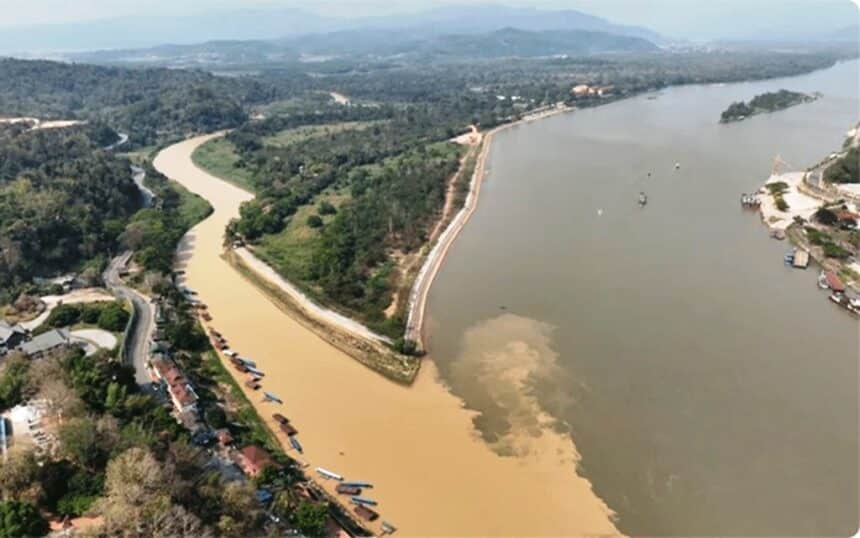
Once inside the river system, arsenic moves in two destructive ways. Dissolved arsenic races downstream in the water column, creating sharp spikes in toxicity whenever rain washes fresh mine waste into streams. Heavier arsenic-bound particles sink to the riverbed and settle into dense layers of mud.
Field measurements published by the Chiang Rai Times show sediment arsenic concentrations reaching 66 to 80 milligrams per kilogram at four sampling sites in Chiang Rai, alongside readings of 25 milligrams per kilogram at Ban Hua Fai on the Sai River. Even on days when surface water looks clear, that toxic mud remains on the bottom. Strong currents, seasonal floods or river dredging stir up the riverbed and release trapped poison back into the water.
Wartime Gold Rush in Myanmar’s Shan State
Behind the muddy water lies a violent resource scramble fueled by Myanmar’s civil war. Since the military coup in February 2021 collapsed central government oversight across Myanmar’s borderlands, armed factions and foreign investors have turned remote mountain forests into unregulated extraction zones.
United Nations data and regional monitoring groups document that active mining sites in Shan State jumped from just 12 before the 2021 coup to at least 85 by late 2026. Along the rugged ridges facing Chiang Rai’s Mae Fah Luang and Mae Sai districts, satellite images reveal sprawling brown scars where dense jungle once stood.
Suebsakun Kidnukorn, a researcher tracking transboundary pollution in northern Thailand, identified three main power brokers behind the mines: ethnic Wa forces overseeing rare-earth operations near the upper Kok River and gold mines near the upper Sai River, Shan armed groups operating around Doi Ko Wan, and roughly 20 companies holding licenses from Myanmar’s military authorities. Those licensed firms include at least 12 gold mines, six manganese operations and two lead mines, alongside uncounted tin and antimony pits.
After ethnic Kachin resistance forces seized major rare-earth hubs in northern Myanmar in 2024, investors shifted southward into Shan State to keep supply chains running. Thai military officers patrolling the border ridge confirmed to reporters that hillsides once worked by small-scale gold panners have been taken over by heavy machinery extracting high-value rare earths.
Geography, Conflict and Supply Chains
To understand why a localized mining boom in Myanmar has triggered an acute water emergency across northern Thailand, investigators point to three converging forces: mountain hydrology, wartime economics and global clean-energy supply chains.
Geographically, Chiang Rai sits at the bottom of a steep international funnel. The Kok River rises in Shan State and winds 130 kilometers through Chiang Mai and Chiang Rai before emptying into the Mekong River at Chiang Saen. The Sai River forms the international border between Myanmar’s Tachileik township and Thailand’s Mae Sai district before joining the Ruak River at the Golden Triangle. Because every major waterway in northern Chiang Rai flows from Myanmar, Thailand has zero physical control over the headwaters.
Historically, cross-border mining in the Golden Triangle operated on a modest scale, constrained by poor roads and periodic army crackdowns. That changed after 2021 when Myanmar’s military junta and ethnic militias alike needed hard currency to buy weapons, fuel and supplies. Minerals buried under Shan State became the fastest way to raise cash.
Global demand for electric vehicles, wind turbines and defense electronics accelerated the rush. Elements such as dysprosium and terbium, vital for permanent magnets, are abundant in the clay hills of Shan and Kachin states. Between 2017 and 2024, Myanmar exported more than $4 billion worth of rare earths to China, with 84 percent shipped after the 2021 coup. Two-thirds of China’s rare-earth imports now originate in Myanmar, feeding a refining sector that controls 90 percent of global supply. Lawless extraction in Shan State keeps global magnet prices low while shifting the environmental cost onto Thai farmers downstream.
United Wa State Army Profits From Toxic Mines
At the center of the border mining economy stands the United Wa State Army, Myanmar’s largest and best-equipped ethnic armed organization. Operating from its autonomous enclave along the Chinese border, the 30,000-strong force maintains a decades-old ceasefire with Myanmar’s military while expanding its commercial footprint deep into southern Shan State near Thailand.
Investigators with the Shan Human Rights Foundation documented in 2025 and 2026 that the group has opened vast mining concessions across southern Shan State territories under its southern command, directly upstream from Chiang Rai.
The financial model is straightforward and lucrative. The Wa army controls land access, provides armed security for heavy equipment convoys and collects licensing fees, transit taxes and production royalties from mining operators. Outside contractors supply excavators, chemical leaching tanks and technical supervisors.
Because these territories sit outside international banking systems and effective state regulation, mine operators pay zero environmental bonds and face no penalties when tailings dams fail. For Wa commanders, mineral revenues fund road construction, local administration and military hardware without relying on illicit narcotics, which the group formally pledged to curb two decades ago. Villagers on the Myanmar side who complain about dead fish or ruined streams face intimidation from armed guards, leaving downstream Thai communities to absorb the runoff.
Beijing’s Silence Over Chinese-Backed Mining Firms
While Wa commanders control the territory, Chinese capital, engineers and supply networks power the mines. Thai academics, border officials and environmental advocates say Chinese-affiliated companies finance the heavy machinery, manage chemical processing and purchase nearly all the extracted gold and rare-earth concentrate.
Trucks loaded with raw mineral ore regularly cross from Myanmar through northern Thailand as transit cargo bound for refineries in southern China. Yet Beijing has maintained strict public silence over the pollution crisis unfolding along Thailand’s northern border.
When Thailand and Myanmar signed a weakened bilateral agreement on river pollution in November 2026, reporters at Mongabay contacted the Chinese Embassy in Bangkok, the Chinese Consulate in Chiang Mai and the Chinese Ministry of Foreign Affairs for comment on Chinese-operated mines in Shan State. None of the offices replied.
Associate Professor Lalita Hanwong, a Myanmar specialist at Kasetsart University, noted that Chinese investments are directly tied to upper river mines, yet officials avoid naming Beijing in diplomatic forums. Civic leaders argue that diplomatic caution is costing residents their health.
“China must also be part of the solution,” said Pianporn Deetes, regional campaigns director for Rivers & Rights and a Chiang Rai resident. “Responsibility does not end at the mine. It extends throughout the entire supply chain — from investors and traders to processors, manufacturers and companies purchasing these minerals.”
Tap Water Shutdowns and Poisoned Village Wells
For families living along the border, geopolitical silence brings immediate daily hardship. In early November 2026, waterworks officials in Mae Sai district detected arsenic levels 30 times above the national safety threshold, forcing an immediate suspension of piped tap water across 14 villages.
More than 20,000 households suddenly lost running water for drinking, cooking and bathing. Municipal crews dispatched water trucks to distribute emergency rations while residents lined up with plastic jugs or spent scarce income on bottled water.
Even when municipal treatment plants filter river water back within legal limits, rural families relying on private wells face a hidden danger. On Nov. 17, 2026, Thailand’s Department of Groundwater Resources confirmed that toxic arsenic had breached underground aquifers, contaminating nine community wells across Chiang Rai and neighboring Chiang Mai provinces.
Hydrologists explained that polluted surface water from the Kok, Sai and Ruak rivers percolates downward through porous alluvial soil into shallow water tables. Because rural households routinely drill shallow domestic boreholes rather than deep bedrock wells, surface-to-groundwater seepage exposes villagers to chronic arsenic poisoning even when they avoid the river.
Health authorities have already detected biological warning signs. Screening by Thailand’s Department of Disease Control found elevated arsenic in the urine of 94 villagers out of 1,269 people tested in northern Thailand, alongside 17 positive cases out of 177 residents tested farther downstream in Nong Khai province along the Mekong River.
Arsenic Enters Crops, Livestock and the Food Chain
Beyond drinking water, arsenic is infiltrating the agricultural heartland that feeds northern Thailand. Thousands of hectares of rice paddies, vegetable plots and fruit orchards along the Kok, Sai and Ruak floodplains depend on river irrigation canals during the dry season.
When farmers pump arsenic-tainted river water onto fields, heavy metals bind to topsoil particles. Soil surveys across Chiang Rai farmland found that half of tested agricultural plots already require ongoing monitoring due to arsenic concentrations between 14 and 25 milligrams per kilogram. Researchers warn that unchecked sediment buildup could threaten up to 16,000 hectares of Thai rice land.
Rice plants carry a distinct biological vulnerability. Unlike wheat or corn, rice grows in flooded paddies where oxygen-poor soil converts bound arsenic into a mobile chemical form that plant roots absorb easily, mistaking it for nutrients like silicon. The toxin accumulates inside grain husks and white kernels eaten daily across the region.
Livestock face parallel exposure routes. Water buffalo, cattle and free-range ducks grazing along riverbanks drink from contaminated backwaters and eat grass coated in dried river silt. While Thailand’s Ministry of Public Health reported that initial spot checks on harvested rice and livestock meat remained within legal limits, buyer confidence has collapsed.
In Mae Sai district, wholesale vegetable sales dropped by 50 percent after news of the water contamination spread, and regional rice buyers halted orders pending laboratory clearance. Farmers now face an impossible choice: leave crops unwatered to wither in the sun, or irrigate with river water that buyers refuse to purchase.
Fishermen and Riverside Vendors Lose Their Livelihoods
Along the banks of the Kok and Sai rivers, entire communities built around freshwater fishing and riverside trade are watching their incomes vanish. For generations, artisanal fishermen cast nets at dawn for catfish, carp and river prawns, selling their catch in morning markets across Chiang Rai.
In October and November 2026, the Ministry of Public Health warned residents not to use Sai River water for drinking, cooking or making ice, and to avoid eating aquatic animals caught in contaminated stretches. Officials cautioned against eating fish organs, bottom-dwelling prawns and shellfish, which concentrate heavy metals ingested from riverbed mud.
“We are no longer talking only about heavy metals in the water or whether people should avoid eating fish organs,” warned researcher Suebsakun Kidnukorn in an interview with The Nation. “The river ecosystem is on the verge of dying.”
Without buyers willing to touch river fish, dozens of fishing families have pulled wooden boats onto the shore. Riverside food stalls, noodle shops and floating bamboo raft restaurants from Tha Ton down to the Kok-Mekong confluence have shuttered or lost most of their daily customers.
Local vendors told the Chiang Rai Times that the crisis compounds back-to-back disasters that battered northern Thailand over the past two years, including severe border flooding and heavy seasonal PM2.5 smog. Small business owners who took out loans to rebuild after floodwaters receded now struggle to draw customers near the water.
Toxic Waters Drive Tourists Away From Chiang Rai
Tourism, a core pillar of Chiang Rai’s provincial economy, has suffered an immediate blow. Travelers visit northern Thailand for long-tail boat journeys through jungle valleys, elephant camps along the Kok River, bamboo rafting and Golden Triangle river cruises.
Boat operators who ferry visitors from Chiang Rai town to riverside Karen villages say bookings dried up almost overnight. Boatman Jamrat told reporters that days pass without a single charter, and tourist boats arriving from Tha Ton have stopped running.
“The local tourism economy has collapsed,” said Chitwan, a riverside business operator in Chiang Rai. “The river is murky and contaminated, and that’s driven people away. Some who’ve been in the water have developed rashes.”
During peak holiday periods like Songkran and the cool winter travel season, families normally crowd sandy riverbanks to swim, picnic and rent floating rafts. With health warnings posted at river piers and murky brown water flowing past riverside resorts, domestic and international travelers are canceling river trips or shortening stays.
Hoteliers and restaurant owners have spent thousands of baht installing commercial reverse-osmosis filtration systems to reassure guests that ice, coffee and shower water are safe. Even so, operators say headlines about poisoned rivers are hard to erase once travelers book vacations elsewhere.
Greed Over Ecology Leaves a Century-Long Scar
Environmental scientists stress that the damage unfolding in Chiang Rai cannot be fixed simply by shutting a valve or waiting for monsoon rains. Unlike organic sewage that breaks down over weeks, arsenic is a chemical element that never degrades in nature.
Hydrologists studying the Sai and Kok basins estimate that heavy-metal sediment trapped behind weirs and settled inside river bends could leach arsenic into northern Thailand’s waterways for up to 100 years unless upstream dumping stops and contaminated silt is removed.
Chronic exposure to inorganic arsenic carries severe medical consequences. According to World Health Organization guidelines, long-term ingestion through water and food causes skin lesions, nerve damage, cardiovascular disease, kidney failure and cancers of the skin, bladder and lungs. Children and pregnant women face heightened developmental risks even at low levels.
Advocates note that the crisis exposes a stark failure of cross-border accountability: mining syndicates and armed militias pocket millions of dollars in short-term profits, global supply chains absorb cheap minerals without auditing mine sites, and Thai farming families pay the price with their land and health.
Thailand’s Emergency Response and Diplomatic Push
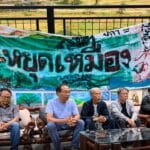
Facing mounting public anger and protests from northern community groups, the Thai government has launched an emergency response combining water engineering, health screening and border diplomacy.
In November 2026, Prime Minister Anutin Charnvirakul instructed the Ministry of Natural Resources and Environment, the Ministry of Public Health and provincial governors to secure alternative raw water sources and monitor municipal tap supplies continuously. The Cabinet previously approved 188.36 million baht across 14 remediation projects for 2026 and 2027, funding twice-monthly water testing, monthly sediment sampling and public arsenic test kits.
On the ground, the Department of Groundwater Resources initiated a recovery plan on Nov. 17 to install 11 community reverse-osmosis filtration plants, build one large agricultural water treatment system and drill real-time observation wells across affected border districts through 2027. Provincial leaders have also proposed sediment traps and toxin-absorption barriers at the Chiang Rai Weir and Mae Sai Irrigation Weir to catch heavy metals before river water enters farm canals.
Officials acknowledge that filters and traps only treat symptoms while upstream mines remain open. During an August 2026 parliamentary inspection in Chiang Rai, local environmental officers revealed they lacked basic budgets even for vehicle fuel to collect river samples regularly.
In November, Thailand signed a bilateral environmental agreement with Myanmar for joint river monitoring, though conservation groups criticized the text as weakened because it lacked binding enforcement or leverage over armed groups in Shan State. Parliamentary committees and civic networks are now pressing Bangkok to tighten customs controls on mineral transit shipments passing through Thailand to China — arguing that halting the trade corridor is the strongest lever Thailand holds.