CHIANG RAI – A coalition of northern Thai civic groups will stage a major border demonstration in Mae Sai district on Nov. 22 to demand urgent joint action from Thailand, Myanmar and China over toxic heavy metals contaminating four regional waterways.
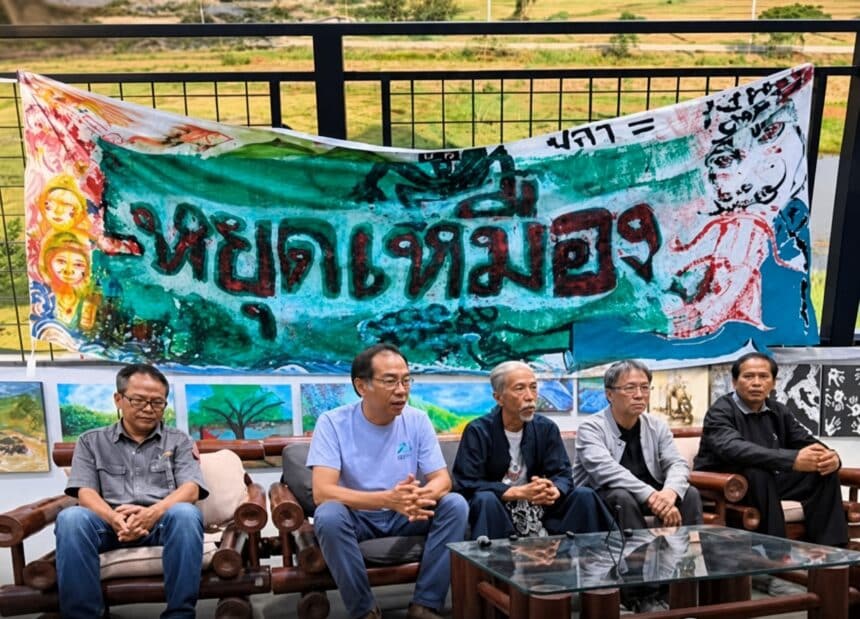
The People’s Network to Protect the Kok, Sai, Ruak and Mekong Rivers announced the rally Thursday at the Chiang Rai Contemporary Art Museum. Organizers warn that nearly two years of unresolved cross-border pollution have tainted raw water supplies used for municipal tap water in Mae Sai, threatening public health, farming and local fisheries.
Key Takeaways• Civic groups will march to the First Thai-Myanmar Friendship Bridge in Mae Sai on Nov. 22 to protest nearly two years of toxic river contamination. • Coalition leaders demand that Bangkok engage Myanmar and China to curb upstream mining discharge and establish a strict, trackable cleanup timeline. • Recent official tests found arsenic levels in the Sai River up to 25 times above safety limits, forcing tap water suspensions for over 20,000 households. |
Demands for Regional Accountability
Niwat Roykaew, president of the Rak Chiang Khong Group, said the contamination crisis has dragged on without concrete solutions from Bangkok. He urged Thai authorities to elevate diplomatic talks and press Myanmar and China—both linked to regional mineral supply chains—to take responsibility at the pollution source.
Somkiat Khuenchiangsa, president of the Living River Association, said the crisis is hitting three fronts: the environment, local livelihoods and public health. Consumer fears over tainted catches have stalled produce sales and hurt fishermen and farmers. He called on agencies to expand testing of water, riverbed sediment and aquatic life, and to publish academic findings openly.
Kiatkhun Chankaen of the Chiang Rai Lanna Assembly of Happiness said residents want clean rivers restored permanently rather than short-lived responses triggered only when the issue makes headlines. Meanwhile, Neramit Chitraksa of Chiang Rai Rajabhat University proposed a public action plan with clear 10-day, 20-day, three-month and six-month benchmarks, alongside backup water supplies and relief for affected farmers.
Upstream Mines Fuel Downstream Crisis
The rally follows mounting scientific and government warnings over unregulated extraction across the border. Recent Thai tests detected arsenic levels in the Sai River reaching 25 times the safe drinking standard, forcing officials this month to suspend tap water supplies across 14 Mae Sai villages and affecting more than 20,000 households.
Chemical tracking and satellite imagery analyzed by Naresuan University researchers traced the toxic sediment to gold and rare-earth mining operations in Myanmar’s eastern Shan State. Because territory in Shan State is fragmented among military authorities, armed groups and private operators, cross-border enforcement remains weak while extracted minerals frequently move through regional transit routes toward China.
Civic leaders have also criticized a recent bilateral river pollution accord between Thailand and Myanmar as significantly weakened, arguing that diplomatically cautious language fails to compel upstream mine closures or guarantee transparent data sharing for downstream communities.
March Schedule and Political Outreach
Suebsakun Kidnukorn, a lecturer at Mae Fah Luang University, outlined a seven-hour program for Sunday’s gathering. Demonstrators will assemble at 1 p.m. at Tham Pha Chom in Mae Sai for public briefings on contamination data, panel discussions and cultural performances.
At 4 p.m., protesters will march through residential neighborhoods and the Sailomjoy Market toward the First Thai-Myanmar Friendship Bridge border checkpoint. Organizers expect a deputy prime minister to arrive at 5 p.m. to accept a formal petition and meet with 10 community representatives, with activities running until 8 p.m.
The network confirmed it has notified Mae Sai police and local agencies of the rally. Organizers also invited all Chiang Rai members of Parliament across party lines and relevant senators to attend and commit to measurable cross-border remedies.