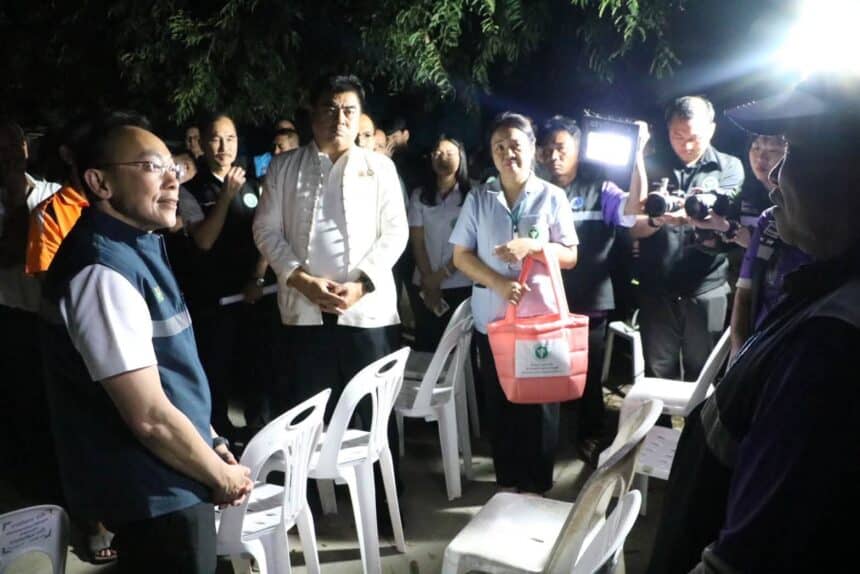
CHIANG RAI — Senior Thai health officials swept through border communities along the Kok and Sai rivers on Nov. 19 to step up toxic heavy metal screening and reassure worried residents. Acting on orders from Public Health Minister Phattana Prompat, Deputy Public Health Minister Dr. Samruk Jungsaman led a multi-agency task force across Chiang Rai province to audit water supplies, review blood and urine data, and map long-term medical care.
The field inspection hits a critical nerve in northern Thailand, where tainted water flowing across the border threatens household taps, river fish, and farmland. Officials say testing alone will not protect border towns; every abnormal screening result now triggers direct medical follow-up and source remediation.
Key Takeaways• Expanded Human Screening: Health teams have tracked residents across five Mae Sai subdistricts over three testing rounds, with lab results pending for 399 people screened in 2026. • Daily Water Checks: Mae Sai Regional Plumbing and municipal crews filter groundwater, shallow ponds, and village tap systems while reporting water quality readings every day. • Coordinated Action Plan: Four public health units are splitting duties across tap safety, food testing, exposure tracking, and local clinical care to resolve contamination at its source. |
Upstream Mines Drive Cross-Border Water Crisis
The emergency deployment follows months of mounting alarm across the Kok-Sai-Ruak basin, which feeds directly into the Mekong River at the Golden Triangle. Independent researchers and Thai pollution monitors have traced spikes in arsenic, lead, and toxic sediment to unregulated gold and rare-earth mining across the border in Myanmar’s Shan State.
Seasonal flooding washes heavy mining runoff straight into Thai waterways, clogging treatment filters and threatening roughly 16,000 hectares of irrigated rice land. Earlier this year, researchers at Mae Fah Luang University flagged elevated arsenic levels in local farm soil, river fish, and the urine of school-age children, prompting urgent calls for sustained clinical tracking alongside diplomatic talks.
Mae Sai Surveillance and Daily Tap Audits
At Mae Sai Hospital, Dr. Samruk met with Department of Health Director-General Dr. Thiti Sawangtham, Ministry Inspector-General Dr. Piya Sirilak, and Chiang Rai Provincial Public Health Doctor Ekchai Khamlua to review district surveillance data. Health workers have intensified monitoring for heavy metals, including lead, across five high-watch zones: Mae Sai, Wiang Phang Kham, Koh Chang, Si Muang Chum, and Pong Pha.
Local clinics have completed three rounds of community screening. In 2025, doctors examined 560 residents and ran urine toxicology tests on 52 people, all returning normal readings. A second round in 2026 tracked 25 repeat patients, again yielding normal results. A third wave recently screened 399 additional residents, whose laboratory results are now pending. Community doctors report no confirmed clinical illnesses tied to the water so far.
To keep household taps safe, Mae Sai Regional Plumbing now filters groundwater, shallow ponds, and village water networks while issuing daily quality reports. Mae Sai Municipality crews are simultaneously auditing household water consumption.
Four-Agency Plan Targets Exposure at the Source
Following the hospital briefing, Dr. Samruk visited homes in Chiang Saen district to hear directly from families along the river. He assured residents that anyone with abnormal test results will receive continuous care from local medical teams rather than facing the crisis alone.
The Ministry of Public Health has divided operational duties across four units to close gaps between testing and treatment. The Department of Health oversees village tap systems and upgrades filtration. The Department of Medical Sciences tests river water, vegetables, and fish for toxic buildup. Meanwhile, the Department of Disease Control tracks human exposure, while local hospitals deploy field doctors to diagnose and treat at-risk groups.
If tests detect contaminants above safety limits in food or water, authorities will trace the source and enforce corrective steps. Residents with elevated exposure readings will undergo deeper clinical evaluations rather than being labeled patients from a single lab screen. “After checking, we must proceed to monitor, prevent, treat, and resolve the problem at its root,” the ministry stated, urging residents to remain aware without panicking and follow local health advisories.