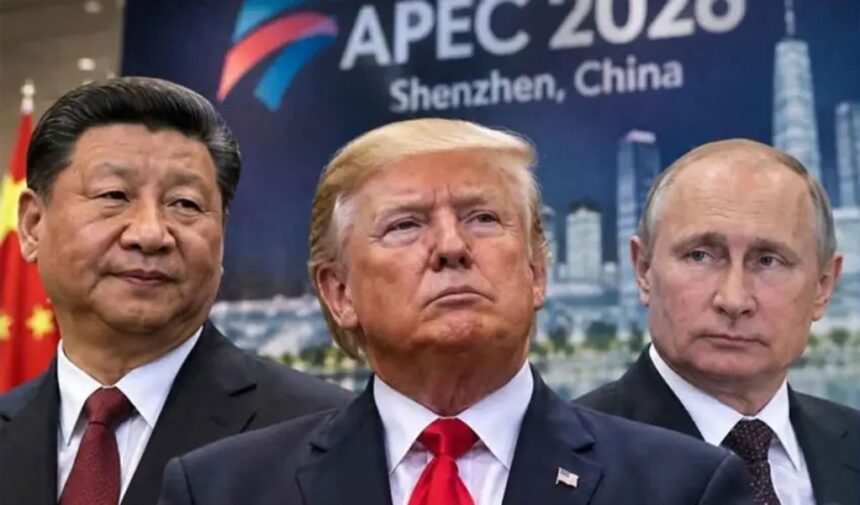
SHENZHEN, China — Chinese President Xi Jinping, U.S. President Donald Trump, and Russian President Vladimir Putin plan to hold a rare three-way meeting Thursday on the sidelines of the Asia-Pacific Economic Cooperation summit in Shenzhen. Both the White House and the Kremlin confirmed the Nov. 19 gathering, which will place the leaders of the world’s three largest nuclear powers in the same room for the first time.
Trump plans to focus the talks on nuclear weapons reduction and the crisis in Iran, according to White House officials. Yet foreign policy analysts quoted by the Associated Press warn that expectations for binding agreements remain low, noting that Beijing has shown little appetite for joining a trilateral arms-control treaty. Because the leaders have not yet met, diplomats say the session’s immediate impact lies in high-stakes optics rather than signed deals.
Key Takeaways
- Three-way talks set for Nov. 19: Donald Trump, Xi Jinping and Vladimir Putin will meet Thursday in Shenzhen during the APEC leaders’ week, marking an unprecedented trilateral summit.
- Nuclear arms and Iran top the agenda: Washington wants to open talks on global atomic stockpiles and Middle East stability, though officials describe the session as a starting conversation.
- Breakthroughs remain unlikely: Foreign policy experts doubt any formal treaty will emerge because China refuses to cap its expanding nuclear arsenal while trailing the U.S. and Russia.
High Optics, Low Expectations in Shenzhen
White House spokeswoman Olivia Wales said Trump wants to curb nuclear proliferation, calling the spread of atomic weapons a severe global threat. Senior U.S. officials cautioned reporters that no formal pact is on the table, describing Thursday’s meeting as an initial step toward broader dialogue. Kremlin spokesman Dmitry Peskov confirmed Putin’s attendance on Saturday, giving Moscow a coveted platform to project superpower parity alongside Washington and Beijing.
Analysts see clear political motives behind the photo opportunity. Nanyang Technological University professor Hoo Tiang Boon told the Associated Press that hosting the summit lets Xi project diplomatic clout, even if power politics overshadow APEC’s free-trade agenda. Meanwhile, Putin and Xi enter the room on familiar ground, having met more than 40 times since 2013 while building a partnership aimed at checking American influence.
Why the Nuclear Vacuum Matters Now
The Shenzhen talks arrive nine months after the final nuclear arms treaty between Washington and Moscow expired. As Al Jazeera reported, the collapse of that bilateral cap left the world’s two largest atomic arsenals unconstrained for the first time in more than half a century. Without inspection rules or warhead limits, military planners across Asia face heightened uncertainty.
China’s refusal to join trilateral limits is rooted in raw math. According to a policy brief from the Brookings Institution, Beijing maintains a much smaller stockpile than either Washington or Moscow and fears that early negotiations would lock China into permanent strategic inferiority. Across Southeast Asia, including northern Thailand, escalating great-power rivalry carries direct operational stakes. Major powers competing over South China Sea shipping lanes and regional supply chains force smaller ASEAN economies to balance trade ties with Beijing against security partnerships with Washington.
Iran Friction and What Comes Next
Conflict in the Middle East adds further urgency to the Shenzhen agenda. U.S. officials insist that preventing Iran from acquiring nuclear weapons remains a core priority, warning that regional instability threatens global energy routes. China relies heavily on Gulf oil shipments passing through the Strait of Malacca and buys discounted Iranian crude, giving Beijing economic leverage that Washington wants Xi to use.
Still, separate diplomatic tracks complicate any sweeping bargain. A senior U.S. official noted that talks over ending the Russia-Ukraine war remain confined to discussions among Washington, Moscow and Kyiv, excluding Beijing. For now, the Shenzhen summit remains a scheduled test of personal diplomacy. Reporters will update this story once Trump, Xi and Putin conclude Thursday’s closed-door session and confirm any joint statements or concrete agreements.