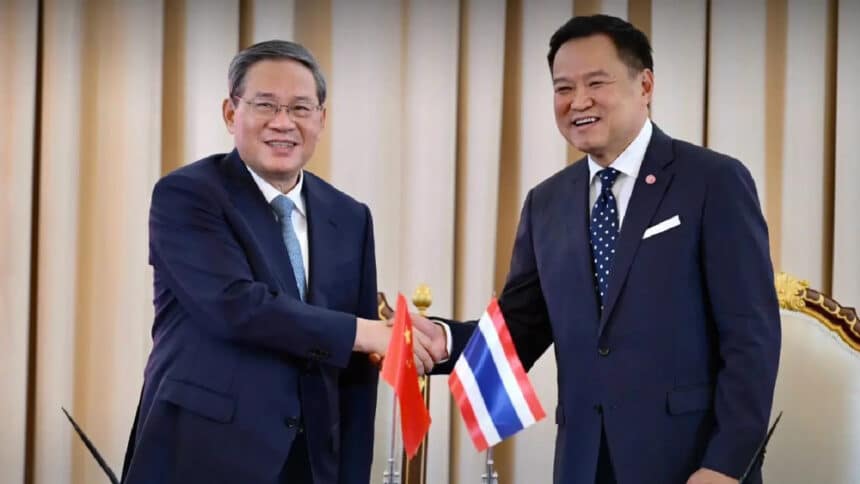
BANGKOK — Thailand and China signed eight cooperation agreements in Bangkok on Friday during Chinese Premier Li Qiang’s official visit, locking in new rules on electric vehicles, agricultural exports, vocational training and cross-border scam crackdowns.
Thai Prime Minister Anutin Charnvirakul and Li witnessed the exchange at Government House, targeting faster customs clearance and deeper industrial supply chains between Southeast Asia’s second-largest economy and its top trading partner.
The pacts arrive as Bangkok seeks to convert heavy Chinese factory investment into local jobs, technology transfer and broader market access for Thai suppliers. The agreements also expand consular staffing and tighten joint policing against cybercrime syndicates that have rattled regional tourism.
Key Takeaways
• Thai exporters gain streamlined quarantine protocols for fresh durian and snake fruit alongside stricter food-safety standards.
• Automotive and vocational education pacts link Chinese EV battery manufacturing with local component sourcing and technical workforce training.
• Security and consular agreements expand joint intelligence sharing to dismantle online scam networks and restore Chinese tourist confidence.
Supply Chains, Skills and Farm Exports
For Thai manufacturers and farmers, the commercial deals promise immediate operational relief. New phytosanitary protocols extend pest-control checks from certified orchards directly to packing houses, cutting the risk of border rejections for fresh durian and salacca. Government officials also pressed Beijing to speed up geographical-indication registrations and open Chinese e-commerce platforms to small Thai enterprises.
On the factory floor, the automotive and vocational education accords aim to move Thailand beyond simple assembly. Anutin urged Chinese executives to use domestic raw materials, share battery technology and upskill local technicians across clean energy and smart-vehicle plants. A companion pact aligns technical college curricula with industry demand, preparing young Thai workers for higher-paying engineering roles while curbing illegal nominee businesses that sideline local firms.
Tourism Slumps and Nominee Risks Force Policy Reset
Friday’s diplomacy reflects urgent economic pressures building across Thailand over the past year. While bilateral trade reached $153.26 billion in 2025, Anews reported that Chinese tourist arrivals dropped 13.57% in October following viral reports of job-scam abductions near Thailand’s borders. That downturn hit hotels, airlines and retail operators ahead of the peak holiday season.
At the same time, rapid Chinese industrial inflows into Thailand’s Eastern Economic Corridor sparked friction among domestic parts makers, who warned that foreign factories were importing entire supply chains without hiring local subcontractors. Earlier bilateral frameworks outlined by Thailand’s Ministry of Foreign Affairs laid the diplomatic groundwork, but Thai trade groups demanded enforceable rules on local content and technology transfer before backing deeper market integration.
Joint Policing and Consular Expansion
To reverse the travel slump, the security and consular documents remove staffing ceilings at diplomatic missions and formalize real-time intelligence exchanges against telecom fraud. Authorities in both countries will track illicit financial flows, rescue trafficking victims and issue coordinated public advisories to counter online misinformation.
If enforced rigorously, the twin track of tighter border policing and higher domestic manufacturing standards could give Thai businesses a fairer playing field. For workers and growers alike, success now depends on how quickly ministries turn Friday’s signatures into customs approvals, factory apprenticeships and safer travel corridors.
Trending News:
Thailand and China Plan Water Toxicity Lab in Chiang Rai
Thailand and China Unite to Dismantle Border Scams