
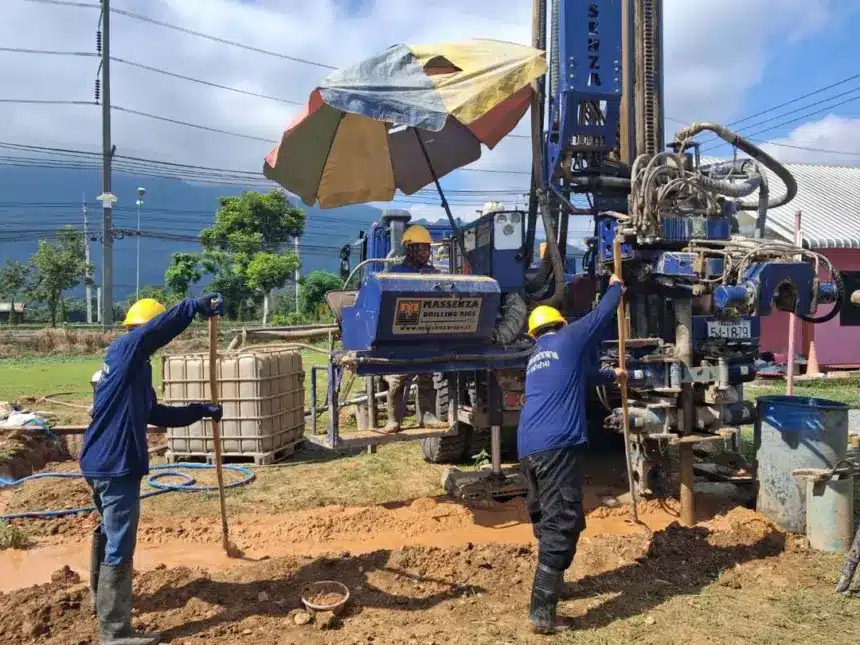
MAE SAI — The Department of Groundwater Resources has drilled a 70-meter deep well at Ban Nam Cham in northern Chiang Rai province, with preliminary field tests showing zero traces of arsenic. Natural Resources and Environment Minister Suchart Chomklin confirmed the borehole yields more than 10 cubic meters of water per hour, offering a vital lifeline to residents cut off from polluted surface waterways.
Two rapid test kits detected no toxic contamination during initial checks at the Mae Sai site. Still, authorities warned that villagers cannot tap the supply until comprehensive laboratory screenings verify the water meets national safety standards.
Key Takeaways
- Clean Initial Screening: A new 70-meter well at Ban Nam Cham in Mae Sai tested negative for arsenic using two preliminary field kits.
- Strong Output Capacity: The borehole produces over 10 cubic meters of groundwater per hour, providing substantial volume for local households.
- Pending Lab Verification: Villagers must wait for secondary laboratory testing before officials clear the well for daily consumption.
Upstream Mining Drives Emergency Drilling
The emergency borehole project responds directly to severe transboundary contamination in the Sai River, which forms the border between Thailand and Myanmar. Runoff from unregulated gold and rare-earth mining operations upstream in Myanmar’s Shan State has repeatedly pushed river arsenic concentrations well past Thailand’s 0.01 milligrams-per-liter safety threshold.
Extreme sediment loads have overwhelmed municipal water treatment plants, forcing periodic production shutdowns across Mae Sai district. Thai researchers estimate that roughly 143 kilograms of arsenic cross the border daily via the river, leaving downstream communities dependent on trucked water deliveries and emergency filtration units.
To break this reliance on compromised surface water, the Department of Groundwater Resources launched an urgent campaign to drill deep wells across 14 affected border villages. Tapping confined aquifers 70 meters underground isolates drinking water from heavy-metal runoff polluting shallow streams and agricultural canals.
Strict Testing Before Community Access
While preliminary field kits offer quick reassurance, groundwater officials refuse to rush public access. Specialists are collecting water samples for certified laboratory analysis to rule out trace heavy metals, high mineral hardness, or bacterial contamination common in deep bedrock formations.
The well testing coincides with broader diplomatic and technical efforts in northern Thailand. Bangkok has pressed neighboring authorities for a six-month halt at Myanmar mines while piloting sediment-trapping weirs along border waterways.
Once laboratory clearance arrives, local administrators will connect the Ban Nam Cham borehole to community storage tanks. At a flow rate exceeding 10 cubic meters per hour, the single well can supply tens of thousands of liters daily—giving Mae Sai families a reliable tap that stays clean regardless of upstream river conditions.
Trending News:
Thailand’s Health Minister Visits Arsenic-Hit Mae Sai
Deep Water Wells Replace Toxic River Water in Northern Thailand