
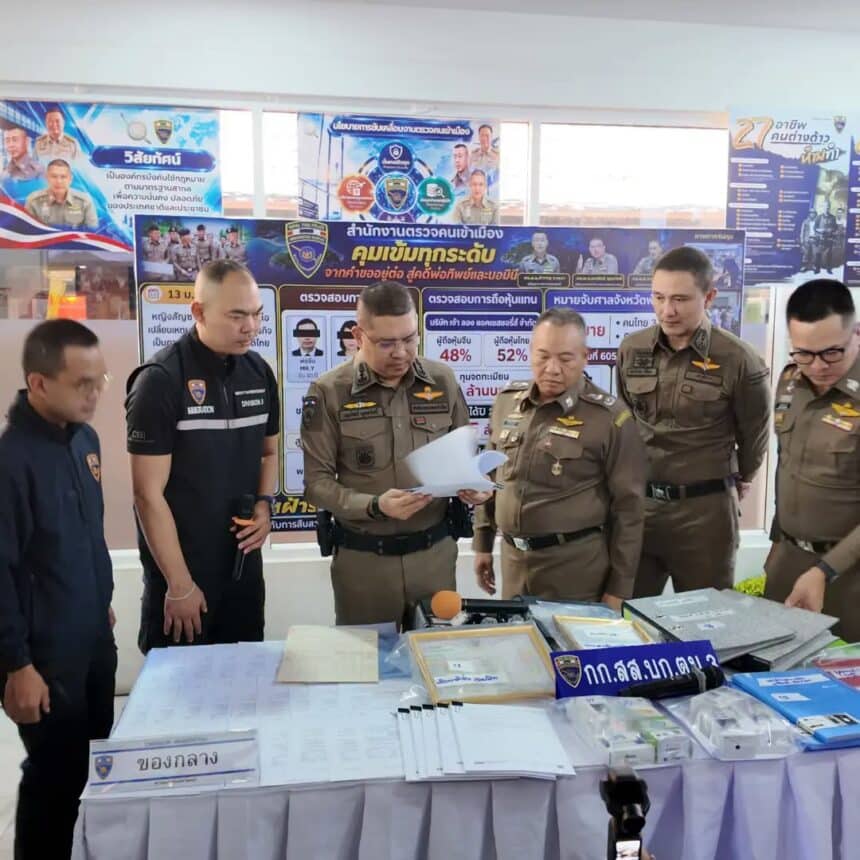
PATTAYA— Thai immigration police arrested a Chinese businessman in Sriracha and three Thai women accused of acting as illegal proxy shareholders across three provinces, following a months-long probe sparked by a forged child-registration filing. Officers from Immigration Bureau 3 took the man, identified by authorities only as Mr. Li, into custody alongside the three local women under arrest warrants issued Oct. 27 by the Pattaya Provincial Court.
The arrests stem from a fake paternity and child-registration scheme uncovered in August, which investigators traced to a broader network of shell companies and real estate holdings. Authorities said the operation serves as a direct warning to foreign residents who rely on Thai stand-ins to bypass ownership bans under the Foreign Business Act and land laws.
Key Takeaways• Immigration Bureau 3 arrested a Chinese suspect, Mr. Li, in Sriracha and three Thai women accused of acting as nominee shareholders across three provinces. • Pattaya Provincial Court issued the arrest warrants on Oct. 27 after an August probe into a fraudulent child-registration filing exposed a wider corporate network. • Both foreign owners and Thai proxies face up to three years in prison, fines up to 1 million baht, and forced asset liquidation under Thai business statutes. |
Forged Records Unraveled a Corporate Shell
The case began quietly at a district office in August. Investigators reviewing a child-registration application flagged discrepancies in paternity records submitted to support a long-stay visa application. That single paper trail led detectives straight to Sriracha, an industrial and residential hub along Chon Buri’s coast.
Rather than stopping at immigration fraud, police audited the financial records tied to Mr. Li. Bank transfers, corporate registries and land deeds revealed that three Thai women held majority shares on paper in businesses spanning three provinces.
According to police briefings in Chon Buri, the women lacked the personal income or capital required to fund the enterprises they supposedly owned. Investigators concluded that Mr. Li supplied the money, directed daily operations and collected the profits while using Thai citizens to satisfy the 51 percent local ownership threshold.
Nominee Enforcement Tightening
For decades, foreign entrepreneurs along Thailand’s Eastern Seaboard—stretching from industrial estates in Sriracha to resort developments in Pattaya—treated nominee setups as an open secret. Under Thailand’s 1999 Foreign Business Act and the Land Code, non-Thai nationals cannot hold majority stakes in restricted service sectors or own freehold land. To get around the rules, many expats paid local acquaintances, accountants or legal fixers small fees to sign share certificates while retaining total control through preference shares or undated transfer forms.
That gray-market workaround is collapsing under coordinated state pressure. Following high-profile corporate scandals—including the November 2026 criminal sentencing of executives at China Railway No. 10 (Thailand) over illegal proxy structures—the Department of Business Development overhauled how it screens new and existing firms. Registrars now cross-check shareholder tax filings, personal bank balances and source-of-funds statements before approving corporate changes or land transfers. Between August and October 2026 alone, tighter vetting cut suspicious new company registrations by 77 percent compared with the prior year, according to commerce ministry data.
Heavy Penalties Ahead
Legal exposure in nominee prosecutions cuts both ways. Under Sections 36 and 37 of the Foreign Business Act, both the foreign investor who directs the scheme and the Thai citizen who lends their name face up to three years in prison, a fine between 100,000 and 1 million baht, or both. Courts also hold the authority to order the immediate dissolution of the company and the forced sale of any land held under the illegal structure.
For expatriates running small restaurants, consultancies or property holding companies in Chon Buri and neighboring provinces, the Sriracha arrests underscore a shift in how cases surface. Police no longer wait for disgruntled business partners to file complaints. Routine visa extensions, civil registry checks and tax audits now trigger cross-agency financial probes—leaving informal nominee arrangements exposed to sudden criminal prosecution and deportation.
Trending News:
Pattaya Cracks Down on Shop Chairs Blocking Sidewalks
Pattaya Police Arrest Chinese Fraud Suspect Over Visa Stay