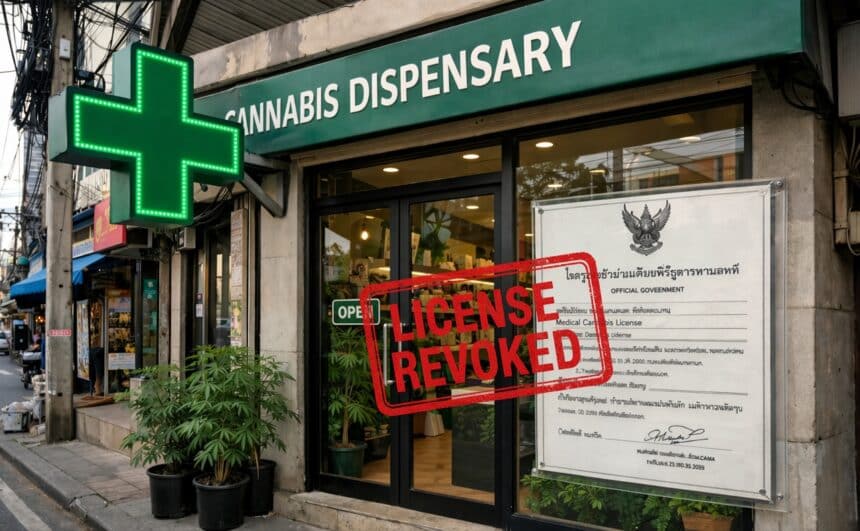
BANGKOK — Thai health authorities revoked 24 cannabis business licenses and suspended 105 others during fiscal 2026, signaling an aggressive enforcement push against shops violating strict medical-only rules.
The Department of Thai Traditional and Alternative Medicine announced the penalties over the weekend after inspectors examined 84% of Bangkok’s 1,710 licensed dispensaries, resulting in legal action against 70 people and the seizure of more than 10.5 metric tons of illicit cannabis products.
Officials will expand those sweeps nationwide in fiscal 2027, placing dispensaries near schools and universities at the top of their inspection list. The crackdown marks a turning point for retailers from Bangkok’s tourist strips to northern hubs like Chiang Rai, where storefronts must now prove they operate as legitimate medical outlets rather than recreational lounges.
Key Takeaways• Licenses pulled: Regulators permanently revoked 24 cannabis shop permits and suspended 105 more after inspecting 84% of Bangkok’s 1,710 registered outlets. • Criminal penalties: Authorities launched legal proceedings against 70 individuals and confiscated 10,584.9 kilograms of cannabis valued at 223.5 million baht across 95 operations. • Nationwide expansion: Fiscal 2027 inspections will extend across all provinces, including Chiang Rai, prioritizing shops located near schools and acting on resident complaints. |
Bangkok Sweeps Yield Heavy Seizures
Inspectors concentrated their initial wave of audits in the capital, which holds the highest density of cannabis retailers in the country. Across 95 joint enforcement operations, officers impounded 10,584.9 kilograms of cannabis flower and extracts worth an estimated 223.5 million baht ($6.9 million).
Public tip-offs drove several high-profile raids. In September, medical cannabis division officers inspected six storefronts in Bangkok’s Watthana district after residents filed complaints over public smoke and unauthorized sales through the city’s digital reporting platform. Dr. Thewan Thaneerat, deputy director-general of the department, said partner agencies are enforcing strict rules to keep cannabis within medical boundaries and prevent broader social harm.
Regulatory Shift Reshapes Provincial Markets
The enforcement blitz stems from Thailand’s sharp policy reversal following the chaotic 2022 decriminalization that saw more than 18,000 dispensaries open nationwide without a comprehensive statutory framework. In June 2025, the Ministry of Public Health reclassified cannabis flower as a controlled herb, banning recreational sales, online orders, and advertising while requiring customers to present a medical prescription form known as Por. Tor. 33.
Compliance rules tightened again in January 2026, when dispensaries were ordered to keep a certified medical practitioner on-site during all operating hours and install odor-control systems. Those mandates have already forced thousands of undercapitalized shops to shutter. Thousands more three-year retail licenses are scheduled to expire between late 2026 and 2027, giving regulators direct leverage to weed out noncompliant operators during renewal reviews.
Northern Retailers and School Zones Face Scrutiny
Outside the capital, provincial markets are bracing for the fiscal 2027 inspection rollout. In northern Thailand, cannabis shops in Chiang Rai and neighboring Chiang Mai cater heavily to seasonal tourists alongside local agricultural growers. Until now, provincial enforcement has lagged behind Bangkok’s daily street-level sweeps, leaving many northern storefronts operating in a legal gray zone.
That breathing room is closing fast. Under the fiscal 2027 mandate, provincial public health offices will audit storefronts across Chiang Rai’s urban core and border districts, verifying practitioner staffing, prescription logs, and certified crop sourcing.
Shops operating near schools, dormitories, and temples face immediate closure if caught selling without prescriptions or allowing on-site smoking, offenses that carry up to one year in prison and a 20,000-baht fine. Regulators also plan to fast-track responses to neighborhood complaints nationwide.