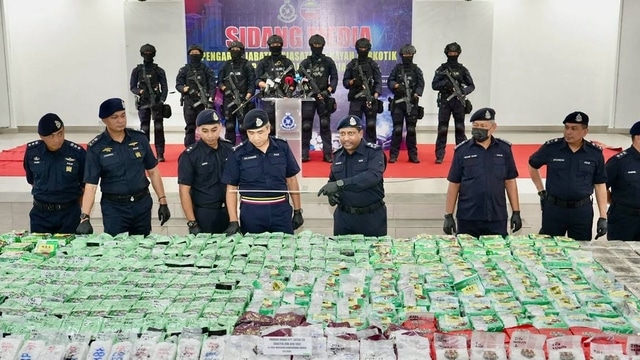
KUALA LUMPUR — Malaysian authorities have dismantled a cross-border drug trafficking ring that allegedly exploited Royal Malaysian Air Force (RMAF) bases and military aircraft to smuggle more than three metric tons of crystal methamphetamine worth 156 million ringgit ($38 million), arresting 13 suspects including seven active-duty air force personnel.
Home Affairs Minister Datuk Seri Saifuddin Nasution Ismail revealed the scale of the breach this week, confirming that investigators uncovered 21 illicit shipments dating back to August 2024 and prompting the federal Cabinet to order immediate, sweeping security controls across military airfields that previously operated outside standard civilian customs checks.
Key Takeaways
- A criminal network allegedly moved more than 3,000 kilograms of methamphetamine valued at $38 million across 21 separate transactions using military air force infrastructure since August 2024.
- Police arrested 13 people in coordinated raids—including seven RMAF members and an air force pilot accused of acting as a transport coordinator—following a Nov. 17 seizure of 96.6 kilograms of methamphetamine at the Subang air base.
- The Malaysian Cabinet has approved immediate security overhauls to bring military air bases under formal border screening protocols as officials hunt for the syndicate’s identified ringleader.
Anatomy of a Breach Inside Subang Air Base
The investigation began not on a military tarmac, but along Malaysia’s busy maritime coast. According to police intelligence briefings cited by Saifuddin, narcotics investigators received a tip in January regarding six suspicious shipping containers at Port Klang, Malaysia’s primary commercial maritime gateway, destined for the eastern state of Sabah on Borneo.
Police opened a formal probe in July, tracking financial and logistical links between two Sabah-based criminal cells and military transport corridors. That surveillance culminated on Nov. 17 during a targeted inspection at the arrival foyer of the RMAF air base in Subang, just outside Kuala Lumpur.
Officers intercepted five suitcases and a cardboard box being prepared for loading onto a military transport plane. Inside, investigators discovered 96.64 kilograms of suspected methamphetamine valued at roughly 4.83 million ringgit, alongside nearly 7 kilograms of precursor chemicals.
Follow-up raids across the Klang Valley, the federal territory of Labuan and the coastal town of Tawau in Sabah netted 13 suspects. Seven belong to the air force, including a military pilot who prosecutors allege coordinated flight logistics and moved narcotics through restricted zones.
Three air force officers and three civilians appeared Friday in the Shah Alam Magistrate’s Court on charges of drug trafficking, an offense that carries the mandatory death penalty or life imprisonment plus mandatory caning under Malaysian law. Because capital drug cases fall under High Court jurisdiction, no pleas were recorded.
Two Years of Unchecked Military Transit
Tracing phone records, cargo manifests and movement logs exposed a far deeper vulnerability than a single rogue shipment. Investigators pieced together 21 separate smuggling runs executed over a 27-month period starting in August 2024, moving enough synthetic narcotics to supply an estimated 15 million individual doses.
According to parliamentary disclosures by the Home Ministry, 14 of those illicit consignments passed through the Labuan RMAF base, accounting for 1.2 metric tons of methamphetamine worth 63 million ringgit. Seven additional shipments moved through the Tawau RMAF base in eastern Sabah, totaling 1.8 metric tons valued at 93 million ringgit.
Both bases sit along strategic maritime corridors bordering the Sulu and Sulawesi seas, placing military runways within short flying or boating distance of lucrative black markets in Indonesia and the southern Philippines.
Saifuddin warned lawmakers that the syndicate’s ability to weaponize national defense assets threatens the core credibility of Malaysia’s security institutions. Military personnel hold clearance to bypass routine civilian baggage and cargo screening, a privilege designed for operational speed that traffickers allegedly turned into a high-volume smuggling pipeline.
Golden Triangle Supply Lines and Regional Pressures
To understand how three tons of synthetic drugs entered Malaysia’s military logistics chain, security analysts look north toward the Golden Triangle, the rugged borderlands where Myanmar, Laos and Thailand converge. Long notorious for opium cultivation, the region has transformed into the world’s largest industrial producer of methamphetamine and ketamine.
Armed conflict and fractured governance in Myanmar’s Shan State have enabled transnational crime syndicates to operate super-labs at unprecedented scale, pushing record volumes of crystal meth—known locally as syabu—southward through Thailand and Peninsular Malaysia.
Once narcotics reach Malaysia, smugglers rely on Borneo’s porous coastlines to reach higher-margin buyers across archipelagic Southeast Asia. In a regional assessment of synthetic drug flows, the United Nations Office on Drugs and Crime specifically identified Sabah as a rapidly expanding maritime transit hub connecting traffickers to Indonesia and the Philippines.
Commercial aviation has faced parallel infiltration in recent months, underscoring how aggressively cartels recruit licensed flight personnel. In July, Indonesian customs authorities arrested a 39-year-old Malaysia Airlines pilot at Jakarta’s Soekarno-Hatta International Airport after finding 26 kilograms of MDMA tablets hidden in his luggage immediately after he piloted a flight from Kuala Lumpur.
Two months later, Malaysian police detained another commercial pilot suspected of laundering proceeds from narcotics sales. While investigators have not tied those commercial airline cases to the air force syndicate, aviation security experts note that uniform privileges and predictable flight schedules make pilots prime targets for cartel bribery.
Cabinet Crackdown and Defense Integrity Crisis
The air force scandal strikes Malaysia’s defense establishment at a politically sensitive moment. Earlier this year, separate investigations into military procurement cartels triggered public anger over alleged bid-rigging and kickbacks inside defense contracts, forcing senior officials to pledge tighter internal oversight.
Prime Minister Datuk Seri Anwar Ibrahim declared Friday that no official, regardless of rank, will be shielded from prosecution as police and military intelligence conduct a joint housecleaning.
Addressing reporters in Kedah on Saturday, Saifuddin confirmed that the Cabinet had approved an immediate policy reversal closing a longstanding jurisdictional loophole. While immigration, customs and police screeners monitor civilian airports, seaports and land crossings, RMAF installations had historically policed their own internal cargo manifests.
Law enforcement officials say they have identified the syndicate’s top ringleader and expect an arrest soon. Yet for defense planners in Kuala Lumpur, capturing the financier will only begin the harder task of auditing every gatekeeper who allowed three tons of contraband onto military runways.