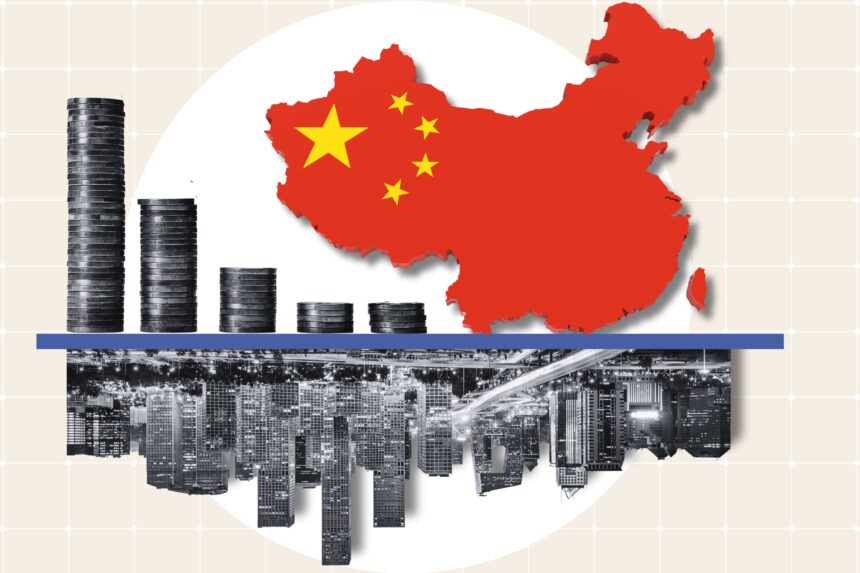
BEIJING — China’s government reported 5% annual economic growth for 2025, claiming its $19.6 trillion economy remains on target even as independent analysts, multilateral lenders and Beijing’s own provinces expose wide gaps in the official ledger.
A November 2026 video report by The Money Timeline synthesizes private macroeconomic audits, provincial restatements and demographic records showing that China has quietly halted hundreds of public statistical series while actual growth runs near half the stated pace.
Those discrepancies carry immediate consequences for global markets and household stability. Between 2021 and 2025, the output gap between the United States and China doubled from $5.5 trillion to more than $11 trillion, according to International Monetary Fund comparisons cited in the report, while domestic deflation, an unresolved property slump and a shrinking workforce push Beijing to dump excess factory goods onto overseas buyers.
Key Takeaways• Growth estimates diverge sharply: While Beijing posted 5% real GDP growth for 2025, New York-based Rhodium Group calculated actual expansion between 2% and 3%, pointing to three consecutive years of domestic deflation and weak bank lending. • Housing and hidden debt strain households: Roughly 48 million prepaid apartments remain unfinished alongside 766 million square meters of unsold floor space, while off-budget local government borrowing lifts China’s true debt ratio to about 127% of GDP. • Demographic decline cannot be revised away: New births fell 17% in 2025 to 7.92 million—the lowest tally since 1949—shrinking China’s population by 3.39 million to 1.405 billion as 23% of citizens pass age 60. |
Testing Beijing’s Numbers Against Physical Activity
Skepticism toward China’s national accounting reaches inside the Communist Party’s upper ranks. In a 2007 diplomatic cable later published by WikiLeaks, then-Liaoning Party Secretary Li Keqiang told U.S. Ambassador Clark Randt that provincial GDP figures were “man-made” and reliable “for reference only.” Li, who later served a decade as China’s premier, tracked three physical proxies instead: electricity consumption, rail freight volume and bank loan disbursements.
Applying Li’s three-part benchmark to 2025 exposes an uneven economy. Total electricity consumption rose 5% to a record 10.4 trillion kilowatt-hours, yet surge demand stemmed largely from electric vehicle charging stations—up 48.8%—and artificial intelligence data centers rather than broad consumer recovery. Meanwhile, rail freight grew just 1.4% in the fourth quarter and 0.4% in December, while new bank loans dropped to 16.27 trillion yuan, a seven-year low.
Provincial restatements deepen the credibility gap. Liaoning officials acknowledged inflating fiscal revenue by roughly 20% annually over four years after Li departed, though the National Bureau of Statistics insisted national totals required no adjustment. Logan Wright, a partner at Rhodium Group, questioned how an economy could log 5% real annual expansion across three straight years of falling prices. According to Rhodium Group’s year-end economic assessment, genuine 2025 growth fell below 3% after momentum stalled sharply in the second half of the year.
A Five-Year Property Slump and Hidden Municipal Debt
Nowhere is statistical opacity sharper than in real estate, which holds roughly 70% of Chinese household wealth—nearly double the U.S. share, according to Reuters data cited in the report. Entering the fifth year of a severe housing downturn, China’s housing ministry instructed private research firms CRIC and China Index Academy to halt public releases of developer sales figures, leaving prospective homebuyers without reliable market pricing.
Physical inventory tells the story that suspended trackers omit. Developers hold 766 million square meters of unsold new property, an area exceeding Singapore’s total land footprint, alongside at least 48 million prepaid apartments that remain unfinished. He Keng, a former deputy head of the National Bureau of Statistics, publicly remarked that China’s vacant housing stock could shelter far more than its current population. Housing investment has fallen from 12.3% of GDP to 6.1%, and Fitch Ratings projects home prices to decline another 4% to 6%.
Falling land sales have starved local governments of revenue, exposing trillions in off-balance-sheet liabilities. While China’s Finance Ministry lists official government debt at 68.5% of GDP, the International Monetary Fund’s augmented debt analysis adds borrowing by local government financing vehicles—municipal shell companies created to fund infrastructure—bringing total public obligations to roughly 127% of GDP. Beijing’s 10 trillion yuan debt swap covered only about a quarter of that hidden pile, Fitch estimated, while 71% of financing vehicles were simply reclassified as ordinary corporations without retiring their loans. Unpaid wages tied to cash-strapped local projects sparked at least 4,861 protests across China during the first 11 months of the year.
Youth Joblessness and Factory Price Wars Spill Overseas
Financial stress radiates directly into China’s labor market. After urban unemployment for workers ages 16 to 24 hit a record 21.3% in June 2023, the National Bureau of Statistics suspended the series in August 2023 before reintroducing a revised formula that excluded enrolled students. Even under the narrower methodology, youth joblessness hovered between 18% and 18.9%. Peking University economist Zhang Dandan estimated that roughly 16 million young people are neither employed nor in school—a cohort larger than Belgium’s population.
With cautious families hoarding cash, household consumption sits at 39.9% of GDP, virtually unchanged from the 39.8% figure that former Premier Wen Jiabao warned in 2007 made China’s growth model “unstable, unbalanced, uncoordinated and unsustainable.” Compare that with 68% in the United States and 52% in the European Union. Instead of subsidizing households, banks channeled credit into factories: manufacturing’s share of medium- and long-term loans climbed from 5.1% to 9.3%, while real estate’s share dropped from 15.9% to 13%, according to People’s Bank of China records.
That industrial surge triggered brutal domestic price wars that Chinese officials call “involution.” Automaker BYD saw domestic sales drop 65% in February from a year earlier and full-year profit fall 19% to 32.6 billion yuan as operating margins narrowed from 4.1% to 2.9%—under $600 per $20,000 vehicle. Unable to clear inventory at home, exporters pushed goods abroad, driving China’s trade surplus to a record $1.19 trillion despite a 20% drop in U.S.-bound shipments, offset by a 26% jump to Africa and a 13% rise to Southeast Asia. IMF Managing Director Kristalina Georgieva warned that China is “simply too big to generate much growth from exports.”
Why Beijing Suppresses Data as Demographics Turn
Beijing’s retreat from statistical transparency follows a deliberate political calculus rooted in China’s post-2008 growth model. After the global financial crisis, central planners leaned on state-bank credit and municipal land auctions to hit annual GDP targets, turning local officials into real estate developers. When regulators cracked down on developer leverage in 2020 to deflate a dangerous credit bubble, they severed the primary funding engine for city budgets and household wealth without building a replacement social safety net.
Suppressing inconvenient indicators—from consumer confidence and land auctions to soy sauce output and developer sales—shields policymakers from market panics and domestic accountability when targets slip. Yet capital markets respond to behavior rather than press releases: a record $426 billion in portfolio capital exited China in a single year, followed by another $146 billion the next quarter.
One dataset remains untouched and poses the sharpest long-term constraint on Beijing’s ambitions. Official civil registries reported just 7.92 million births in 2025, a 17% single-year drop and the lowest tally since the People’s Republic was founded in 1949. With 11.31 million deaths recorded, China’s population shrank by 3.39 million to 1.405 billion—its fourth consecutive annual contraction—while 323 million residents, or 23% of the nation, are now over 60.
The state-backed Chinese Academy of Social Sciences projects China’s main pension fund could run dry by 2035, prompting authorities to raise men’s retirement age from 60 to 63. As demographic researchers at Rhodium Group noted in April 2026, fiscal subsidies to shore up social security already absorb more than 10% of general budget spending, leaving Beijing less room to rescue indebted cities or overtake a U.S. economy the IMF projects will remain more than $11 trillion larger through 2030.