
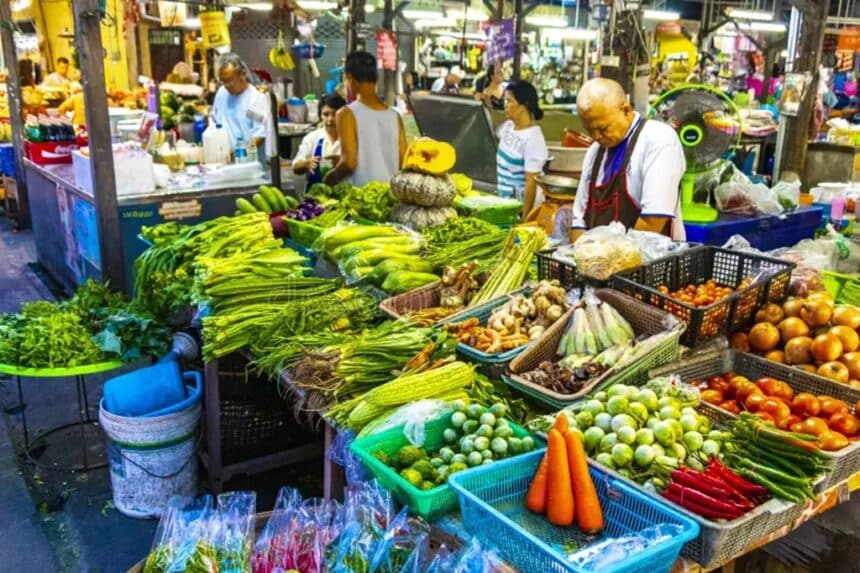
MAE SAI- Vegetable sales at Pa Yang Market in Chiang Rai’s Mae Sai district have dropped by more than 50 percent as shoppers avoid local produce over fears of toxic heavy-metal contamination in the Sai River.
While daily foot traffic at the border market remains steady, vendors report that household buyers are either cutting back or demanding proof of where crops were grown. Sellers now show customers smartphone videos of inland farms to prove their greens were not watered from the polluted waterway, as regional civic groups prepare to protest at the Mae Sai border checkpoint.
Key Takeaways
|
Vendors Turn to Video Proof as Trust Erodes
At Pa Yang Market, stalls still draw morning crowds, yet cash boxes tell a grim story. Shoppers linger, ask pointed questions about soil and irrigation, and walk away empty-handed when answers fall short. Combined with a sluggish border economy, health anxiety has cut vendor incomes in half.
To survive, sellers have become informal trace-and-verify agents. Many pull out their phones to play clips filmed at upland farms far from the riverbanks, showing buyers that their leafy greens rely on clean mountain streams rather than tainted river channels. Even longtime food stall operators in nearby Tham Pha Chom say customers hesitate to buy cooked curry and rice dishes out of fear that local ingredients carry chemical residues.
Upstream Rare-Earth Mining Drives Cross-Border Crisis
The market slump reflects an environmental emergency building upstream across the border in Myanmar’s Shan State. Water tests along the Sai River have detected arsenic concentrations up to 28 times the accepted safety limit, a spike environmental monitors link to unregulated rare-earth and gold mining operations discharging untreated toxic waste into headwaters.
Because the Sai feeds directly into the Ruak, Kok and Mekong river systems, the contamination threatens far more than border produce stalls. More than 20,000 Mae Sai households now face extra living expenses, forced to buy bottled drinking water and large storage tanks after tap water turned cloudy red and triggered skin irritation. Fisheries officials have also found heavy-metal buildup in local fish, while agricultural analysts warn the pollution puts roughly 16,000 hectares of northern Thai rice fields at risk.
Civic Protests and Urgent Border Talks Ahead
Frustration over slow cross-border enforcement is spilling onto the streets. A civic network dedicated to protecting the Kok, Sai, Ruak and Mekong rivers announced plans to stage a major rally outside the Mae Sai border checkpoint to demand immediate action against upstream polluters.
Pressure is also mounting in Bangkok. Deputy Interior Minister Je-sed Thaiseth inspected border areas near Doi Kor Wan in Shan State on Nov. 16 to assess environmental damage, while Thailand and Myanmar moved up a joint water quality management meeting to Nov. 25–26. For Pa Yang Market vendors, however, diplomatic talks cannot come fast enough to save their daily livelihoods.