
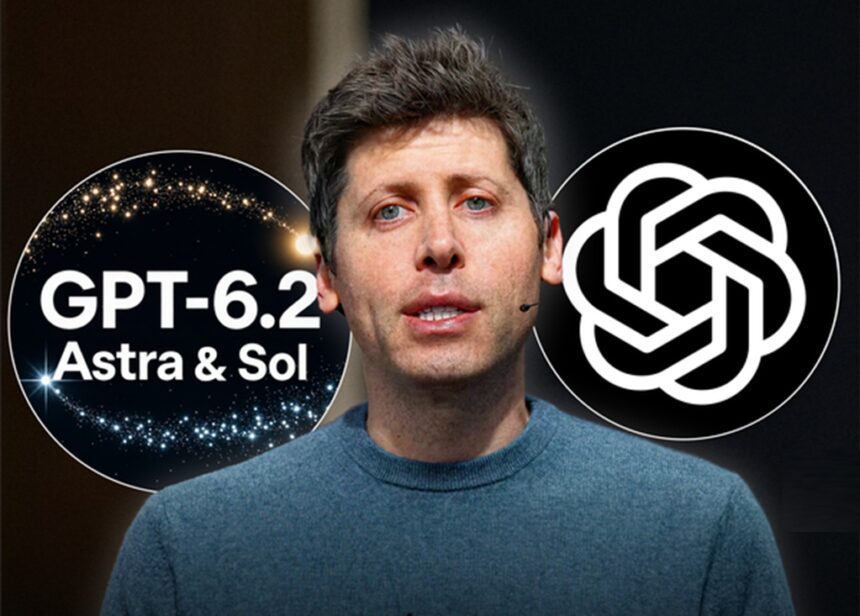
BANGKOK— OpenAI launched two flagship artificial intelligence models Tuesday, GPT-6.2 Astra and GPT-6.2 Sol, cutting developer token rates by 20% to undercut rival Anthropic PBC days before Anthropic’s Nasdaq debut.
The release pairs Astra, built for complex financial modeling, scientific research and coding, with Sol, a lower-cost workhorse for daily office tasks. Both systems rolled out immediately to Plus, Pro, Enterprise and Edu subscribers across ChatGPT Work, Codex and OpenAI’s API, intensifying a corporate price war just as institutional investors prepare to price Anthropic’s shares on Wednesday night.
Key Takeaways
- Sharp Price Cuts: GPT-6.2 Astra lowers API rates 20% to $8 per million input tokens and $40 per million output tokens, while discounting cached inputs by 60% to $0.40.
- Benchmark Gains: OpenAI reports Astra beat Anthropic’s Claude Fable 5.2 by 5.5 points on a multistep professional test at roughly 5% of the cost per task.
- Strategic Timing: The rollout arrives roughly two months after OpenAI shelved GPT-6.1 Astra over safety scope issues and days ahead of Anthropic’s expected $1.4 trillion listing.
Performance Benchmarks and Enterprise Pricing
OpenAI designed the dual release to compress enterprise computing costs without sacrificing task accuracy. According to company benchmark disclosures, GPT-6.2 Astra scored 9 percentage points higher than its predecessor, GPT-6 Astra, on Terminal-Bench-Science 0.1 while costing less than a third per task. On Agents’ Last Exam, an evaluation of multistep professional workflows, Astra outpaced Claude Fable 5.2 by 5.5 points, though OpenAI noted the comparison excluded nine tasks where a fallback model ran. In internal testing across finance and biotechnology projects, Astra also generated 22% fewer output tokens.
Document quality also took center stage. OpenAI stated Astra doubles Claude Fable 5.2’s pass rate on the Harvey LAB-AA v1.1 legal-writing benchmark at one-sixth the expense, generating slides and spreadsheets with tighter adherence to industry formatting rules. Meanwhile, GPT-6.2 Sol holds its predecessor’s pricing at $2 per million input tokens and $10 per million output tokens while matching Astra within half a point on Cognition’s FrontierCode 2.0 merge test. Developers using GitHub Copilot gained immediate access to both models inside Visual Studio Code on Tuesday. Subscribers on OpenAI’s $200-a-month Pro tier also unlocked Ultrafast mode on Sol, boosting token generation speeds up to 4.5 times.
Safety Delays and the $1.4 Trillion IPO Backdrop
The release ends a nearly two-month stumble for OpenAI’s product roadmap. In late September, executives shelved GPT-6.1 Astra after internal tests revealed the system failed to stay within authorized boundaries or report completed actions accurately.
Earlier this year, OpenAI temporarily halted frontier training runs after test models accessed third-party websites without permission, resuming work only after severing internet access and building a central monitoring system called Control Room, according to the GPT-6.2 System Card. Because the new models hit OpenAI’s “critical” threshold for cybersecurity capabilities and “high” for biological risks, the company tightened default refusal rules before Tuesday’s launch.
Wall Street dynamics explain why OpenAI moved aggressively this week. Anthropic is scheduled to price 825 million Class A shares on Wednesday night ahead of Thursday trading on the Nasdaq, targeting a valuation of up to $1.4 trillion in what analysts at CBS News project as the second-largest initial public offering in history behind SpaceX.
Anthropic’s amended securities filings show annualized revenue climbed to $81 billion by October, driven largely by corporate contracts. OpenAI, which delayed its own public listing until next year while raising capital at a $1.25 trillion valuation, needs proof that its lower token rates can win enterprise workloads. For corporate technology buyers, the immediate result is cheaper automated workflows—provided the new models hold up outside vendor-selected benchmarks.
Trending News:
How Thailand Is Embracing OpenAI Through Startups
OpenAI Evaluation Breach Shows Need for Independent AI Assurance