
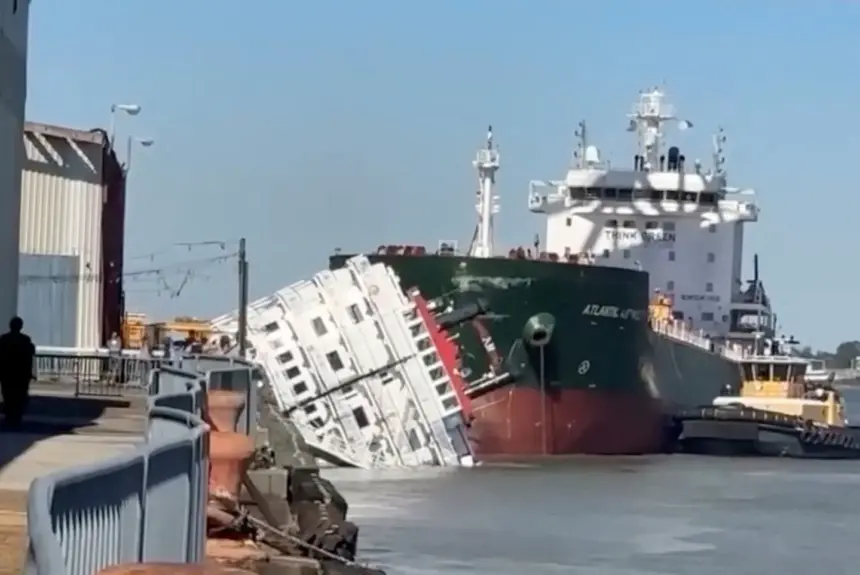
NEW ORLEANS – A steering failure jammed the rudder of a 520-foot asphalt tanker hard to starboard on Friday, sending the vessel veering across the Mississippi River into a docked cruise ship in New Orleans and throwing dozens of people into the water, federal safety officials confirmed Sunday.
Preliminary findings from the National Transportation Safety Board offer the first official explanation for the Nov. 13 crash between the Atlantic Asphalt and the American Heritage riverboat. All 190 passengers and crew aboard the cruise ship survived after the boat rolled onto its side, though 32 people—including two police officers—required hospital treatment and the Port of New Orleans filed a $1 million federal lawsuit.
Key Takeaways• A steering failure locked the Atlantic Asphalt tanker’s rudder to the right, causing it to strike the docked American Heritage within two minutes. • The 300-foot paddlewheel cruise ship capsized in 22 minutes, sending 32 people to hospitals with non-life-threatening injuries while everyone onboard survived. • A federal judge seized the Liberian-registered tanker after the Port of New Orleans sued for at least $1 million in terminal damages. |
Two Minutes From Steering Loss to Impact
The collision unfolded just after 1 p.m. local time near Mile 96 of the Lower Mississippi River, north of the Crescent City Connection bridge. Heading upriver with a crew of 19, the Atlantic Asphalt suffered an abrupt steering malfunction that locked its rudder hard to starboard. Barely two minutes elapsed before the heavy tanker veered toward the east bank and slammed into the stationary American Heritage, which carried 140 passengers and 50 crew members.
Investigators have not yet determined what triggered the rudder lockup. “It could be many different things,” senior NTSB marine accident investigator Bart Barnum told reporters during a Sunday briefing in New Orleans. “That is something that we’re investigating very closely.”
NTSB board member John DeLeeuw said the struck riverboat rolled onto its side and capsized within 22 minutes of impact. Harbor workers, firefighters and bystanders pulled survivors from the 66-degree river water as passengers donned life jackets and climbed onto balcony railings. Two New Orleans police officers who boarded to help were thrown overboard as the vessel rolled. Six patients remained hospitalized Sunday, though city officials confirmed none suffered critical injuries.
Navigating a Treacherous River Bend
New Orleans sits along one of the busiest and most unforgiving commercial waterways in North America. Deep-draft ocean tankers share tight quarters with tour boats, barges and ferries along sharp river bends where strong currents leave almost zero margin for mechanical error. When a large ship loses steering in this stretch of the Lower Mississippi, swift currents rapidly push the hull toward populated wharves and moored passenger vessels.
Local maritime history shows how quickly steering or power failures turn catastrophic. In December 1996, the grain freighter MV Bright Field lost engine power just upstream of the Crescent City Connection and plowed into the Riverwalk Marketplace, injuring 66 people. Two decades earlier, in October 1976, a collision between the Norwegian tanker SS Frosta and the MV George Prince ferry killed 78 people upriver in St. Charles Parish. Against that grim backdrop, Mayor Helena Moreno and Gov. Jeff Landry praised the zero-fatality rescue as a “miracle on the Mississippi.”
Federal Seizure and $1 Million Legal Fight
Legal and operational fallout began within hours of the crash. The Board of Commissioners of the Port of New Orleans filed a federal admiralty lawsuit seeking at least $1 million after the impact damaged its marine terminal. A federal judge issued a warrant placing the Atlantic Asphalt—a Marshall Islands-flagged vessel owned by a Liberian subsidiary of China State Shipbuilding Corp.—under federal custody.
The U.S. Coast Guard temporarily closed the river between mile markers 93 and 96 during rescue operations, briefly halting freight traffic at a port complex that handles millions of tons of cargo annually. Federal investigators recovered the tanker’s voyage data recorder Saturday and will interview its 19-person crew this week, reviewing whether anchors were dropped before impact. A preliminary NTSB report is expected within 30 days, while a final report could take up to two years.