
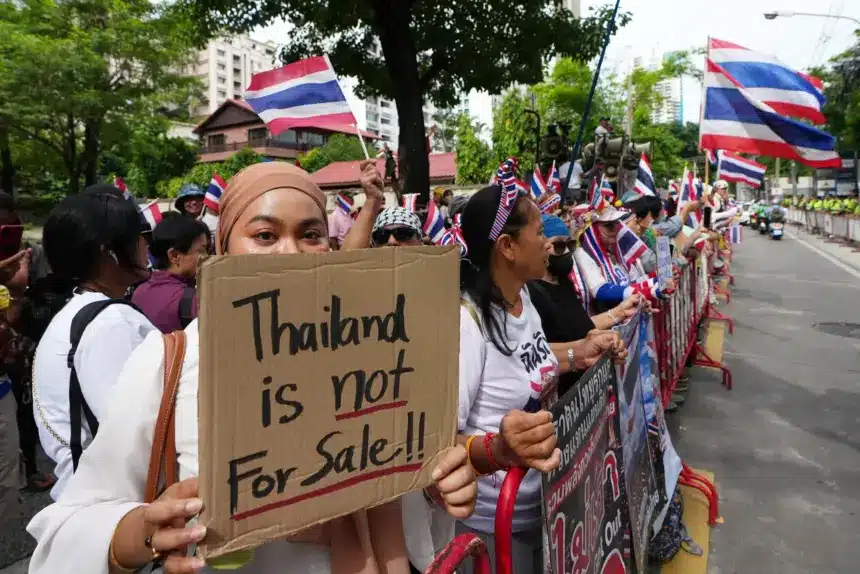
BANGKOK — Thailand’s police, tax auditors and labor inspectors have launched sweeping nationwide raids to dismantle illegal foreign-owned businesses and proxy land deals, arresting dozens of foreign nationals and flagging nearly 2,000 companies across major tourist hubs. The enforcement blitz directly answers mounting anger from Thai shopkeepers, builders and hoteliers who say offshore capital and illicit workers are pricing them out of their own economy.
From luxury pool villas in Hua Hin and Phuket to unlicensed guesthouses on Koh Phangan and underground offices in Pattaya, authorities are targeting schemes where foreign investors use Thai citizens as paper shareholders to bypass strict ownership bans. Recent operations have netted Russian, Israeli, Chinese and Western property buyers alongside undocumented Indian workers, signaling an abrupt end to decades of lax oversight in the country known as the Land of Smiles.
Key Takeaways• More than 200 officers raided a luxury Hua Hin villa estate, arresting 13 foreign nationals and exposing shell companies holding 300 million baht in land through Thai proxies. • The Ministry of Commerce flagged 1,932 companies for nominee risks in November 2026 while probing Russian-backed firms in Phuket and Israeli-linked networks on Koh Phangan. • Parallel labor sweeps across Pattaya, Bangkok and Udon Thani arrested dozens of undocumented Indian workers operating illegal gambling hubs, retail stalls and food carts. |
Dawn Raids Shatter Hua Hin Luxury Villa Illusion
The crackdown hit home in Prachuap Khiri Khan province when Deputy National Police Chief Pol. Gen. Samran Nualma led more than 200 officers into a gated pool-villa estate in Hua Hin’s Thap Tai subdistrict.
Armed with 45 court arrest warrants for foreigners and 39 summonses for Thai nationals, investigators searched 15 luxury properties priced between 10 million and 20 million baht each. Police arrested 13 foreign residents—including Chinese, British, Italian, French, Dutch, Austrian, Filipino and American citizens—at their doorsteps.
Inside the estate, officers uncovered 33 suspicious companies holding roughly 300 million baht worth of land on behalf of overseas buyers. None of the firms conducted genuine commerce. Thai citizens listed as majority shareholders admitted to investigators that they never invested a single baht and merely signed registration papers for small fees. Several detained villa owners told police that local law and accounting offices had assured them the corporate workaround was standard practice.
Local resistance has moved far beyond police tip lines. Across Hua Hin and Chiang Mai, neighborhood associations and small hotel operators have petitioned provincial governors to audit foreign-run cafés, tour desks and short-term villa rentals that evade Thai licensing taxes while undercutting domestic prices.
Russian and Israeli Capital Reshapes Island Economies
Nowhere is the economic friction sharper than on Thailand’s southern resort islands, where waves of post-pandemic arrivals brought billions of baht in foreign cash—and whole parallel ecosystems. On Koh Phangan and Koh Samui, investigators from the Department of Special Investigation found that foreign-invested entities account for nearly 68 percent of all registered businesses, according to Khaosod. Israeli investors alone hold stakes in 720 companies on Koh Phangan, representing 22 percent of foreign-linked firms on the island.
Authorities targeted an Israeli-linked network dubbed “Galp-Tree,” spanning 19 companies that operated unlicensed preschool childcare centers alongside luxury villa rentals marketed exclusively to foreign clients. Thai business owners on the island complain that insular enclaves now rely on foreign-owned transport, private security, restaurants and real estate brokers, locking local vendors out of the tourist supply chain.
In Phuket, where Russian, Chinese and British nationals top the registry of foreign shareholders, the scale is even larger. Government audits revealed that foreigners hold shares in roughly 35 percent of the island’s 32,000 registered companies. Police and commerce officials identified more than 360 Phuket firms—heavily concentrated in Russian-backed real estate developments, international schools, car rental fleets and hospitality venues—suspected of hiding behind fake Thai partners.
Street-Level Sweeps Target Undocumented Indian Workers
While white-collar investigators trace offshore wire transfers, immigration and labor squads have stepped up street raids against foreigners working without permits in protected trades. Under Thai labor law, retail vending, tour guiding, salon work and street food sales remain strictly reserved for Thai citizens.
In Pattaya, immigration police stormed a walled luxury villa and arrested 25 Indian nationals running a 24-hour transnational online gambling hub. Suspects had installed private power generators and cooked meals inside the compound to avoid drawing attention from neighbors or utility inspectors. Days earlier, Ministry of Labour teams raided wholesale stalls in Bangkok’s Pratunam market, detaining 35 undocumented workers from India, Myanmar, China and Pakistan who were selling garments directly to shoppers.
Enforcement has also reached provincial towns far from the beaches. In Udon Thani, tourist police arrested a 24-year-old Indian vendor selling ice cream from a pushcart after discovering he had overstayed his visa by 525 days. Local market traders across Bangkok, Chonburi and Chiang Mai have flooded labor hotlines with complaints that unlicensed foreign vendors and informal money lenders are eroding slim retail margins.
Legal Loopholes Fueled the Crisis
Thailand’s current confrontation is the predictable collision between rigid twentieth-century protectionism and modern global capital flows. Under the Land Code and the Foreign Business Act of 1999, non-Thai citizens are barred from owning land outright and restricted from holding majority stakes in service, retail and hospitality firms.
For decades, an entire cottage industry of corporate lawyers and accounting firms bridged that gap by setting up Thai limited companies with 51 percent Thai nominal ownership and 49 percent foreign equity, paired with preference shares that handed full voting control to the foreigner.
Weak inter-agency coordination allowed those shell structures to multiply unchecked for twenty years. Company registrars at the Department of Business Development rarely cross-checked shareholder tax records with land title transfers at the Department of Lands. Commerce Ministry investigators recently uncovered a single Thai bookkeeper listed as a shareholder in 212 separate companies worth 247.5 million baht, alongside 140 accountants across 29 firms acting as front shareholders in more than 2,000 ventures.
New Financial Firewalls Close the Corporate Backdoor
Three external shocks turned a tolerated gray market into a political flashpoint. Geopolitical instability in Eastern Europe and the Middle East drove tens of thousands of long-stay arrivals into Phuket, Pattaya and Koh Phangan, pushing residential rents and land prices beyond the reach of local families. At the same time, Thailand’s sluggish post-pandemic domestic recovery left small Thai merchants fighting for every tourist baht, stripping away public patience for foreign competitors who pay neither corporate income tax nor social security contributions.
To choke off future violations, the Department of Business Development enacted Order No. 2/2569 in August 2026, requiring every Thai shareholder in a foreign-invested company to submit three months of bank statements proving independent financial capacity before registration. Registrars now trace funds directly from a Thai partner’s personal bank account into corporate equity, eliminating sham loans.
Live database integration between the Commerce Ministry and all 462 provincial land offices now flags dormant land-holding companies automatically. In November 2026, commerce officials announced that 1,932 firms face immediate nominee audits, while Prime Minister Anutin Charnvirakul ordered nationwide land-holding probes completed by December. Convictions under the Foreign Business Act carry up to three years in prison, fines reaching 1 million baht and compulsory land divestment—a stark warning that Thailand’s hospitality no longer extends to those who bend its laws.