TAIYUAN, China – A rapid wave of factory explosions, warehouse infernos, and high-rise blazes tore through major Chinese provinces in early November 2026, killing at least 14 people and leaving dozens hospitalized while exposing sharp gaps between official casualty tallies and witness reports.
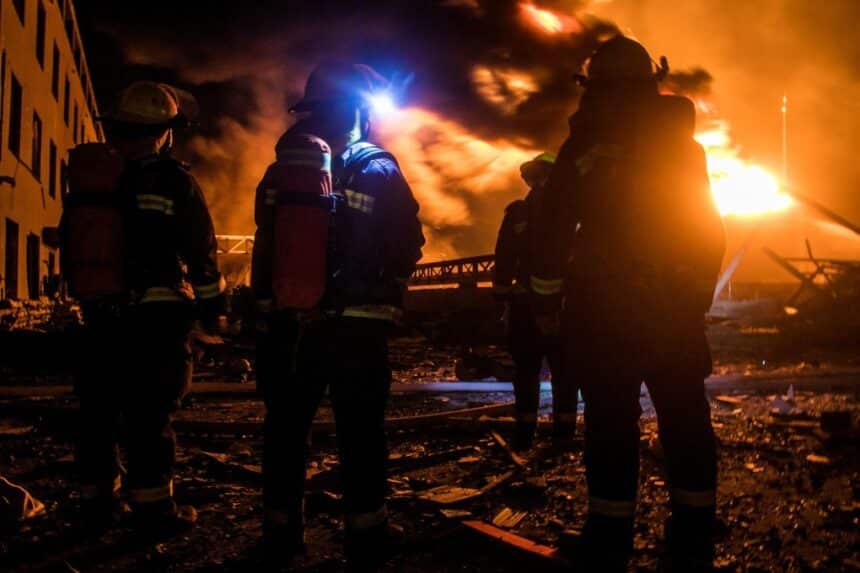
On the night of Nov. 14 alone, two major blasts struck separate regions within hours: a tanker exploded at an oil processing plant in Xinghua, part of Taizhou in Jiangsu province, just as flames engulfed a military-industrial warehouse in Guangzhou’s Baiyun district.
The back-to-back disasters, documented in bystander footage and compiled by China Observer, point to an escalating public safety crisis across China’s industrial and urban centers. Local regulators routinely close safety inspections with small fines rather than fixing broken equipment, leaving factory workers and nearby residents exposed to deadly chemical, electrical, and structural hazards.
Key Takeaways• Twin blasts on Nov. 14 struck an oil processing plant in Jiangsu province and People’s Liberation Army Factory No. 7431 in Guangzhou, sparking wide discrepancies between official injury reports and local accounts. • A Nov. 8 high-rise fire in Taiyuan killed 14 people after property managers paid a 5,000-yuan fine for faulty fire hydrants in 2023 without fixing the building’s broken safety systems. • Fierce price wars and cut-rate manufacturing have fueled a parallel surge in solar installation blazes and electric vehicle battery fires across multiple provinces. |
Twin Blasts in Jiangsu and Guangzhou
The shock wave in Xinghua hit after dark on Nov. 14. Residents living less than a mile from the oil processing compound reported cracked walls and shattered window frames as the blast rattled surrounding neighborhoods. Local emergency officials sealed off the plant and stated that a pressurized tanker had exploded, sending one injured worker to the hospital.
Online accounts from the scene painted a far grimmer picture. Posting on X on Nov. 15, a user citing local firefighters alleged that a worker had set a fuel tanker ablaze in retaliation after being beaten during a dispute over unpaid wages. Those unverified reports claimed more than 30 people died and over 20 suffered injuries, noting that lights across the factory building were still on when flames swallowed the structure.
Hours earlier, around 8 p.m. on Nov. 14, thick smoke and towering flames erupted inside a military compound in Guangzhou’s Baiyun district. A resident filming from an upper-floor apartment described fire engines arriving from neighboring districts as secondary crews rushed in to contain burning military supplies. Public records identify the site as People’s Liberation Army Factory No. 7431, also known as the Guangzhou Shenshan Automobile Factory. Covering roughly 2.1 million square feet, the state-owned enterprise manufactures military and civilian vehicle parts, including Baiyun-brand storage batteries exported to Southeast Asia and Africa. Officials have not released casualty numbers or damage estimates.
Warehouse Infernos Strain Urban Buffers
The Nov. 14 blasts followed a string of major commercial fires that exposed how tightly industrial storage sites sit packed against residential neighborhoods. On the morning of Nov. 12, flames tore through Jiang Packaging Products Co. inside the Beidu Industrial Park in Chongqing’s Qijiang district. Thick black smoke blotted out the sun for hours, reducing the factory building to a bare steel frame before crews brought the fire under control. Local officials reported no casualties.
Four days earlier, on Nov. 8, an early-morning fire gutted a single-story tire and general goods warehouse at 47 Dongyu Street in Jinan, straddling the border of Huaiyin and Tianqiao districts. Intense heat shattered second-story windows across adjacent storefronts and coated neighboring shops in thick soot. Industry sources estimated business losses in the tens of millions of yuan, though local authorities have yet to publish an official tally.
In Hangzhou, Zhejiang province, firefighters battled another fast-moving warehouse blaze on Nov. 10 after fabric stock ignited inside a brick-and-concrete facility. Crews contained the fire within an hour, avoiding injuries, though a local community staff member warned that dense smoke from the site underscored chronic fire-safety lapses in commercial storage.
Investigative Context: Fines Over Fixes
Behind the November clusters lies a regulatory system that often treats lethal safety violations as routine administrative fees. Nowhere was that failure clearer than at the Haohong International Apartments in Taiyuan, capital of Shanxi province. On the afternoon of Nov. 8, a fire broke out on the fourth floor of the 40-story mixed-use tower, known locally as the Big Gold Building, and raced upward into hotel floors.
According to reporting by Anadolu Ajansi, the Taiyuan blaze killed at least 14 people and sent 38 others to local hospitals. A survivor identified as Mr. Lan told reporters he led six people—including three hotel maids—onto an exterior window ledge after smoke alarms failed to sound and thick smoke blocked the emergency stairwells. They waited nearly 40 minutes for rescue.
Municipal records show Taiyuan fire inspectors placed the building’s management company in a high-risk “red” category in 2022 and cited it again in 2023 for broken fire gear and low hydrant water pressure. Regulators closed the case with a 5,000-yuan fine—roughly $700—allowing the tower’s hotels, training centers, and bathhouses to keep operating without repairs. Authorities detained the property manager only after the Nov. 8 deaths. The disaster echoes a broader national pattern of deadly building fires driven by lax code enforcement, including a September 2026 textile factory fire in Foshan that killed eight workers and an October 2026 shoe factory blaze in southeastern China that claimed at least 28 lives.
Green Tech Fires Track Fierce Price Wars
Safety breakdowns extend beyond aging factories into China’s fast-growing clean-energy and electric vehicle sectors, where cutthroat price competition has pressured manufacturers to trim component costs. On Oct. 30, flames swept across a mountainside solar power array in Dali, Yunnan province, following earlier rooftop solar fires in Beijing on Sept. 7 and Changsha, Hunan province, on Aug. 11.
Industry analysts warn that severe overcapacity in solar manufacturing has pushed suppliers toward thinner aluminum frames, lower-grade encapsulation film, and poorly insulated wiring. As detailed in a 2026 technical review by the International Fire and Safety Journal, loose direct-current connectors, overheated inverters, and degraded cabling frequently trigger electrical arcing that turns rooftop and hillside arrays into fast-spreading fires.
Electric vehicles have faced similar scrutiny following several high-profile fires across multiple provinces. On Nov. 14, a BYD vehicle rear-ended a cargo truck in Hebei province and burst into flames, destroying the truck’s entire load. Five days earlier, an elevated highway fire in Shanxi province engulfed a car-carrier trailer loaded with electric vehicles. Separate incidents saw an electric minivan catch fire while parked near chargers in Hunan on Nov. 10 and another EV ignite during a car wash in Sichuan on Oct. 30.
To address battery fires, Beijing enacted mandatory national standards in July 2026 requiring electric vehicle packs to withstand thermal runaway without fire or explosion, as reported by industry outlet CnEVPost. Yet firefighters on the ground still face intense suppression battles. Once lithium-ion cells enter thermal runaway, internal chemical reactions generate extreme heat and flammable gases that can reignite hours later, forcing rescue crews in Hunan to tip a burning minivan on its side and use a crane to extract its battery pack.
Across each incident, local residents and online commenters have voiced growing frustration over delayed disclosures and tight controls on casualty figures. When factories sit steps away from apartment blocks and commercial towers operate with broken alarms, minor equipment failures quickly escalate into community-wide emergencies.
Until inspectors enforce mandatory shutdowns rather than nominal fines—and until officials release transparent investigations into both industrial accidents and labor disputes—workers and residents remain on the front lines of China’s industrial safety gap.
Trending News: