CHIANG RAI– Fish fillets harvested from northern Thailand’s Kok River remain safe to eat when thoroughly cooked, but researchers warned residents Tuesday to discard internal organs after laboratory tests detected dangerous concentrations of lead and arsenic in fish guts across Chiang Rai and Chiang Mai provinces.
The findings, released by the AI CARE Research Cluster following water and aquatic sampling on Oct. 15, offer immediate relief to local fishers and diners who rely on the waterway while underscoring persistent heavy-metal risks in bottom-feeding species and organ meats.
Key Takeaways• Clean Fillets: 126 of 127 tested fish muscle samples met national safety standards, with zero excess lead or arsenic recorded over the past year. • Toxic Organs: Over a quarter of tested fish viscera (32 of 125 samples) failed safety checks, with lead peaking at 32.8 times the legal limit in Chiang Rai. • Strict Prep Rules: Health advisors urge cooks to gut small whole fish before fermenting and avoid pond snails from Ban Sop Ruak. |
Heavy Metals Concentrate in Viscera and Snails
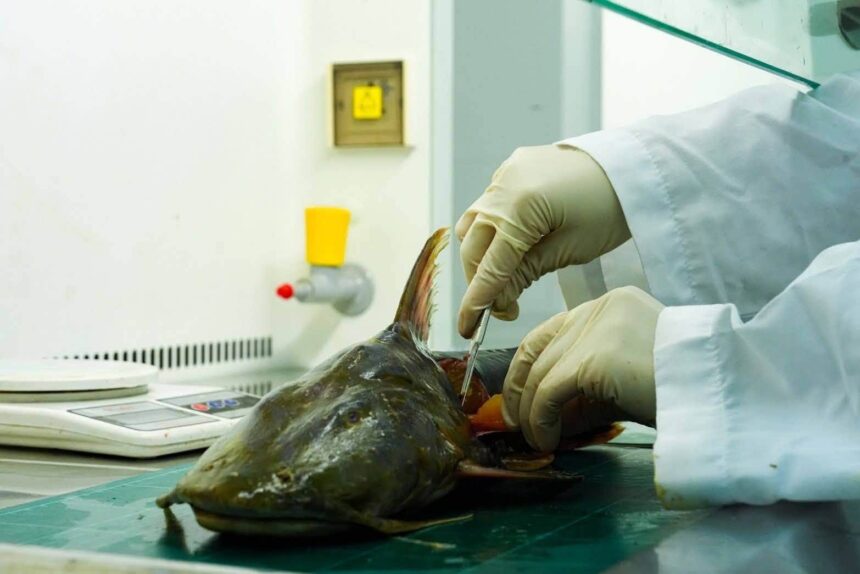
Researchers analyzed 259 cumulative aquatic samples—127 fish fillets, 125 fish viscera, and seven shellfish specimens. Assoc. Prof. Thanapol Penrat of Thailand Science Research and Innovation and lecturer Saranporn Koedkoh of Naresuan University International College reported that 126 muscle samples passed safety thresholds with no excessive mercury. The sole lead violation in muscle tissue dated back to August 2025, meaning every fillet collected during the past year, including the rainy season, cleared safety limits.
Internal organs told a starkly different story. In Chiang Rai, 26 of 112 viscera samples exceeded lead limits, peaking at 9.85 milligrams per kilogram—roughly 32.8 times the permissible ceiling. Seven Chiang Rai gut samples also breached arsenic limits, reaching 9.03 milligrams per kilogram, or 4.5 times the legal threshold. In Chiang Mai, five of 13 gut samples failed lead checks. Meanwhile, one of seven tested shellfish, a pond snail, carried arsenic at 1.2 times the safe limit.
Upstream Mining Fuels Cross-Border River Concerns
The contamination reflects mounting ecological pressure across the transboundary Kok and Sai river basins, which flow from Myanmar’s Shan State into northern Thailand. Environmental investigations and satellite tracking have linked surging sediment toxicity to unregulated gold and rare earth mining upstream, leaving communities in Ban Ruam Mit and Mae Yao wary of water once used freely for farming and household wells.
Because heavy metals bind to riverbed silt and accumulate in digestive tracts rather than muscle tissue, bottom-dwelling species and filter-feeding snails absorb higher toxin loads. The Department of Fisheries has echoed these warnings across 10 aquatic species, prompting Thai officials to propose a 150-kilometer pollution control zone and deploy chemical “fingerprinting” in diplomatic talks with Myanmar and China.
Kitchen Precautions and November Risk Outlook
To keep river fish on local tables safely, researchers issued seven kitchen guidelines. Cooks should stick strictly to steamed, grilled, or thoroughly cooked fillets, avoiding raw fish salads (laab) to prevent both chemical and parasitic exposure.
Traditional chili pastes (nam prik and jaew) must be prepared using cleaned fillets only, and cooks must eviscerate small whole fish before making fermented staples like pla ra, pla jom, or pla daek. Residents should also avoid harvesting pond snails near Ban Sop Ruak.
Under the cluster’s risk forecast for Nov. 1–30, 2026, Kok River fish meat remains safe for public consumption. However, officials advise residents to avoid eating Chiang Rai fish guts and recommend a complete halt to consuming or selling fish viscera harvested in Chiang Mai while basin-wide monitoring continues.
Trending News:
Chiang Rai Resort Raid Leads to 1.16M Meth Pill Bust
Deep Water Wells Replace Toxic River Water in Northern Thailand