
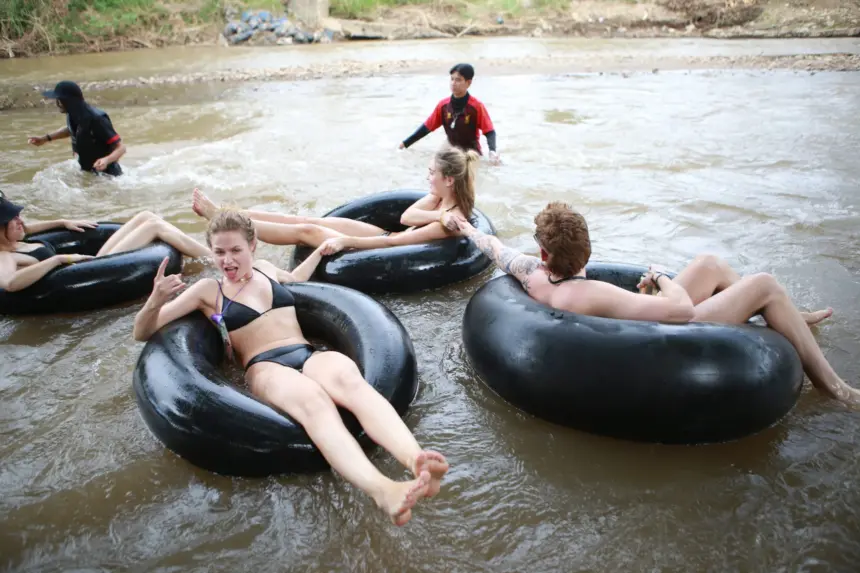
MAE HONG SON – River rafting and tubing in Mae Hong Son offer two distinct experiences: guided white-water trips and relaxed floating on the Pai River. Pai is the practical base for both, rather than Mae Hong Son town.
That distinction matters when you’re choosing accommodation or planning transport. A full-day rafting trip can cover dozens of kilometers, while tubing stays closer to Pai and usually belongs to the drier months.
Route length, seasonal water levels, published prices, and safety arrangements help you choose a trip that fits your time and confidence.
Key Takeaways
- Pai is the main base for recreational tubing and commercial white-water rafting in Mae Hong Son Province.
- Rafting options include full-day runs and two-day expeditions with an overnight jungle camp.
- Basic tubing listings start around ฿200 to ฿300, while premium packages can cost around ฿450.
- Tubing generally suits drier months; rafting often benefits from higher rainy-season flows.
- Water conditions matter more than calendar dates, and safety equipment belongs in every booking decision.
River Rafting and Tubing in Mae Hong Son: Start in Pai
Pai is where commercial visitor information concentrates both activities. It’s the practical place to arrange transport, meet rafting guides, and organize a tubing outing.
However, Pai and Mae Hong Son town aren’t interchangeable departure points. Some longer rafting journeys travel through remote parts of the province, but their advertised arrangements begin in Pai. Staying in the provincial capital puts you somewhere different from the main river-trip hub.
For tubing, aboutPAI places a put-in near Wiang Nuea bridge, roughly 4 km from Pai. It also describes pickups around Walking Street, although individual packages have their own transport arrangements.
Allow time to reach Pai before committing to a river day. The usual Chiang Rai to Pai route connects through Chiang Mai, so arriving the previous day makes sense for a morning departure.
Choose a Short Rafting Run or a Multi-Day River Journey
Full-day rafting offers a substantial outing without an overnight stay. A two-day expedition adds more river distance and a jungle-camp night.
Thailand’s Pai River adventure guide describes rapids at Grades I to IV. However, a river-wide description doesn’t establish the difficulty of every departure.
Full-day rafting on the Pai River
Published full-day itineraries cover roughly 35 to 45 km. Pai Adventures describes 15 sets of rapids reaching Class IV, with Susa Waterfall and a hot spring among the advertised stops.
Another product describes a 45 km run starting near Soppong, with pickup from Pai and Class II to IV rapids. Its listed inclusions include lunch, a helmet, a life jacket, and a safety briefing.
These details belong to particular products. Water levels affect the route and rapid difficulty, so neither the distance nor the grade is a universal promise.
Two-day rafting through Pai Wildlife Sanctuary
Thai Adventure Rafting advertises a 65 km expedition through Pai Wildlife Sanctuary. Its description includes about 60 rapids, reaching Class IV, and an overnight jungle camp.
This format suits travelers who want an overnight river journey and can commit two days to it. It also requires comfort with a camp stay rather than returning to accommodation in Pai that evening.
Dates, fitness requirements, camp arrangements, meals, and transfers are material parts of the package. The operator’s safety statements are its own claims, not an independent assessment of every departure.
Pai River Tubing Is a Slower, Seasonal Way to Get on the Water
Tubing replaces paddling through rapids with floating in an inflatable tube. It’s generally the more casual choice, although moving water still deserves respect.
Published guide prices put basic outings around ฿200 to ฿300, with premium options around ฿450. Transport, stops, and entertainment account for some differences between packages.
How a tubing trip works
Providers may drive guests upstream before they float back toward Pai. Some outings focus on the river itself; others add music or bar stops.
aboutPAI names Jungle Tubing and Pai Authentic Travel among providers. It lists Tuesday and Friday departures for Pai Authentic Travel, plus a premium experience with a DJ and three bar stops. Those are published guide details, not an endorsement or a universal operating schedule.
Route length, transport, and time spent at stops shape the outing. A package’s total duration can therefore be considerably longer than its actual floating time.
Why low water can change the float
Late in the dry season, shallow sections can interrupt the ride. Tubes may scrape the bottom, and participants sometimes have to get out and walk or pull them through low water.
That makes tubing less effortless than the word “float” suggests. If your priority is an uninterrupted drift, adequate depth matters as much as sunshine.
Low water also changes the pace. A short route can take longer when the current weakens, so a gentle-looking river doesn’t guarantee a quick outing.
Time Your Visit Around Water Levels, Not Just the Calendar
For river rafting and tubing in Mae Hong Son, seasonal windows are useful guides. Rainfall and actual river conditions determine what can run safely.
Listings broadly place tubing between October or November and May, and rafting around June through January. These windows overlap, but they don’t guarantee that both activities operate on the same day.
Tubing usually belongs to the drier months
Operators often suspend tubing during the monsoon because high, fast water makes an otherwise casual activity hazardous. Khaosod English documented a rainy-season tubing suspension in Pai in July 2023.
That history supports treating tubing as a seasonal activity, without assuming a fixed annual reopening date. Dry weather alone also doesn’t establish safe conditions, especially when rain upstream affects the river.
Rafting can be stronger in the rainy season
Rafting listings often describe stronger flows during the rainy season, particularly around July through October. Higher water can produce more powerful rapids, but storms and floods can also stop trips.
Meanwhile, February through April can bring low water that limits some routes. The broader advice on adventure tourism in Thailand applies here: rainfall changes both availability and difficulty.
Flexible travel dates help when the river forces a cancellation.
Check Safety, Inclusions, and Costs Before You Book
Thailand Addict’s comparison gives approximate rafting prices of ฿1,800 per person for one day and ฿3,500 for two days. Other listings differ, so these figures are budgeting examples rather than fixed rates.
Group size, route, transport, meals, equipment, and overnight arrangements all affect value. A lower headline price doesn’t tell you whether two trips include the same things.
Ask what equipment and guide support are included
For rafting, a suitable booking includes a safety briefing, a properly fitting helmet and life jacket, and trained guide support. Transport, meals, and weather-related cancellation terms should also appear clearly in the trip description.
For tubing, a life jacket and a clear transport arrangement matter even on a social outing. Upstream transport and return transport aren’t necessarily the same inclusion.
Equipment claims also don’t establish identical standards across providers. The named items, guide arrangements, and planned route matter more than broad promises about an “adventure package.”
Know when to skip the river
Fast currents, rising water, storms, lightning, and flash-flood conditions are reasons to postpone or cancel. A provider’s decision that conditions are unsafe should end the discussion about entering the river.
Follow guide instructions and stay with your group. For tubing, avoid drinking before or during the float, including on packages that advertise bar stops.
A relaxed atmosphere doesn’t remove the risks posed by rocks, current, or changing water levels. Alcohol and moving water are a poor combination.
Frequently Asked Questions
Can beginners go rafting on the Pai River?
Some guided trips may suit first-timers, but the Pai River includes listed sections reaching Class IV. Suitability depends on the route, water level, fitness, and comfort with rapids. A general “beginner-friendly” description doesn’t cover every section or departure.
Is rafting or tubing available in Mae Hong Son town?
The documented commercial hub is Pai, rather than Mae Hong Son town. A trip advertised as “Mae Hong Son rafting” may use the province’s name while departing from Pai. Longer routes can travel through the wider province without starting in the provincial capital.
Do I need to book a rafting trip in advance?
Advance arrangements make sense for multi-day trips and fixed-date departures. A complete booking should identify the departure date, pickup, group arrangements, payment terms, and weather-related cancellation policy. These details matter more than reserving an unspecified rafting package.
Are children allowed on Pai River trips?
Age and height rules depend on the provider, route, and river conditions. The published information doesn’t establish one shared minimum age across Pai’s river trips. Children need an age-appropriate itinerary and correctly fitting safety equipment; an adult-friendly outing isn’t automatically suitable for a child.
Choose the River Day That Fits Your Trip
Choose guided rafting if you want rapids, longer river distances, or an overnight expedition. Tubing is the easier-going option when dry-season depth and flow support a safe float.
Pai is the practical starting point, but the river determines what kind of day is possible. Give current water conditions, safety equipment, transport, and package inclusions more weight than a seasonal label or headline price.
The strongest plan leaves room for weather-related changes. A river day that suits the conditions is worth more than forcing the wrong activity into a fixed schedule.