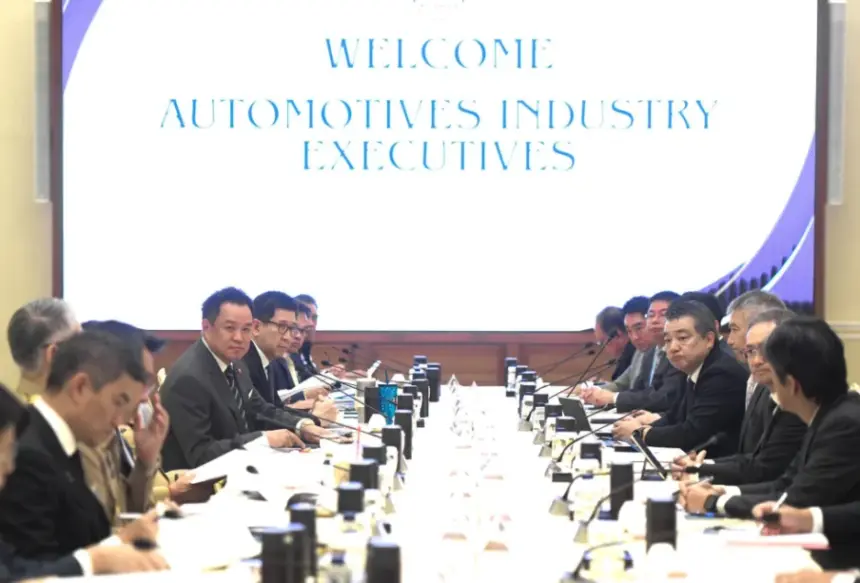
BANGKOK — Thailand’s government leaders met with eight major Japanese and Chinese automakers at Government House on Sunday to negotiate local supply chain expansion and clean-energy rules. Prime Minister Anutin Charnvirakul and Finance Minister Ekniti Nitithanprapas urged manufacturers to buy more Thai-made auto parts, share engineering knowledge, and train local workers as the Southeast Asian hub adapts to electric and hybrid vehicles.
Executives from Toyota, Isuzu, Mitsubishi, BYD, Great Wall Motor, and MG joined the talks to outline operational needs. While Thai officials described the meeting as an agreement to keep factories in the country, several company requests—such as faster construction of public charging stations and steady tax incentives—remain under review rather than finalized policy.
Key Takeaways• Government Demands: Thai officials pushed eight Japanese and Chinese carmakers to source more domestic components, transfer vehicle technology, and upskill roughly 750,000 auto employees. • Industry Requests: Automakers asked Bangkok to expand public electric vehicle charging networks nationwide, protect investment incentives, and keep biofuel standards steady. • Unconfirmed Commitments: Officials reported broad pledges to maintain Thai production bases, but individual automakers have not yet issued public statements confirming new capital outlays from Sunday’s meeting. |
Proposals and Policy Hurdles
During the talks, Anutin and Ekniti promoted a technology-neutral strategy backing internal combustion engines, hybrids, plug-in hybrids, and battery electric vehicles equally. The prime minister pressed the 20 automotive representatives to integrate small and medium-sized Thai suppliers into their production lines so local firms capture value from next-generation cars.
Automakers arrived with their own operational demands. Industry representatives called on the government to build more electric vehicle charging stations in Bangkok and outer provinces to ease consumer range anxiety. They also asked for fair regulatory treatment and higher quality standards for E20 gasohol and B20 biodiesel, confirming their current engines can safely run on those domestically produced fuels. Ekniti told reporters he would coordinate with the Transport and Energy ministries to review the charging station proposals, leaving those infrastructure upgrades under consideration rather than approved.
Distinguishing Pledges From Policy
Thai officials portrayed the meeting as a decisive win for domestic manufacturing, saying every firm agreed to use Thailand as a production and export base. Yet distinguishing official announcements from binding corporate commitments requires caution. Representatives from Toyota Motor Thailand, BYD Auto Thailand, and Great Wall Motor have not issued independent comments or updated capital spending schedules.
Policy changes already on the books explain why automakers are lobbying Bangkok closely. Earlier this year, the Thai Cabinet approved a three-tier excise tax structure taking effect Jan. 1, 2027, raising taxes on imported battery electric and range-extended vehicles to 35 percent. Officials designed the levy to encourage local assembly and offset zero-tariff advantages that Chinese electric vehicles previously enjoyed under regional free-trade rules. Meanwhile, the Board of Investment of Thailand courts battery and component makers with tax holidays, forcing manufacturers to weigh local assembly costs against import penalties.
The Detroit of Asia at a Crossroads
Thailand earned its reputation as the Detroit of Asia over four decades by anchoring its industrial policy to Japanese automakers. Companies like Toyota, Isuzu, and Mitsubishi built dense supplier networks across eastern provinces like Rayong and Chonburi, turning the country into the world’s 11th-largest auto producer and Southeast Asia’s top vehicle exporter.
That foundation shifted after 2022, when aggressive Thai subsidies drew Chinese electric vehicle giants such as BYD and Great Wall Motor to open local plants. Japanese brands saw domestic sales shrink as price-conscious buyers switched to Chinese models. Independent analysis from Reccessary notes that while massive factory investments make a sudden Japanese exit unlikely, legacy carmakers risk gradually moving parts production to neighboring countries unless Thailand balances electric vehicle subsidies with support for hybrid supply chains.
For communities in Thailand’s eastern industrial belt, the stakes are immediate. Hundreds of smaller Thai parts factories make exhaust systems, transmissions, and engine blocks that battery-powered cars do not need. Forcing foreign automakers to source local parts and retrain Thai technicians is Bangkok’s attempt to prevent layoffs as auto manufacturing leaves the gasoline era behind.
Trending News:
Thailand, China Seal Eight Deals on EVs, Trade and Scams
PHEVs, Not EVs, Lead Thailand’s Early Electrification Vehicle Sales