
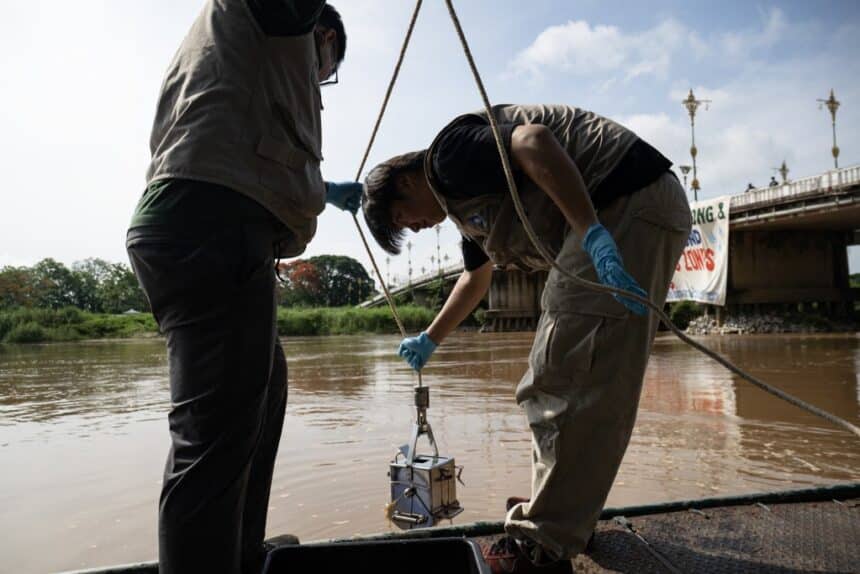
CHIANG RAI — Thai fishery officials warned residents across northern Thailand this week to stop eating 10 species of wild freshwater shrimp, snails, clams and bottom-feeding fish after laboratory tests detected unsafe levels of toxic heavy metals in riverbeds across the Kok, Sai, Ruak, Salween and Mekong basins.
Department of Fisheries Director-General Pinsak Suraswadi issued the advisory on Monday after an emergency interagency summit in Bangkok with Pollution Control Department chief Surin Worakijthamrong and acting marine resources head Phadet Laithong. Random sampling of 69 northern aquatic species confirmed that pollutants trapped in river mud have entered the local food chain, prompting immediate inspections of Mekong River fish cages and a three-color warning flag system.
Key Takeaways
- Ten wild species in the Kok, Sai, Ruak, Salween and Mekong rivers exceeded safety limits for accumulated toxins, including freshwater shrimp, golden apple snails, river snails, freshwater mussels, horse mussels and mollusk-eating fish.
- Farm-raised fish from controlled aquaculture ponds remain safe to eat, though officials will expand safety testing to floating net cages in the Mekong River.
- Authorities will deploy a green, yellow and red warning flag system across northern waterways and provide technical relief to affected fish farmers.
Bottom-Dwellers Absorb Riverbed Toxins
Heavy metals sink into river mud rather than dissolving evenly in open currents, placing bottom-feeding wildlife at acute risk of chemical buildup. Laboratory tests confirmed unsafe toxin concentrations in freshwater shrimp, golden apple snails, river snails, freshwater mussels, horse mussels and predatory fish that eat shellfish, including basa and native catfish.
Pinsak urged villagers in high-risk districts to avoid wild shellfish and bottom-dwellers until water quality improves. For mid-water fish species below contamination limits, fishery experts advised cooks to discard all internal organs, where heavy metals concentrate most heavily, before preparing meals.
Commercial aquaculture farms received a clear exemption from the warning because pond-raised fish rely on regulated water and formulated feed rather than river silt. Still, inspectors will launch sweeping checks of floating cages anchored in the Mekong River to verify that passing sediment has not tainted caged stock.
Upstream Mines Drive Cross-Border Pollution
The crisis traces back nearly two years to unregulated gold, tin and rare-earth mines across the border in Myanmar’s Shan State. Runoff from mountain strip mines washes arsenic, lead and manganese into headwaters feeding northern Thailand. In November, Thai testing found arsenic in untreated Sai River water at 25 times the safe drinking limit, while provincial health screenings in Chiang Rai detected elevated inorganic arsenic in urine samples from 31 of 549 tested residents.
Geography intensifies the threat for Chiang Mai and Chiang Rai provinces. The Kok, Sai and Ruak rivers flow south from Myanmar before joining the Mekong along the Golden Triangle. Seasonal rains flush toxic tailings downstream, coating riverbeds that sustain thousands of subsistence fishing families and irrigate roughly 27,000 rai of rice paddies.
Diplomatic efforts to halt the pollution at its source have stalled. Thai officials signed a weakened river pact with Myanmar authorities in Naypyidaw on Nov. 12, leaving enforcement gaps around mines controlled by armed ethnic groups and foreign syndicates.
To help river communities track daily hazards, the Department of Fisheries is rolling out a three-tier flag system modeled on beach safety alerts. Green flags will mark zones safe for fishing, yellow flags will signal caution and restricted harvesting, and red flags will warn residents away from heavily contaminated waters.
The interagency task force also plans technical support for fish farmers drawing water from affected tributaries, helping them upgrade filtration or shift to alternative livelihoods. Meanwhile, engineers are preparing an 18-month pilot project in Mae Sai district using specialized sediment-trapping basins designed to capture up to 94.6% of arsenic-laden silt before it reaches downstream farms and waterworks.
Trending News:
Residents in Mae Sai Rally Against Myanmar Toxic Mine Pollution
Deep Water Wells Replace Toxic River Water in Northern Thailand