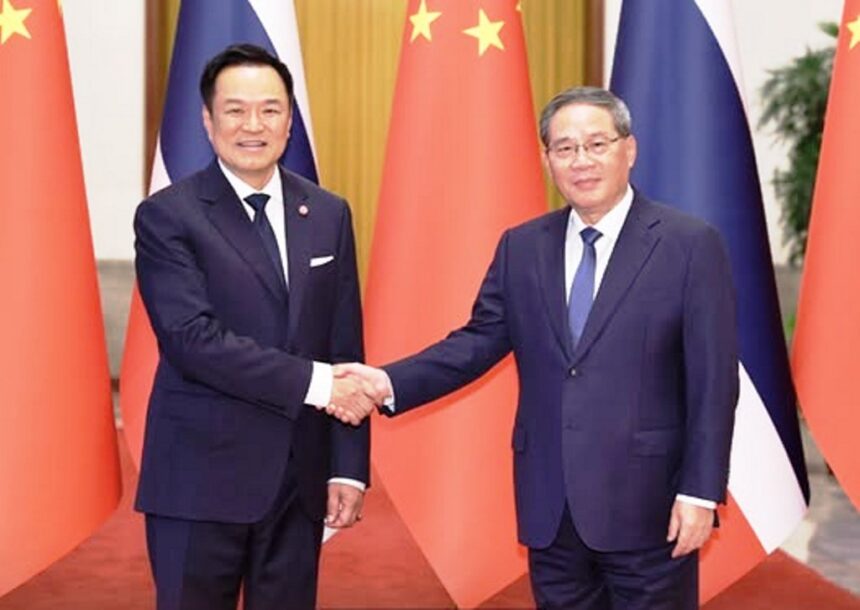
BANGKOK – China’s Premier Li Qiang arrived in Thailand on Friday for a three-day official visit aimed at locking in major trade, clean-energy and security agreements with Prime Minister Anutin Charnvirakul.
The high-stakes trip, running Nov. 13–15, brings together executives from 50 organizations at a bilateral business forum to finalize seven government-endorsed pacts. Those deals target electric vehicles, battery recycling, semiconductors, farm exports, vocational training and cross-border fraud—reshaping Thailand’s industrial supply chains and regional security posture.
Key Takeaways
- Seven bilateral agreements are slated for signing during Li’s Nov. 13–15 stay, anchored by a five-year automotive and electric vehicle manufacturing pact.
- New agricultural protocols open Chinese customs access for Thai snake fruit—worth an estimated $2.26 million annually—while streamlining fresh durian shipments.
- Both governments will formalize joint security mechanisms under Beijing’s Global Security Initiative to dismantle transnational online scam syndicates.
Deals Target EV Supply Chains and Farm Exports
Ahead of Li’s arrival, Thailand’s Cabinet endorsed seven cooperation drafts spanning industry, agriculture, education and diplomacy. The centerpiece is a five-year memorandum between Thailand’s Ministry of Industry and China’s Ministry of Industry and Information Technology. It establishes a joint working group to integrate Thai auto-parts makers into global electric vehicle, smart-car and battery-recycling supply chains.
At the Thai-Chinese Business Forum, representatives from 50 state and private organizations are negotiating capital commitments in semiconductors, clean energy and artificial intelligence. For Thai manufacturers, aligning technical standards with Chinese firms offers access to advanced battery and chip-packaging technology, though local suppliers face stiff price competition.
Farmers stand to gain immediate relief at the border. Two phytosanitary protocols with China’s General Administration of Customs set uniform pest-control rules from certified orchards to packing houses. According to Thailand’s Public Relations Department, the pacts will speed up customs clearance for fresh durian and open a new export channel for Thai snake fruit projected to generate at least 76 million baht ($2.26 million) a year.
Why Beijing and Bangkok Are Recalibrating Now
The diplomatic push follows Prime Minister Anutin’s July 2026 trip to Beijing, where both nations pledged to build a shared industrial ecosystem. Yet friction has mounted on Thai factory floors. Data reported by CNA shows Thailand imported nearly $2.4 billion in electric passenger cars during the first nine months of 2026—with China supplying 96% of that value—undercutting domestic assembly targets and prompting Bangkok to raise import taxes.
For local communities in Thailand’s Eastern Economic Corridor, shifting Chinese automakers from pure vehicle imports to localized battery and parts production is critical to protecting manufacturing jobs. Meanwhile, a parallel five-year vocational education pact will overhaul technical curricula and fund hands-on training centers so Thai technicians can staff high-tech assembly lines rather than losing skilled roles to imported labor.
Tourism and border stability also forced urgency onto the agenda. Viral reports of travelers being trafficked into scam compounds along Thailand’s borders rattled Chinese tourists this year. By linking diplomatic staffing updates with joint cybercrime enforcement, Bangkok aims to restore traveler confidence before peak winter arrivals.
Regional Security and Southeast Asian Leverage
Beyond commerce, the two governments are formalizing a security agreement under China’s Global Security Initiative to trace illicit money flows and dismantle cross-border scam networks. That follows their agreement earlier this year to launch a foreign affairs and defense “2+2” strategic dialogue.
Li departs Bangkok on Nov. 15 for Manila to attend the 29th China-ASEAN Summit. By locking in bilateral semiconductor, rail and clean-energy commitments ahead of the regional gathering, Thailand reinforces its status as mainland Southeast Asia’s primary logistics and manufacturing hub—even as Anutin balances deeper Chinese ties alongside ongoing trade negotiations with Washington.