
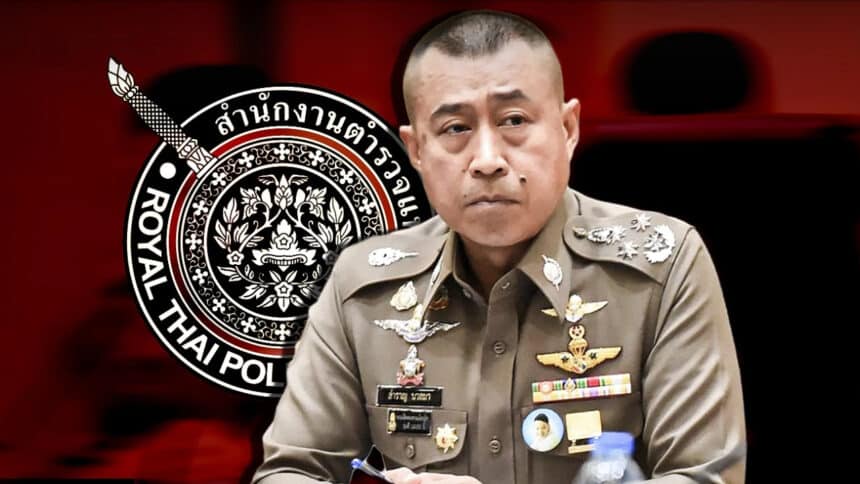
BANGKOK – Thailand’s top police commander has ordered an aggressive nationwide crackdown on illegal immigration and transnational crime syndicates, targeting human smuggling rings, visa abusers and cross-border fugitives across the kingdom.
Police Gen. Samran Nualma, commissioner-general of the Royal Thai Police, directed all regional bureaus and border checkpoints this week to intensify sweeps alongside Immigration Bureau Commissioner Police Lt. Gen. Noppasin Poolsawat. The directive immediately tightens screening at major transit hubs and tourist provinces as authorities move to dismantle foreign criminal networks operating under expired or fraudulent travel documents.
Key Takeaways• Police Gen. Samran Nualma and Immigration Bureau Chief Police Lt. Gen. Noppasin Poolsawat launched coordinated nationwide sweeps targeting illegal entry, visa overstays and foreign crime rings. • Joint task forces have already disrupted smuggling routes in southern Thailand, arresting brokers and seizing forged passports at major railway and border transit points. • The enforcement drive builds on strict 2026 government visa reforms aimed at closing security gaps in major tourist hubs and border provinces. |
Coordinated Sweeps Hit Southern Transit Hubs
The order produced swift operational results along Thailand’s southern corridor. On Tuesday, officers from Immigration Division 6 and local police raided Hat Yai Railway Station in Songkhla province, arresting four Myanmar smuggling brokers and 23 undocumented migrants bound for Malaysia. Investigators reported each migrant paid 40,000 baht ($1,160) to cross clandestine border trails.
Police Col. Charoenphong Khantiloh, spokesperson for Immigration Division 6, confirmed the Hat Yai arrests directly executed Samran and Noppasin’s crime suppression mandate ahead of major seasonal festivals. Suspects carrying counterfeit travel documents face up to 10 years in prison and fines reaching 200,000 baht under Thai law. Authorities also urged residents to report suspicious foreign activity through the Immigration Bureau’s 1178 hotline.
Beyond border checkpoints, Noppasin has targeted fraud inside domestic civil registries. Late last month, the Immigration Bureau chief announced DNA testing exposed 24 Chinese children registered under fake Thai fathers, part of a wider probe into transnational syndicates exploiting Thai citizenship and birth records to shield illicit business operations.
Tightened Border Controls
The latest police mobilization reflects mounting pressure on Bangkok to repair security vulnerabilities exposed over the past two years. Following Prime Minister Anutin Charnvirakul’s return to office, the Cabinet moved in May to scrap a previous 60-day visa exemption for 93 countries, speeding up deportations of foreign criminals who had used extended tourist stays as cover for telecom scam centers, money laundering and illegal nominee businesses.
Official enforcement data shows the scale of the challenge. During the first five months of 2026 alone, immigration officers denied entry to 29,490 high-risk travelers, revoked 668 fraudulent student visas and arrested more than 14,100 overstayers and unauthorized workers. Provincial hotspots such as Chonburi, Phuket, Chiang Mai and Mae Hong Son bore the brunt of illicit foreign enterprises, prompting local business associations to demand fairer enforcement against unregistered operators undercutting licensed Thai companies.
Geographic realities along Thailand’s 5,600 kilometers of porous land borders compound the policing burden. Ongoing conflict in neighboring Myanmar continues to drive irregular migration, giving human trafficking networks a steady supply of vulnerable workers seeking passage to Malaysia or jobs inside Thai construction and hospitality sectors.
Digital Screening Balances Security and Tourism
While tightening street-level enforcement, Noppasin’s bureau is overhauling airport technology to avoid choking Thailand’s vital tourism economy. Earlier this month, the Immigration Bureau expanded automated border control gates at international airports to passport holders from 33 countries and territories, freeing frontline officers to focus on biometric watchlists and high-risk arrivals.
The dual strategy pairs faster clearance for verified visitors with aggressive database cross-checks linking Royal Thai Police records to Interpol notices. Police commanders have instructed provincial stations to audit hotels, condominiums and language schools for mandatory foreign residency reporting under Section 38 of the Immigration Act.
For expatriates, migrant workers and tour operators across Thailand, the directive signals immediate scrutiny at road checkpoints and immigration offices. Police headquarters confirmed joint task forces will maintain daily inspections through year-end, warning that local officials who turn a blind eye to harboring undocumented foreigners will face disciplinary transfers alongside criminal prosecution.
Trending News: