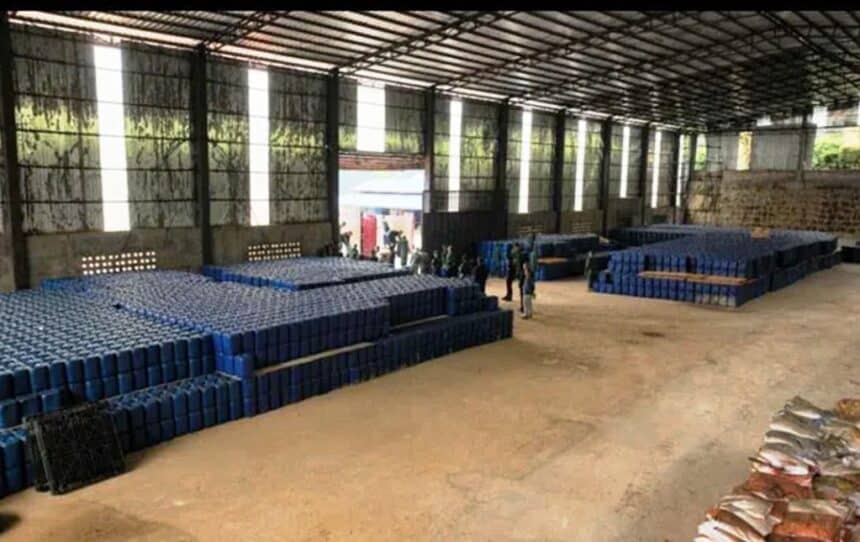
PANGKHAM, Myanmar — The Wa Army handed over 1,337.31 metric tons of seized drug precursor chemicals to Chinese officials on Tuesday, exposing the massive industrial scale of synthetic narcotics production inside Myanmar’s autonomous border enclave.
The Wa State Justice Department transferred the stockpile through the Pangkham border crossing into Menglian County in China’s Yunnan province, according to an announcement published by local media outlet Wa News Land. While framed by the United Wa State Army as a public relations victory against drug trafficking, regional security analysts point out that capturing more than 1,300 tons of raw materials inside Special Region 2 proves the territory remains a primary manufacturing hub for Southeast Asia’s illicit drug trade.
Key Takeaways
- Wa Army officials transferred 1,337.31 metric tons of confiscated precursor chemicals to Chinese authorities at the Pangkham-Menglian border gate on Nov. 17.
- Publicly released announcements omitted the specific chemical compounds, seizure locations, and suspect identities while promoting the armed group’s anti-narcotics stance.
- The massive volume underscores the entrenched industrial capacity of illicit laboratories operating across Shan State despite periodic border crackdowns.
Unanswered Questions Behind the Border Handover
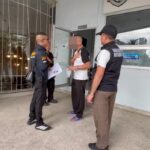
Official imagery distributed by Wa News Land showed heavy cargo trucks lined up along the frontier dividing Myanmar’s northern Shan State from southwestern China. Wa officials described the confiscated materials as essential chemical ingredients used to synthesize dangerous narcotics capable of inflicting severe physical and psychological harm. Yet the announcement left critical investigative details unaddressed.
Authorities declined to identify the exact chemical compounds in the shipment, where enforcement units intercepted the cargo, or whether any syndicate operators were arrested. That lack of transparency reflects a long-standing pattern in Special Region 2, an autonomous zone governed with minimal outside oversight since the armed group signed a 1989 ceasefire with Myanmar’s military.
Tuesday’s transfer follows a separate narcotics handover two months earlier in the group’s southern command. On Sept. 4, the UWSA’s 171st Military Region—headquartered in Mong Hsat directly across the border from Thailand’s Chiang Rai and Chiang Mai provinces—turned over confiscated drugs valued at 1.391 billion kyat to Myanmar military authorities.
Golden Triangle Supply Chains and Beijing’s Pressure
To understand why more than 1,300 tons of industrial chemicals accumulated in a remote mountain enclave, investigators look upstream to cross-border supply chains and geopolitical pressure from Beijing. Synthetic drugs such as methamphetamine and ketamine require vast quantities of legitimate dual-use industrial solvents and reagents, most of which originate in chemical manufacturing hubs across China and India before being diverted through porous river and overland routes into unregulated territory.
According to the United Nations Office on Drugs and Crime, synthetic drug production across the Golden Triangle has surged to record highs as Myanmar’s civil war deepens economic desperation and weakens state policing. In its regional synthetic drugs assessment, the agency reported that East and Southeast Asian authorities seized a record 236 tons of methamphetamine in a single year, with Shan State serving as the primary production engine.
For border communities in northern Thailand and southern Yunnan, the operational impact is immediate. Precursor stockpiles of this magnitude translate into hundreds of millions of methamphetamine pills—locally known as yaba—moving south through jungle trails into Chiang Rai and across Mekong River transit corridors, straining provincial hospitals, courts, and border patrol units.
At the same time, Beijing has tightened economic and border controls on ethnic armed groups along its frontier, including previous trade blockades and crackdowns on transnational cyber-scam syndicates. Regional observers note that these pressures compel Wa leaders to stage high-profile enforcement handovers to protect vital cross-border trade lifelines.