


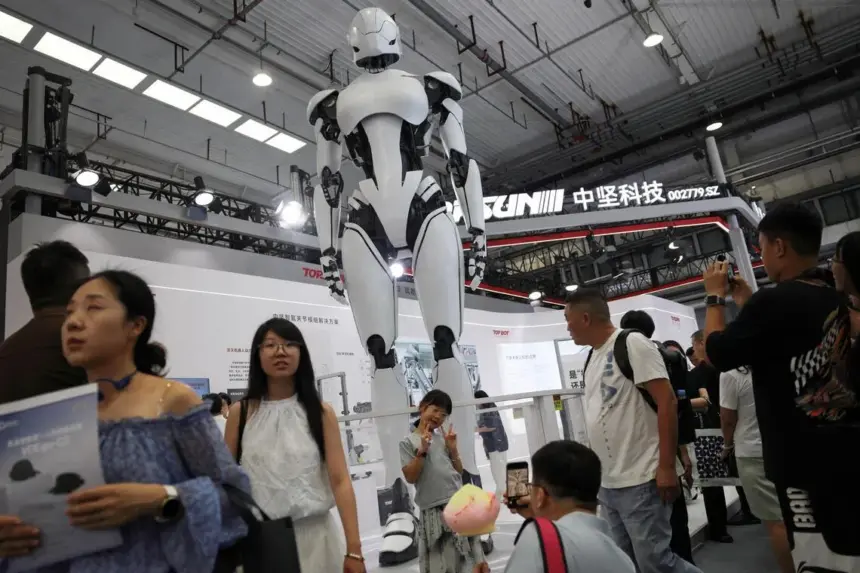
BEIJING – China’s robotics companies shipped more than 97% of the world’s humanoid robots in the first half of 2026 and drew billions in speculative investor cash, yet almost none of those machines can perform an autonomous factory job on their own, according to a Nov. 6 industry analysis by Asia business commentator Statrys. Behind viral clips of backflipping androids and blockbuster stock debuts, manufacturers rely heavily on university labs, stage performances and remote-control operators to sustain revenue while racing to solve an acute shortage of real-world training data.
The gap between viral spectacle and commercial utility has triggered a fierce price war at home, regulatory warnings from Beijing’s top economic planners and sweeping import restrictions from Washington. While Unitree Robotics saw its annual sales surge tenfold between 2023 and 2025 ahead of a frenzy on Shanghai’s tech-heavy STAR Market, tightening margins, U.S. national security bans and a lack of practical workplace software threaten to wipe out most of China’s 150-plus humanoid startups before the decade ends.
Key Takeaways
- Chinese manufacturers accounted for over 97% of global humanoid robot shipments in early 2026, led by Unitree Robotics, which generated more than $240 million in 2025 revenue and roughly $40 million in profit.
- Nearly three-quarters of Unitree’s humanoid revenue comes from universities and research labs rather than factories, because robots still lack the millions of hours of human-motion data needed for autonomous manual labor.
- An aggressive domestic price war—pushing entry-level humanoids down to $5,900—combined with new U.S. Federal Communications Commission restrictions on foreign robots is shifting guaranteed profits toward component and chip suppliers.
Blockbuster Valuations Outpace Real-World Utility
Retail investors and state planners have poured money into bipedal machines at a pace that dwarfs actual commercial adoption. When Hangzhou-based Unitree Robotics prepared to list on Shanghai’s STAR Market in mid-2026, domestic savers subscribed for more than 8,000 times the shares on offer. Regulators cleared the company’s listing application from acceptance to approval in 73 days, a record speed for the exchange, catapulting Unitree’s valuation to roughly $50 billion on its opening day of trading.
That valuation towered more than 40 times above the entire $1.1 billion Chinese humanoid robot market recorded in 2025, according to Statrys host Bertrand, a 26-year Asia business veteran. Still, Unitree stands apart from cash-burning rivals. Its revenue climbed from roughly $22 million in 2023 to more than $240 million in 2025, yielding around $40 million in profit while domestic competitor UBTech posted over $100 million in annual losses.
Unitree shipped more than 5,500 humanoids in 2025, leading the world. By the first half of 2026, global humanoid shipments nearly quadrupled, with Chinese firms building almost every unit. Yet corporate disclosures show that buyers sit far from the automated assembly lines depicted in promotional reels.
Viral Stunts Hide a Classroom Revenue Model
Television broadcasts and viral social feeds have turned walking machines into household spectacles across China. At the 2026 Spring Festival Gala, 25 Unitree humanoids executed synchronized kung fu routines and backflips before hundreds of millions of viewers without human joysticks. Months earlier in Hangzhou, state broadcaster CCTV aired China’s first humanoid kickboxing tournament, where four Unitree G1 robots traded punches and took knockdown counts—though human operators outside the ring controlled every strike via remote.
Public endurance tests have exposed sharper technical limits. In Beijing’s inaugural humanoid half-marathon in 2025, only six of 21 entrants crossed the finish line, with the winner needing two hours and 40 minutes alongside multiple battery swaps. Hardware leaped forward a year later when a machine built by smartphone maker Honor completed the distance in 50 minutes and 26 seconds, nearly seven minutes faster than the human world record.
Running fast does not translate into useful labor. During the first nine months of 2025, 73.6% of Unitree’s humanoid revenue came from universities and research institutes where students dismantle the machines to study hardware mechanics. Another 17.4% came from units bought to greet guests in hotel lobbies or perform on stage, leaving roughly 9% from actual industrial buyers. Even that small industrial slice represents a sharp pivot for Unitree, which relied on four-legged robot dogs for almost all its sales three years ago before humanoids reached 51.5% of core revenue in 2025.
The Data Bottleneck Holding Back Robot Brains
A few state-backed utilities have begun deploying legged machines for repetitive patrols. State Grid, operator of most of China’s power network, listed Unitree among suppliers for autonomous high-voltage substation inspections and outlined plans to purchase roughly 8,500 robots in 2026 at a cost near $1 billion. Rival China Southern Power Grid bought an equity stake in Unitree directly.
Patrolling a fenced electrical yard follows predictable paths, whereas folding a towel or sorting irregular warehouse goods demands fine motor judgment that artificial intelligence still lacks. Large language models learned to write by ingesting billions of free web pages, but no comparable internet archive exists for physical human touch, grip force and hand-eye coordination.
To close that gap, robotics firms have turned to labor-intensive data factories. In southern India’s Tamil Nadu state, gig workers strap on cameras at home and earn $25 per hour filming themselves slicing mangoes and folding laundry. Inside Chinese humanoid training centers, technicians wear virtual-reality headsets and move robotic arms with sensor-equipped controllers; novices require around 300 attempts to record a single usable motion, while veteran trainers need about 50.
E-commerce giant JD.com has partnered with the city government of Suqian to mobilize 100,000 internal staff and 500,000 outside workers to generate 10 million hours of training footage within two years—100 times the 100,000 hours collected across the entire industry to date.
Software developers are buying directly into hardware makers to bridge the intelligence divide. Chinese AI startup DeepSeek invested roughly $21 million into Unitree’s public listing under a three-year lockup to co-develop embodied AI models. Even so, robots currently complete basic physical tasks at roughly 20% of human speed. Ace Robotics Chairman Wang Xiaoxiong predicts a breakthrough “ChatGPT moment” for robotics by late 2027, while Goldman Sachs projects commercial parity closer to 2030.
Beijing’s Playbook and Washington’s Wall
China’s robotics surge follows an industrial blueprint Beijing previously used to dominate solar panels and electric vehicles: flood a strategic sector with state backing, build dense regional supply chains and drive prices down until foreign rivals cannot compete. After Beijing elevated humanoids into its national five-year plan with a target of 10,000 commercial units by year-end, registrations in smart robotics topped 450,000 companies—triple the count four years earlier—while venture funding hit $8.7 billion by July 2026, nearly double the previous full-year record.
That stampede has alarmed China’s own economic planners. In a rare public rebuke, a spokeswoman for the National Development and Reform Commission warned that the sector risks inflating a speculative bubble, noting that the technology remains immature, commercial business models are unproven and over half of China’s 150-plus humanoid builders are startups or cross-industry entrants producing near-identical clones instead of original research. Analysts at Chatham House similarly cautioned that until machines master reliable dexterity and battery endurance, gyrating valuations will outpace workplace demand.
On the factory floor, the price war has already arrived ahead of the market. Unitree priced its full-size H1 humanoid at $90,000 in 2023, cut the smaller G1 to $16,000 in 2024 and introduced the R1 in 2025 at roughly $5,900—a price point far below Tesla’s aspirational $20,000 target for its Optimus robot. In the first quarter of 2026, Unitree’s unit sales jumped 68%, but its profit fell by half as competition squeezed margins.
Recognizing that U.S. manufacturers cannot match Chinese hardware costs, Washington erected regulatory barriers in mid-2026. In June, the Pentagon added Unitree to its Section 1260H list of Chinese military-linked companies alongside Alibaba, Baidu and BYD, barring the firm from U.S. defense contracts. Weeks later, on July 28, the Federal Communications Commission added foreign-produced mobile robots—including humanoids and robot dogs—to its national security Covered List. While previously authorized models remain legal to operate, any new foreign model now requires special clearance from the U.S. Department of War before entering the American market.
Why Component Makers Hold the Safest Bet
With dozens of robot brands locked in a race to the bottom on sticker prices and locked out of U.S. expansion, industry veterans see the steadiest profits flowing to the companies supplying critical parts rather than finished androids. Every humanoid joint relies on a precision gearbox known as a harmonic reducer to convert high-speed motor spins into controlled torque.
Chinese manufacturer Leader Drive sold more than 400,000 harmonic reducers in 2025, capturing 30% to 40% of the domestic market and more than doubling its profit—turning its founding brothers into billionaires. Nearby supplier Tuopu builds motor-driven actuators for Tesla’s Optimus inside manufacturing clusters where specialized parts factories sit within a two- to three-hour drive of one another.
American chipmaker Nvidia occupies an equally insulated position on the computing side. When Nvidia launched its Jetson Thor robotics processor in 2025, leading Chinese builders including Unitree, UBTech, AgiBot, Galbot and EngineAI signed on as early adopters. Whether Unitree dominates or stumbles against 149 domestic challengers, every surviving contender still buys the same underlying chips and precision gears—leaving the riskiest bets to investors chasing whichever robot brand survives the inevitable shakeout.