Last Updated on August 14, 2026 by Jeff Tomas
BEIJING, China – In sports, the final minutes of a lopsided game are often called “garbage time.” The outcome is already certain, but the players must still finish the remaining time on the clock.
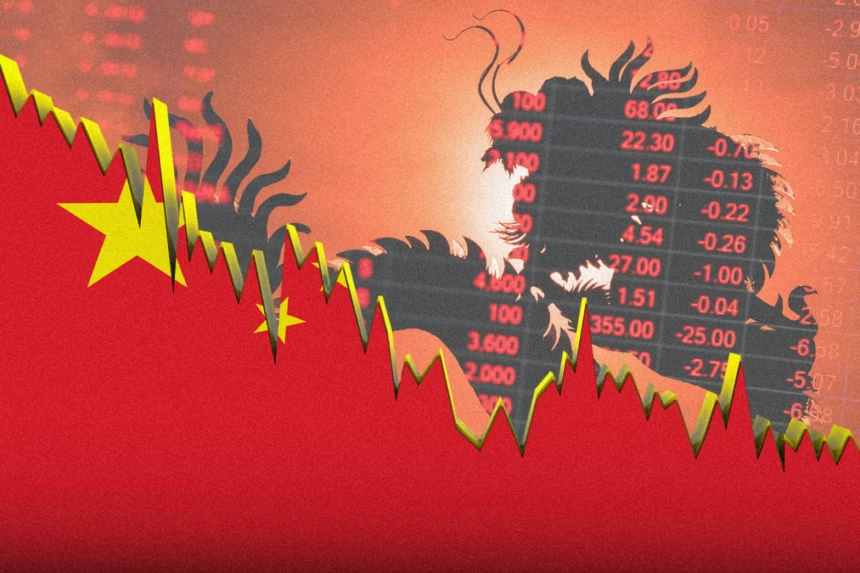
Today, many political and economic experts are applying this exact concept to modern China. They argue that the country has entered its own historical garbage time. The system keeps running, but the golden era of endless growth is completely over.
Key Takeaways
- Economic Slowdown: China’s rapid growth has ended, replaced by soaring youth unemployment and a massive real estate crisis.
- Population Decline: A shrinking workforce and falling birth rates are creating deep demographic problems for the nation’s future.
- Global Shifts: Rising political control is driving away foreign investment and causing widespread doubt among Chinese citizens.
The End of an Economic Miracle
For decades, the world watched China’s rise with a mix of awe and deep concern. Factories operated day and night, transforming small farm towns into massive modern cities. The country built high-speed rail networks that successfully reshaped global supply chains.
The ruling political party promised citizens a powerful national revival and widespread middle-class prosperity. They painted a picture of endless technological leadership and a strong global role. This optimistic story resonated deeply with citizens from the early 2000s to the 2010s.
However, that grand dream has dramatically changed over the past few years. Economic growth has slowed sharply, leaving millions of workers feeling deeply anxious. Many people now wonder if the best days are firmly in the past.
According to global financial reports, the current economic reality is becoming undeniably grim. The government continues to project confidence, but the underlying data tells a very different story. You can read more about these economic shifts in this Reuters analysis.
The Bursting Real Estate Bubble
Real estate once accounted for nearly thirty percent of China’s entire gross domestic product. Today, this massive sector has become a crushing burden on the national economy. Major property developers have defaulted on their massive, unsustainable financial debts.
Construction on countless housing projects has stalled completely, leaving unfinished towers empty. Ordinary homebuyers have lost their life savings, and consumer confidence has totally disappeared. This collapse has created severe financial pressure for millions of regular families.
Local governments previously relied heavily on land sales to fund their operating budgets. Without this crucial income stream, many cities now face hidden debts totaling trillions of dollars. This invisible debt crisis threatens to bankrupt municipal governments across the country.
To understand the scale of this property crisis, look at the collapse of major developers. Financial news outlets like Bloomberg have documented the widespread fallout of these defaults. The damage to the broader economy will likely take many years to fully repair.
High Youth Unemployment Rates
Finding a good job has become incredibly difficult for recent university graduates in China. Official data shows youth unemployment hovering between fifteen and twenty percent recently. However, many independent researchers believe the actual number could be much higher.
Young people face intense educational competition from a very early age. They study relentlessly for years, hoping to secure a stable and profitable career. Unfortunately, the current job market simply cannot absorb this massive influx of educated workers.
The technology and education sectors were once major sources of high-paying jobs. However, harsh government crackdowns on private businesses have destroyed countless career opportunities. This has left an entire generation feeling deeply frustrated and utterly hopeless.
Many young adults are now choosing a lifestyle known as “lying flat.” This movement involves rejecting the intense pressure of the modern Chinese workplace. They prefer to work minimum hours rather than participate in an exhausting system.
A Devastating Demographic Crisis
China is currently facing one of the most severe demographic challenges in modern human history. Birth rates have plummeted to historic lows despite government efforts to encourage larger families. The deeply rooted effects of the former one-child policy are finally taking their toll.
A rapidly shrinking workforce will soon have to support a massive retired population. This shift will place extreme financial pressure on the national pension and healthcare systems. The burden on single children to care for aging parents is becoming unmanageable.
The government has tried introducing new policies to promote childbearing and family growth. Sadly, these recent initiatives have produced very limited and disappointing results. High living costs and intense social pressure make raising children seem financially impossible.
Many young couples are simply choosing not to start families at all. They feel the economic environment is too unstable to properly raise a child. The South China Morning Post frequently reports on this growing demographic emergency.
The Flight of Wealth and Talent
When a nation enters a period of decline, the elites are usually the first to notice. Wealthy business owners and political insiders are quietly moving their assets out of China. They are seeking safe havens in Western democracies and other parts of Asia.
These wealthy individuals are buying overseas properties and securing foreign passports for their families. Sending their children abroad for education has become a top priority for the elite. This mass exodus of capital is a glaring sign of a deep legitimacy crisis.
Despite strict capital controls, money continues to flow out through various underground channels. This rapid wealth drain severely damages domestic investment and slows economic growth. Even government officials are displaying growing risk avoidance in their daily duties.
The loss of highly skilled professionals and top students is equally damaging. Brain drain deprives the country of the very talent needed to drive future innovation. A nation cannot thrive when its brightest minds are desperately trying to escape.
Shifting from Markets to State Control
The feedback mechanisms that once allowed the Chinese economy to adapt have seriously weakened. During the early reform era, practical economic solutions were heavily favored over strict ideology. Today, political loyalty has absolutely taken priority over professional expertise and market sense.
The government has become the primary allocator of capital through massive industrial subsidies. It heavily favors state-owned enterprises and directs lending to politically connected projects. Resources now flow toward political goals rather than actual consumer demand and market needs.
This aggressive intervention creates highly inefficient investments and dangerous financial asset bubbles. A system can temporarily hide these problems through rapid credit expansion and strong political control. Eventually, the harsh economic realities will break through the deceptive outward appearance.
When diminishing returns appear, the government typically responds by increasing its market intervention. It tightens control over private companies that become too independent or overly successful. This creates a vicious cycle that continually stifles private investment and vital innovation.
According to reports from The Financial Times, this heavy-handed approach scares away investors. Foreign companies are increasingly hesitant to pour money into such an unpredictable environment. The golden era of free-flowing foreign capital seems to be ending rapidly.
The Burden of Unnecessary Infrastructure
For many years, state-led infrastructure investment drove a massive portion of China’s economic growth. The country constructed incredible airports, endless highways, and sprawling new urban areas. These highly visible achievements became the center of global manufacturing and supply chains.
However, many of these colossal projects were funded by dangerous amounts of debt. They were driven by political goals and rigid GDP targets rather than true market demand. Government officials simply wanted to show growth, regardless of the actual financial cost.
The tragic result has been the creation of completely abandoned “ghost cities” nationwide. These are massive residential and commercial districts where almost nobody actually lives or works. They stand as silent monuments to inefficient planning and extreme resource waste.
Furthermore, this strategy has led to severe, long-term industrial overcapacity across many sectors. Factories are capable of producing far more goods than the world can actually consume. This overcapacity forces companies to slash prices, which drives down global profit margins.
Many local governments can no longer afford to maintain these massive infrastructure projects. The debt burden from these investments is quietly destroying local economies from the inside out.
The Failure of the Anti-Corruption Campaign
Several years ago, the government launched a massive anti-corruption campaign targeting senior officials. Initially, this sweeping movement gained widespread public support from everyday Chinese citizens. People were eager to see corrupt politicians, known as “tigers,” face actual justice.
Over time, however, the true nature of this political campaign became increasingly clear. It transformed into a powerful tool for removing political rivals and consolidating supreme power. The campaign successfully placed loyal allies into key strategic positions across the government.
While it may have reduced some local corruption, the campaign also created widespread fear. Today, the absolute safest strategy for any government official is to show unwavering loyalty. There is very little room left for administrative innovation or necessary risk-taking.
Officials are terrified of making mistakes that could be wrongly labeled as corruption. This paralyzing fear has led to severe bureaucratic stagnation at every level of government. Crucial decisions are endlessly delayed because nobody wants to take personal responsibility.
The New York Times has thoroughly documented the chilling effect of these political purges. The entire system has become rigid, defensive, and entirely unable to adapt to change.
Communism Versus Traditional Cultural Values
The ruling party often presents its leadership as a natural continuation of imperial tradition. By invoking ancient Confucian ideas, they try to claim historical legitimacy for their rule. They want citizens to believe the government has the authority to dictate daily life.
In reality, the Marxist communism that forms the government’s foundation directly opposes traditional thought. Ancient emperors believed they ruled by the “mandate of heaven” through caring for citizens. They understood that the public could easily overthrow a cruel or unjust ruler.
Confucian thought places the family at the very absolute center of morality and society. It views respect for elders as the true beginning of all personal virtue. The family is the essential basis of personal character and healthy social order.
Communist theory, however, takes the exact opposite view of human relationships and society. It places the state above the family and seeks to eliminate all private property. The system actively disrupts traditional family structures to ensure total loyalty to the government.
Critics argue that state-sponsored cultural programs completely misrepresent true Chinese heritage to the world. They use the ancient name of Chinese civilization while quietly undermining its core values.
Echoes of Falling Chinese Dynasties
At the end of the Ming and Qing dynasties, China experienced highly concentrated power. This was quickly followed by severe bureaucratic stagnation and devastating financial decline. Factional struggles and excessive military expansion eventually led to their ultimate historical collapse.
Many historians believe these exact patterns closely resemble the challenges facing the current government. In the past, dynasties collapsed after rulers violated fundamental moral principles and neglected citizens. Internal decay usually developed for many decades before a final, catastrophic breaking point.
Famine, popular uprisings, and external military pressure were usually just the final, visible triggers. The actual structural foundation of the society had already been rotting away for years. Today, similar signs of systemic decline are becoming increasingly impossible to ignore.
Intellectuals are losing confidence, and ordinary people are quietly responding through widespread passive resistance. The fragile balance that supported the government for decades has been severely weakened. Citizens traded political freedoms for economic prosperity, but that prosperity is now rapidly disappearing.
As detailed by major news organizations like The Wall Street Journal, public frustration is quietly mounting. Historical cycles in China suggest that highly centralized regimes eventually face unavoidable breaking points.
Growing International Isolation and Backlash
Internationally, China’s aggressive “wolf warrior” diplomacy has faced severe and highly damaging backlash. This hostile foreign policy approach has rapidly alienated many crucial trading partners worldwide. Western nations are now actively accelerating efforts to reduce their supply chain dependence.
This aggressive posturing has deeply damaged the country’s image among developing nations as well. It has directly contributed to the formation of powerful new regional balancing groups. Alliances like the Quad and AUKUS have formed specifically to counter this growing threat.
The popular domestic narrative claims that the East is rising while the West declines. However, this nationalistic story is becoming increasingly disconnected from actual global economic reality. The United States and its allies continue to hold massive leads in critical technology.
Meanwhile, neighboring countries are reaping the benefits of this rising geopolitical tension. Vietnam, India, and Mexico are quickly emerging as highly attractive alternative manufacturing destinations. Global corporations are desperately seeking ways to move their factories out of Chinese territory.
This ongoing supply chain shift is causing permanent damage to the domestic export economy. Once these massive factories relocate abroad, those high-paying manufacturing jobs rarely ever come back.
A New Ideological Global Conflict
The international community is increasingly viewing this situation through a strictly ideological lens. Global leaders are beginning to frame the conflict as a battle between freedom and control. Many politicians see authoritarian systems as a direct threat to basic human rights.
During a historic speech, former U.S. President Donald Trump described communism as a deadly threat. He labeled it the greatest danger the United States has faced since its founding. This strong rhetoric highlights the growing ideological divide between global superpowers today.
Future competition between democratic nations and authoritarian regimes will likely focus heavily on ideology. It is no longer just a simple battle over trade deficits and territorial claims. It has become a fundamental clash over how human societies should be properly governed.
Democratic nations are built on principles of natural rights, limited government, and religious freedom. They strongly defend private property, local governance, and the vital concept of popular sovereignty. Authoritarian regimes are viewed as actively rejecting these fundamental, universally desired human principles.
This deep ideological divide makes meaningful diplomatic cooperation increasingly difficult to achieve. Global tensions will likely remain incredibly high as this massive power struggle continues indefinitely.
The Daily Struggles of Ordinary Citizens
While politicians and elites play global power games, ordinary citizens suffer the real consequences. Migrant workers and small business owners are facing incredibly harsh economic realities today. They are dealing with falling wages, highly unstable jobs, and rapidly rising living costs.
For the average young person, merely starting a family has become financially impossible. The deeply held belief in upward social mobility has been completely replaced by insecurity. People feel that no matter how hard they work, they cannot get ahead.
The “lying flat” phenomenon is no longer viewed simply as a sign of laziness. It is widely recognized as a quiet, desperate form of withdrawal from an unfair system. The system demands absolute loyalty and endless effort while offering fewer and fewer rewards.
Every day, people are cutting back heavily on basic spending just to survive the month. This widespread reduction in consumer spending pushes the economy further into dangerous deflationary territory. Small businesses are closing their doors permanently because customers simply have no extra money.
The psychological toll on the working class is becoming a major, hidden social crisis. Mental health struggles are rising sharply as financial hope continues to slowly fade away.
Surviving the Era of Garbage Time
Many experts argue that this historical “garbage time” may easily last for several decades. Real-world examples clearly show that systemic decline can be incredibly slow and deeply painful. Totalitarian systems can survive for generations through strict social control and complete global isolation.
However, compared to past declining regimes, modern China possesses significantly greater economic resources. It has unmatched surveillance capabilities, immense nationalist mobilization power, and massive foreign exchange reserves. This means a long period of tightly controlled decline remains a very distinct possibility.
We will likely witness repeated financial crises followed by temporary, state-funded economic recoveries. Yet, every additional year the current system remains brings greater costs for ordinary society. These tragic costs include wasted human talent and irreversible damage to the natural environment.
There is also a rapidly growing risk of the government initiating external military conflicts. Leaders often use foreign wars to distract angry citizens from terrible domestic economic problems. This dangerous strategy threatens the peace and stability of the entire global community.
Ultimately, the end of this difficult period could eventually bring newfound freedom and relief. Until then, the world must carefully navigate this incredibly volatile and unpredictable transition phase.
FAQ: Visa Overstay in Thailand
What is the penalty for overstaying a visa in Thailand?
If you stay past your visa expiration date, you must pay a fine. The Thai immigration office charges 500 Thai Baht for every single day you overstay.
What is the maximum fine for a Thai visa overstay?
The fine is capped at a maximum of 20,000 Thai Baht. This maximum amount applies if you have overstayed for 40 days or more.
Will I be banned from entering Thailand if I overstay?
Yes, depending on how long you overstay. An overstay of more than 90 days results in a 1-year ban. Overstaying for more than 1 year leads to a 3-year ban. A 3-year overstay causes a 5-year ban, and 5 years brings a 10-year ban.
What happens if the police catch me before I surrender?
If authorities catch you before you voluntarily go to immigration, the penalties are much harsher. You will face immediate deportation and a minimum 5-year ban, even for a short overstay.
Trending China News:
China’s War on Porn: Does Blocking It Have Wider Consequences?
From Sightseeing to Living: A New Way to Experience China
China Forced To Admit Economic Hardship as Leadership Clashes Over a Cure