


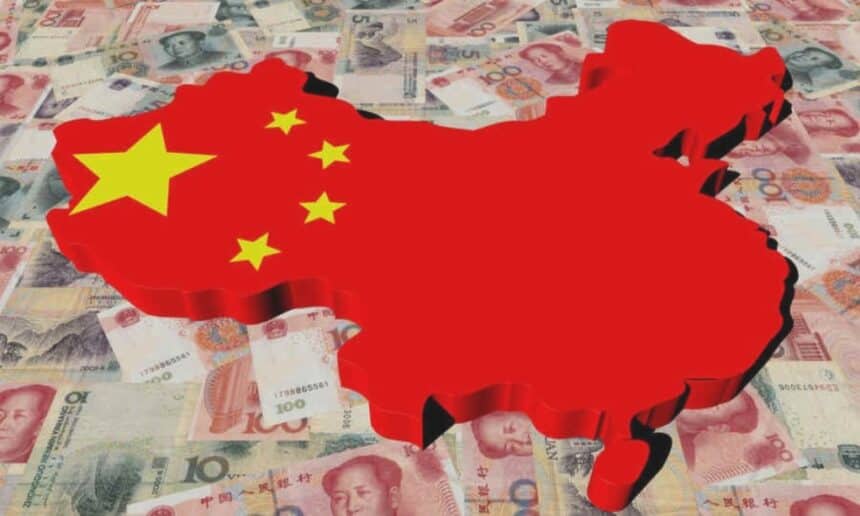
BEIJING — China’s central government is enforcing a massive 10 trillion yuan ($1.38 trillion) debt-swap rescue after decades of off-budget provincial borrowing collapsed under the weight of a prolonged real estate slump, forcing Chinese households to absorb the cost through depressed savings yields, thinner public services and tighter central control over regional economies.
According to an economic breakdown and fiscal data compiled by the International Monetary Fund, at least 12 of China’s 31 provincial-level regions now spend more than 100% of their annual tax revenue solely to service principal and interest payments. The restructuring shifts trillions of yuan in high-interest shadow loans onto Beijing’s official balance sheet, trading immediate local default risk for weaker domestic consumption and the loss of regional fiscal autonomy that powered four decades of rapid growth.
Key Takeaways
- Provincial debt service costs nearly tripled from 150 billion yuan in 2017 to over 400 billion yuan in 2025, consuming 60% of regional tax revenues on average and over 100% in 12 provinces.
- Beijing’s 10 trillion yuan bond-swap rescue lowers interest costs by moving hidden shell-company loans onto central books, but strips local governments of independent tax and subsidy powers.
- High household savings rates above 40% fund Beijing’s cheap 1.6% borrowing costs, trapping families in low-return state financial products and depressing consumer spending.
Anatomy of a Broken Balance Sheet
How much China actually owes depends on who counts the bills. Beijing officially acknowledges central government debt equal to roughly 30% of gross domestic product, a figure that climbs to about 60% when standard provincial bonds are included. When analysts at the International Monetary Fund factor in off-budget liabilities held by state-backed shell companies, total public debt surges past 120% of GDP — exceeding the United States’ public debt-to-GDP ratio. Combined across government, corporations and households, total debt in the Chinese economy surpasses 300% of annual output.
The real shock lies in the speed of the deterioration. A decade ago, nine Chinese provinces maintained debt loads below 25% of their regional economic output, a threshold economists generally view as manageable. Today, that number has fallen to zero. Twenty-two provinces now carry debt burdens exceeding half of their annual GDP, with several heavily indebted regions approaching the 100% mark.
Debt servicing has become an unbearable drain on daily governance. By the end of 2017, provincial authorities spent roughly 150 billion yuan a year on debt costs, taking about three out of every 10 yuan collected in local taxes. By 2025, annual debt-servicing outlays had nearly tripled to more than 400 billion yuan, consuming six out of every 10 tax yuan nationwide. In a dozen provinces, total debt payments exceed 100% of incoming tax revenue, leaving zero local funds for hospitals, public schools, road maintenance or civil servant salaries without emergency cash transfers from Beijing.
Investigative Context: The 1994 Tax Squeeze
Local officials did not engineer this financial trap purely out of recklessness. The structural fuse was lit in 1994, when Beijing overhauled its national tax-sharing system to reverse a steady decline in central revenue. Under the 1994 fiscal reform, the central government centralized tax collection and slashed the provincial share of national tax receipts from roughly 80% down to 45%. Yet Beijing left local governments responsible for funding more than 70% of day-to-day public expenditures, including health care, education and urban infrastructure.
At the same time, China’s 1994 Budget Law barred municipal and provincial governments from issuing bonds or borrowing directly from banks. Caught between rigid spending mandates and shrinking tax shares, local leaders exploited a legal loophole. They established thousands of state-owned corporations known as local government financing vehicles, or LGFVs. Municipalities transferred public land to these entities, which used the parcels as collateral to secure bank loans and issue corporate bonds for bridges, industrial parks and subway lines.
When the 2008 global financial crisis threatened Chinese exports, Beijing ordered a massive infrastructure stimulus that supercharged LGFV borrowing. State banks opened credit lines under political pressure, pushing local debt to 11 trillion yuan by late 2009 and 18 trillion yuan by 2013. For years, rising land prices masked the fragility of the model: cities sold land at higher valuations to pay off maturing loans. Once China’s property bubble burst and land sales dried up, the cash flow vanished, exposing a classic debt pyramid.
Beijing’s 10 Trillion Yuan Rescue
Confronted with the threat of widespread municipal defaults, President Xi Jinping’s administration rolled out a multi-year stabilization package anchored by a 10 trillion yuan debt-swap program approved by the National People’s Congress Standing Committee. The strategy follows two steps: forcing local authorities to bring hidden LGFV liabilities onto official ledgers, and allowing provinces to issue lower-yielding sovereign-backed bonds to refinance high-interest shadow debt.
The swap does not erase a single yuan of principal, nor does it magically generate new revenue. Instead, it exploits a stark gap in borrowing costs. LGFVs frequently paid punitive interest rates to roll over short-term commercial loans, whereas China’s central government borrows at ultra-low yields. While 10-year U.S. Treasuries yield near 5% and German bunds trade around 3.3%, 10-year Chinese government bonds yield roughly 1.6%.
By replacing expensive off-budget obligations with central-backed bonds, Beijing cuts annual interest expenses and buys time for strained regional budgets. Still, independent analysts note that capital spending has already slowed sharply across major economic hubs as local officials shift focus from building new projects to cleaning up old ledgers. In Guangdong, China’s wealthiest province, fixed-asset investment plunged more than 14% during the initial phase of the debt cleanup, signaling how aggressively Beijing’s oversight is curbing local spending.
The End of Provincial Competition
Rescuing the provinces comes with a steep political price: the end of local fiscal independence. For more than four decades following Deng Xiaoping’s market reforms, Beijing encouraged cities and provinces to compete fiercely for private investment, talent and industrial leadership. That decentralized rivalry helped incubate global corporate giants — including Huawei, Xiaomi, Alibaba and electric vehicle maker BYD — all of which began as local ventures nurtured by ambitious municipal governments.
Today, whoever pays the bills writes the rules. Because Beijing is underwriting provincial solvency, central planners now dictate local budgets line by line. Under central directives enacted since August 2024, provincial and municipal officials are strictly prohibited from offering unauthorized tax breaks, land discounts or targeted subsidies to lure businesses without explicit approval from Beijing.
Stripping away those local policy tools eliminates wasteful duplicate factories, a chronic problem in sectors ranging from solar panels to batteries. At the same time, centralizing economic decision-making risks dulling the entrepreneurial experimentation that drove China’s rise. Without fiscal breathing room, local officials have little incentive to back emerging startups or test market reforms, leaving national growth increasingly reliant on top-down industrial mandates from the capital.
Why Households Absorb the Shock
Beijing’s ability to borrow at 1.6% does not reflect pristine public balance sheets; it rests on the trapped savings of ordinary Chinese citizens. While the U.S. economy saves less than 20% of its annual output and Germany saves under 30%, China’s national savings rate exceeds 40%. Strict capital controls prevent Chinese families from moving their money freely into overseas stock markets such as the S&P 500.
For two decades, families parked their wealth in apartments. With home prices falling and real estate no longer viable as a store of value, savers have few alternatives beyond state-owned banks and government-linked wealth funds. Those institutions channel household deposits directly into low-yielding government bonds, effectively subsidizing Beijing’s debt bailout through minimal returns on personal savings — a mechanism economists describe as a stealth tax on families.
This financial structure collides directly with Beijing’s stated goal of boosting domestic consumption. If households suddenly withdrew their savings to spend in shops and restaurants, deposit bases would shrink, forcing interest rates higher and making Beijing’s debt-swap refinancing far more expensive. Conversely, if Beijing raises taxes or trims social safety nets to pay down the swapped debt, families feel poorer and cling even tighter to their cash.
Stalled Consumption and the Growth Dilemma
The fallout is visible across China’s consumer economy, creating a split between booming factories and hesitant shoppers. While Chinese automakers dominate global electric vehicle exports, domestic passenger car sales are forecast to drop 22% in 2026 after nearly a decade of stagnation. That slump persists even though China has only one-third as many motor vehicles per capita as developed economies such as Spain, underscoring that weak demand stems from caution rather than market saturation.
Holiday spending figures reinforce the chill. During China’s seven-day National Day Golden Week holiday in October, average spending per tourist trip dipped 1.9% year-on-year to roughly 894 yuan, the weakest reading since pandemic restrictions were in place in 2022. Domestic box office receipts over the same holiday totaled 1.16 billion yuan, a 36.6% drop from the prior year and the lowest level since 2014.
Standard economic stimulus packages struggle to gain traction under these conditions. When Beijing injects liquidity into the financial system, anxious households funnel extra yuan into bank deposits rather than retail stores — echoing the balance-sheet stagnation that trapped Japan’s economy after its 1990s asset crash. Until Beijing resolves how to fund public services without draining household wealth or stifling local initiative, China’s debt rescue will remain a delicate balancing act paid for by its own citizens.
Trending News:
China Cracks Down on Scam Centres in Myanmar
China Buybacks Stall as Beijing Courts APEC Leaders