



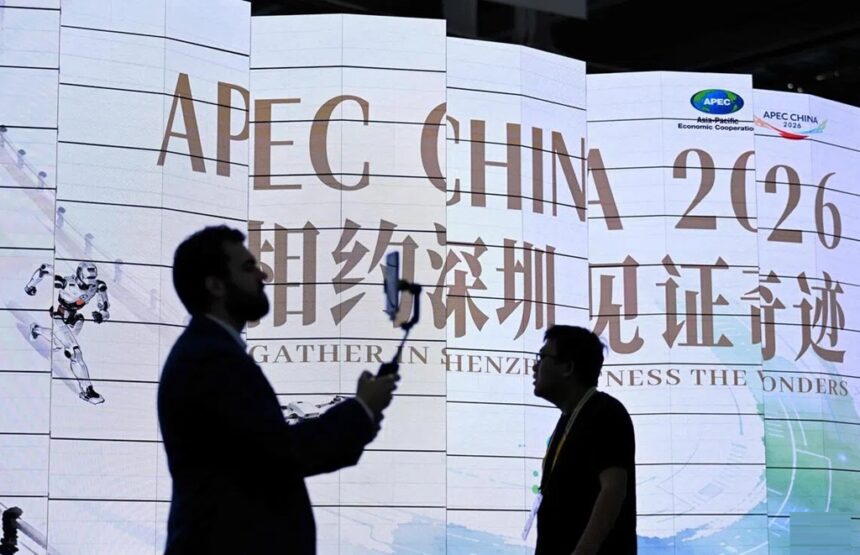
SHENZHEN, China — Chinese corporations have tapped less than 10% of the 200 billion yuan in cheap central bank financing requested by commercial lenders this month to buy back falling shares, exposing deep investor skepticism even as President Xi Jinping hosts world leaders at the Asia-Pacific Economic Cooperation summit in southern China.
The reluctance on mainland trading floors highlights a widening gap between Beijing’s aggressive monetary rescue tools and real-world corporate confidence. While Xi used the Shenzhen forum this week to sign fresh tariff relief with Canada and project economic stability alongside U.S. President Donald Trump and Russian President Vladimir Putin, mainland equities stagnated, crude oil stockpiling surged on falling global prices, and domestic fuel consumption remained sluggish.
Key Takeaways
- Stock market rescue stalls: Only 52 Chinese companies disclosed roughly 15 billion yuan ($1.9 billion) in share buyback deals through Nov. 16, representing under 10% of the 200 billion yuan banks sought from the People’s Bank of China.
- Crude stockpiling rebounds: China’s fourth-quarter oil imports are projected to reach 10.1 million barrels per day as refiners take advantage of a 20% monthly drop in Brent crude to rebuild reserves depleted during the Middle East conflict.
- Canada-China tariff thaw: Beijing agreed Tuesday to lift duties on roughly $280 million in Canadian pork and seafood exports, while Ottawa extended tariff exemptions on Chinese steel and aluminum for two years.
Cheap Central Bank Loans Fail to Ignite Equities
Mainland stock indexes barely budged during the first half of November despite extraordinary liquidity support from Beijing. The benchmark CSI 300 Index slipped 0.1% through Nov. 16 after a sharp sell-off in technology shares wiped out an early monthly rally, leaving the index reeling from a 14% drop across September and October.
To arrest the slide, financial regulators leaned heavily on a relending facility first introduced in 2024. Authorities cut the interest rate charged to commercial banks from 1.25% to 1%, removed the program’s original 300 billion yuan ceiling and made the lending channel permanent. Commercial banks responded by requesting more than 200 billion yuan from the People’s Bank of China this month alone.
Corporate treasurers moved far more cautiously. By Nov. 16, just 52 listed firms had disclosed buyback financing agreements totaling about 15 billion yuan, edging past the previous monthly record of 12.9 billion yuan. Even fewer companies executed actual market purchases, completing just 4.3 billion yuan in repurchases during the first 16 days of November compared with 17 billion yuan in all of October. While 97 firms announced new repurchase plans valued at a combined 16.9 billion yuan at the midpoint of their target ranges, equity strategists warned that liquidity alone cannot fix weak earnings.
Meng Lei, a China equity strategist at UBS Securities, said buybacks by themselves will not reverse market gloom without stronger fiscal stimulus from Beijing. A portfolio manager at GVAC Capital noted that broader corporate participation could eventually reassure nervous retail traders when valuations drop, though investors burned by repeated downturns remain on the sidelines amid weak consumer spending, sluggish industrial output and tighter U.S. restrictions on offshore computing power.
Refiners Accelerate Crude Stockpiling as Prices Drop
While equity investors hesitated, China’s state-backed and independent oil buyers moved aggressively to lock in cheaper energy supplies. Crude oil imports are recovering faster than analysts anticipated in the final months of 2026, fueled by a roughly 20% slide in Brent crude prices this month that made reserve replenishment substantially cheaper.
London-based consultancy Energy Aspects raised its fourth-quarter import forecast for China to 10.1 million barrels per day. That pace sits well above June’s trough of 7.15 million barrels per day, though it remains below China’s 2025 full-year average of 11.6 million barrels per day. The International Energy Agency expects global oil markets to swing back into surplus during the fourth quarter as Persian Gulf exports recover from wartime disruptions.
Storage tanks are absorbing much of the incoming volume. Energy Aspects estimates China added 13 million barrels to crude inventories in October and projects stockpiling to accelerate past 880,000 barrels per day in November before moderating to 650,000 barrels per day in December. Independent refiners are rushing to exhaust remaining annual import quotas before year-end, encouraged by stronger diesel profit margins and fresh government fuel export quotas.
Analysts project that full utilization of remaining quotas could boost refinery processing runs by roughly 1 million barrels per day across November and December. Buyers have stepped up spot purchases from the Persian Gulf alongside competitive cargoes from Brazil and West Africa, offsetting reduced Iranian shipments constrained by a U.S. naval blockade. Domestic road fuel demand remains soft, however, with Goldman Sachs estimating September gasoline and diesel consumption fell 700,000 barrels per day below year-earlier levels as electric vehicles capture market share.
Xi and Carney Strike Targeted Tariff Relief in Shenzhen
On the diplomatic front, Beijing sought to turn friction between Washington and its traditional allies into bilateral trade openings. Meeting on the sidelines of the Shenzhen summit on Tuesday, Xi and Canadian Prime Minister Mark Carney agreed to roll back targeted tariffs and expand commercial ties as Ottawa works to reduce its heavy reliance on the U.S. market.
Under the pact, Beijing will grant tariff relief covering approximately 400 million Canadian dollars ($280 million) in Canadian frozen pork, fish and seafood exports. In return, Ottawa agreed to extend existing tariff exemptions on Chinese steel and aluminum products for two years beyond their scheduled expiration at the end of 2026. Both governments also pledged to expand bilateral air routes, coordinate on narcotics enforcement and deepen cooperation across oil, natural gas, renewable power and nuclear energy.
The Shenzhen agreement builds on Carney’s January visit to Beijing, the first by a Canadian prime minister in nearly a decade, and supports Ottawa’s goal of boosting exports to China by 50% by 2030. Bilateral trade talks between Ottawa and Washington collapsed in August, triggering retaliatory duties on both sides even though the United States still absorbs roughly two-thirds of all Canadian goods and services exports.
Xi urged Canada to partner with Beijing on reforming global governance and framed China as a steady commercial anchor during global trade disputes. Michael Kovrig, a former Canadian diplomat detained in China for nearly three years during an earlier diplomatic rift, noted that Xi gains clear diplomatic leverage whenever a Group of Seven nation deepens economic ties with Beijing during a trade standoff with Washington.
High-Stakes Diplomacy Unfolds Amid Global Flashpoints
The bilateral deals took place against the backdrop of rare top-level choreography in Shenzhen. Xi opened the APEC leaders gathering by calling for freer trade, deeper regional economic integration and joint standards on artificial intelligence, cross-border data flows and supply chains.
During the official summit photograph, Trump and Putin flanked Xi and shook hands. Trump praised Beijing’s hospitality, noted he had spoken with Xi throughout the leaders’ dinner and looked ahead to formal discussions with both counterparts. Behind the cordial optics, sharp policy divisions persisted. Trump warned that heavy-handed global regulation could stifle artificial intelligence development, contrasting with Xi’s push for coordinated regional oversight. Japanese Prime Minister Sanae Takaichi also exchanged brief remarks with Xi amid strained Tokyo-Beijing relations before holding separate talks with Putin.
European and Asian diplomats watched the Shenzhen sidelines closely for any signs of U.S. concessions regarding Russia’s war in Ukraine or territorial tensions over Taiwan, the self-ruled island Beijing claims as its own.
IStructural Headwinds Behind Beijing’s Playbook
The divergence between Beijing’s headline-grabbing summitry and its muted stock market reflects deeper structural shifts inside China’s economy that monetary engineering alone cannot resolve. When the People’s Bank of China rolled out its swap and buyback relending facilities in late 2024, policymakers hoped low-interest credit would trigger a self-sustaining rally similar to state-backed interventions in 2015. Two years later, listed private firms remain hesitant to take on debt simply to prop up share prices when domestic household demand is weak and export margins face tariff pressure.
Historical precedent shows that Chinese equity rallies fueled solely by central bank liquidity tend to fade unless accompanied by direct fiscal transfers to households or clear regulatory stability for private technology firms. Because corporate boards must still repay relending loans even if their share prices fall further, many executives prefer holding cash reserves rather than levering up balance sheets in an uncertain earnings environment.
The same structural transition is reshaping global energy markets. For two decades, any rebound in Chinese crude imports signaled accelerating factory output and highway freight demand. In late 2026, however, rapid electrification of China’s passenger car fleet and heavy-duty trucking sector has permanently eroded domestic gasoline and diesel growth. Refiners are no longer buying crude primarily to fuel domestic commuters; instead, Beijing is using state storage infrastructure as a counter-cyclical buffer—buying aggressively when Middle East supply recoveries depress Brent prices, and throttling back purchases whenever global benchmarks climb.
For middle powers like Canada, China’s shifting economic model presents both opportunity and constraint. While tariff relief on $280 million in seafood and pork offers immediate relief to Canadian agricultural producers hit by U.S. trade friction, China’s total market cannot replace the integrated North American supply chain that absorbs the vast majority of Canadian manufacturing and energy output. As the Shenzhen summit demonstrated, Beijing can offer tactical tariff concessions and diplomatic visibility, yet its domestic market remains constrained by the very consumer caution keeping mainland investors on the sidelines.