
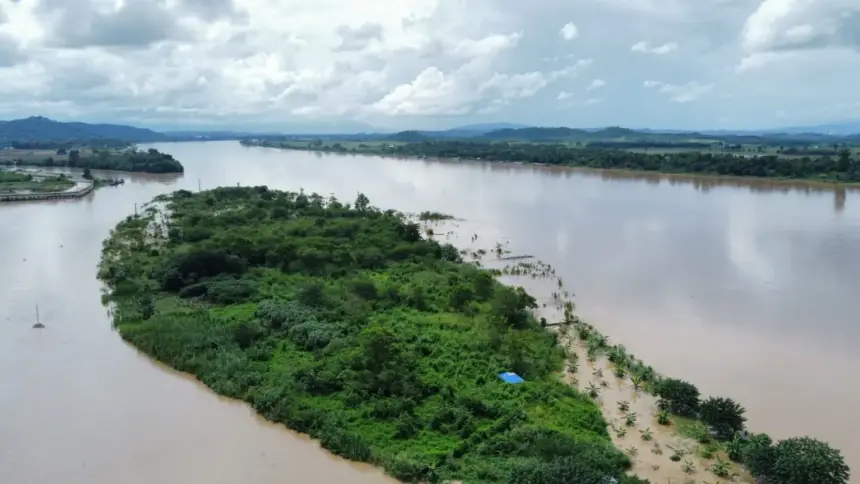
CHIANG RAI— Thai security forces and local administrators raided a disputed sandbar island in the Mekong River on Friday afternoon, confronting Lao nationals who had cleared land for crops and built temporary shelters in violation of a bilateral border treaty.
The joint operation took place at 2 p.m. on Nov. 27 at Don Mahawan island, opposite Ban Don Mahawan village in Chiang Rai province’s Wiang subdistrict. Under directives from Chiang Khong District Chief Surachet Puinoi, officials intervened after intelligence reports confirmed unauthorized farming on the emerging landmass, which remains off-limits to citizens of both nations under rules set by the Thai-Lao Joint Boundary Commission. Thai officers issued formal warnings to the farmers, securing compliance without confrontation.
Key Takeaways
- Thai administrative, naval and paramilitary units inspected Don Mahawan island on Nov. 27 after reports of treaty violations.
- Inspectors found Lao citizens cultivating field crops, kitchen gardens and agricultural produce alongside makeshift structures.
- Bilateral rules assign newly formed Mekong sandbars to the nearest state for stewardship while banning civilian economic use by either side.
Joint Task Force Deploys to River Border
Senior District Clerk Udom Chankiti ordered security chief Wasana Patchaiyaphum and deputy security clerk Danaiwat Srimuang to lead the riverine patrol. The task force combined Territorial Defense Volunteer Company 7 personnel with sailors from the Chiang Khong Station of the Mekong Riverine Unit, Ranger Company 3101 troops and provincial security officers from Chiang Rai.
Patrol boats landed on Don Mahawan island and documented active agricultural plots carved into the alluvial soil. Inspectors found rows of cash crops, household vegetable gardens and temporary shelters erected by residents from Laos. Rather than seizing equipment or detaining workers, Thai officials briefed the cultivators on the legal status of the river channel and instructed them to respect cross-border protocols. District authorities reported that the engagement concluded peacefully.
Shifting Sandbars and Treaty Friction
The dispute highlights a recurring geopolitical vulnerability along the 1,845-kilometer Laos-Thailand border, more than half of which follows the shifting course of the Mekong River. While colonial-era Franco-Siamese treaties anchored the frontier to the river’s deepest navigable channel, seasonal water fluctuations constantly reshape sandbars and create new islets.
To prevent territorial flashpoints, minutes from the Thai-Lao Joint Boundary Commission stipulate that any newly formed island falls under the administrative care of the nearest country. Crucially, the accord prohibits citizens from both Thailand and Laos from farming, settling or exploiting natural resources on these neutral zones until formal demarcation is finalized.
Upstream hydropower operations have complicated those rules in recent years. Unpredictable water releases from cascading dams in China and Laos have altered natural flood cycles and trapped river sediment, exposing fertile riverbanks and sandbars for longer stretches of the dry season, according to environmental monitoring by the Mekong Dam Monitor. For border communities facing shrinking fisheries and erratic river levels, newly exposed alluvial land offers tempting, nutrient-rich ground for quick dry-season harvests.
In Chiang Khong, where riverside villages rely heavily on cross-border trade and river transport near the Fourth Thai-Lao Friendship Bridge, unchecked land grabs on mid-river islets risk sparking local disputes over fishing rights and riverbank erosion. District officials said regular joint patrols will continue along the Wiang subdistrict shoreline to deter repeat encroachments and preserve stability along the northern frontier.