
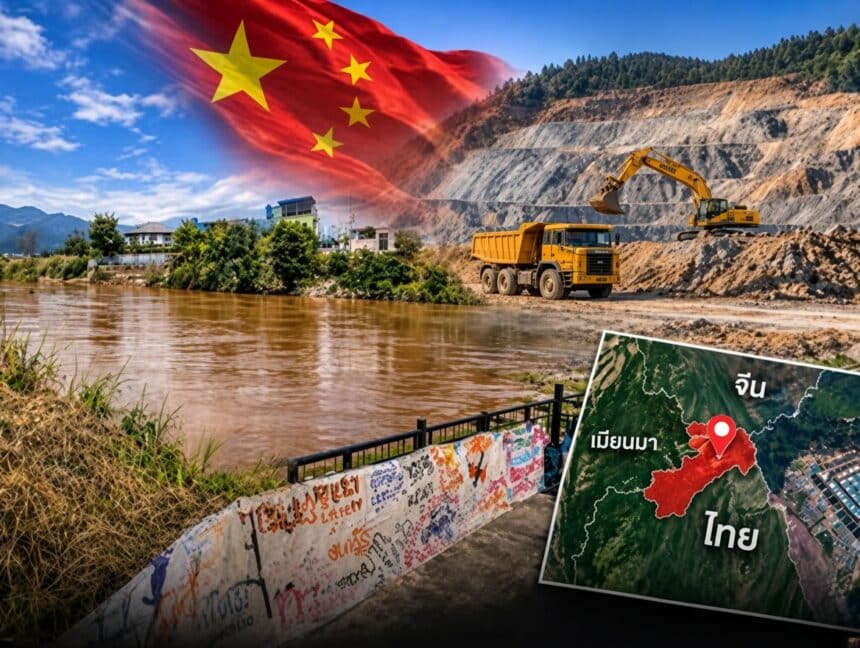
CHIANG RAI — River protection advocates in northern Thailand are demanding that Beijing halt mineral purchases from unregulated mines in Myanmar and finance up to two decades of environmental cleanup across Chiang Rai province.
Ahead of a border inspection scheduled for Sunday, Nov. 29, local networks urged Deputy Prime Minister and Foreign Minister Sihasak Phuangketkeow to view the upstream mining zones across the Mae Fah Luang frontier and secure long-term compensation through the Lancang-Mekong Cooperation framework.
The push follows months of alarm over toxic heavy metals washing down the Kok, Sai and Ruak rivers from Myanmar’s eastern Shan State into Thai farmland and waterways. Growing public fear over arsenic contamination has already triggered tour and hotel cancellations across Chiang Rai during the peak cool-season travel window, threatening livelihoods in a province dependent on nature tourism and irrigated agriculture.
Key Takeaways• River coalitions want China to stop buying rare earths and gold from polluting mines in Myanmar’s Shan State and fund 10 to 20 years of ecological relief in Chiang Rai. • Advocates asked Foreign Minister Sihasak Phuangketkeow to inspect border hills opposite Mae Fah Luang district on Nov. 29 as bilateral working group talks unfold. • Arsenic alerts in northern rivers have prompted tourists to cancel or delay Chiang Rai hotel bookings despite assurances that treated tap water meets safety standards. |
Border Inspection Demands and Mekong-Lancang Funding
Community leaders and watershed networks along the Kok and Sai basins say recent diplomatic agreements between Bangkok and Naypyidaw stop short of holding polluters financially accountable. In letters submitted ahead of the Nov. 29 field visit, campaigners urged Sihasak to visit border vantage points opposite Ban Mong Kao Lang, Ban Mong Paet Lang and Ban Phaya Phrai in Mae Fah Luang district, where hillside excavation scars across the Myanmar frontier are visible from Thai soil.
Advocates argue that diplomatic pledges mean little without supply-chain penalties. Because Chinese refiners and manufacturers serve as the primary buyers of critical minerals extracted in northeastern Myanmar, river coalitions want Beijing to suspend mineral imports from non-compliant sites. They also called on Thai diplomats to seek a 10- to 20-year remediation fund under the Beijing-backed Lancang-Mekong Cooperation mechanism to pay for riverbed dredging, health screening and agricultural soil recovery.
Thai officials have begun pressing Beijing and Naypyidaw for action. During talks in Bangkok earlier this week, Thai negotiators proposed a six-month suspension of upstream mining operations and urged Chinese delegates to adopt mineral traceability rules verifying whether imported rare earths come from regulated sites.
Upstream Extraction and Cross-Border Watershed Risks
The crisis stems from a rapid expansion of unregulated gold and rare-earth mining inside Myanmar’s autonomous and conflict-affected pockets of Shan State since 2021. Unlike conventional pit mining, in-situ leaching for rare-earth elements relies on injecting ammonium sulfate and other chemical solutions directly into hillsides, stripping vegetation and flushing heavy metals into mountain tributaries whenever seasonal rains hit.
Tests conducted by Thailand’s Pollution Control Department across 26 rounds of sampling detected arsenic concentrations exceeding national safety limits in nearly a third of surface water samples and 82% of riverbed sediment samples along the Kok and Sai rivers. Researchers using chemical fingerprinting found that roughly 39% to 50% of excess arsenic in the Kok River carries signatures tied to rare-earth extraction, while the remainder aligns with gold and sulfide-ore processing. More than 2,400 unregulated mines across mainland Southeast Asia pose similar chemical hazards, according to research cited from the Washington-based Stimson Center.
Geography compounds the risk for northern Thailand. The Kok River originates in Shan State and winds more than 150 kilometers through Chiang Rai before emptying into the Mekong River, feeding paddy fields and village water systems along the way. While the Provincial Waterworks Authority supplies treated tap water to roughly 82,000 households in Chiang Rai, over 400,000 other households rely on independent community waterworks and shallow wells lacking heavy-metal filtration.
Tourism Cancellations Hit Chiang Rai Businesses
Environmental anxieties are spilling directly into Chiang Rai’s local economy. Hotel operators and tour agencies report an uptick in cancelled trips and delayed reservations as travelers question water safety in riverside resorts and eco-tourism hubs.
Suwanna Pinsuwan, secretary of the Chiang Rai Hotel Association, said member properties have recorded immediate room cancellations alongside more than 100 pending room blocks put on hold by hesitant tour groups. Municipal water officials insist treated tap water remains within safety thresholds, yet Suwanna warned that public assurances fail to calm visitors while natural rivers remain visibly turbid and advisories warn against eating local river fish.
Bangkok plans to designate over 150 kilometers of the Kok River as a formal pollution-control zone starting Dec. 2 while drilling deep groundwater wells for 14 border villages. Until upstream discharges stop at their source, Chiang Rai’s farmers and tourism operators face a prolonged test of survival.