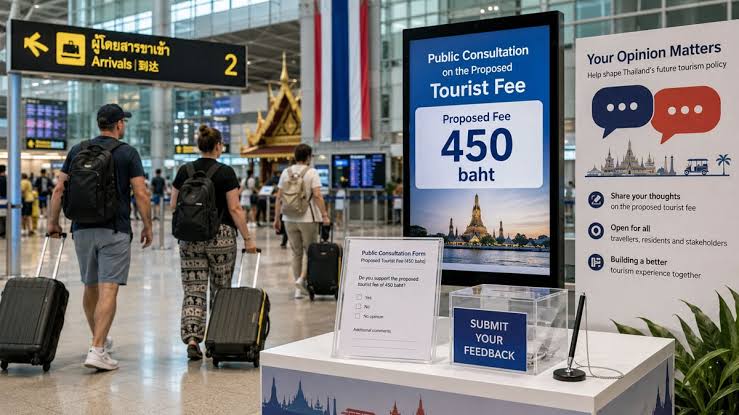
BANGKOK – Thailand’s proposed 450-baht ($13.50) tourist entry fee will likely not take effect until at least June or July 2027, missing the government’s earlier first-quarter target after officials pushed back the rollout to finalize rules and payment technology. The charge is not yet an active border requirement, meaning international travelers entering Thailand face no new entry levy today.
The Ministry of Tourism and Sports confirmed the revised timeline ahead of Thursday’s Nov. 12 review by the National Tourism Policy Committee, chaired by Deputy Prime Minister Suphajee Suthumpun. Even if the committee and the Cabinet sign off this month, Thai law mandates a 180-day transition period after publication in the Royal Gazette before border collection can legally begin.
Key Takeaways• No Immediate Fee: The 450-baht charge remains a draft proposal; travelers do not pay it now, and collection cannot start before June or July 2027. • Air Arrivals First: Aviation passengers will pay during Phase 1, while land and sea border crossings face a separate rollout roughly one year later. • Core Exemptions Drafted: Foreigners holding valid Thai work permits, transit passengers, diplomatic staff and children under age 2 are slated for exemption. |
Permanent Secretary for Tourism and Sports Natthriya Thaweewong said officials are still refining exemption rules and verification systems following Thursday’s committee deliberations. Under the current draft, six groups are scheduled to skip the fee: foreign nationals holding valid Thai work permits, transit passengers, diplomatic and official passport holders, border-pass holders, airline crew members and children under age 2.
Frequent business flyers and expats living in Thailand without work permits—such as retirees or long-stay visa holders—remain a sensitive gray area. Legal analysts at G.A.M. Legal Alliance note that while work-permit holders are explicitly shielded because they pay local taxes and social security, other long-term residents must watch the final Cabinet text closely. Meanwhile, transit travelers qualify only if they remain airside without clearing Thai immigration.
How Airlines and Border Checkpoints Would Collect It
Technical bottlenecks remain the biggest hurdle. Tourism operators warned officials that collecting cash at Suvarnabhumi or Phuket airports would trigger severe immigration bottlenecks. To prevent queues, the ministry favors bundling the 450-baht charge directly into international airline ticket prices during Phase 1, alongside backup options via a dedicated mobile app, web portal or airport kiosks.
Integrating the charge into global airline ticketing systems presents a major coding challenge: carriers must automatically separate exempt Thai citizens, work-permit holders and transit flyers from paying tourists at checkout. Land and sea arrivals—including cross-border traffic from Malaysia and Laos—are delayed by roughly another 360 days after the aviation launch.
Years of Delays and Rising Travel Costs
Thailand’s entry levy has stalled repeatedly since 2023, evolving from an earlier 300-baht air and 150-baht land model into today’s flat 450-baht plan. As The Bangkok Guide documents, successive administrations shelved the tax to avoid deterring price-sensitive visitors during post-pandemic recovery, even as the ministry estimates the levy would raise 8 billion baht annually for site restoration and emergency visitor insurance.
This delay also arrives amid broader pressure on Thailand’s regional price competitiveness. Earlier in 2026, aviation regulators raised the International Passenger Service Charge from 730 baht to 1,120 baht, while the Finance Ministry recently paused a separate 1,000-baht outbound departure tax.
Hotel associations have backed the 450-baht entry fee only on condition that the government audits hospital insurance payouts transparently rather than letting funds vanish into general budgets.