
CHIANG RAI – State planners have drafted a five-year strategy to rebuild northern Thailand’s premier border province into a climate-resilient tourism hub, setting the stage for a $10 million international funding bid.
The Designated Areas for Sustainable Tourism Administration (DASTA) finalized the 2028–2032 master plan this week to anchor Chiang Rai’s visitor economy in local identity and natural landscape protection. If approved by provincial leaders, DASTA’s board, the National Tourism Policy Committee and the Thai Cabinet, the blueprint will unlock proposed backing from the U.N. Industrial Development Organization (UNIDO) to turn the province into a national model for climate adaptation.
Key Takeaways
• DASTA’s 2028–2032 plan aims to protect Chiang Rai’s tourism sector against extreme weather by tying growth to local heritage and ecosystems.
• UNIDO is reviewing a $10 million Adaptation Fund initiative to establish Chiang Rai as Thailand’s pilot climate-ready tourism province.
• The draft requires four sequential approvals—from provincial authorities, the DASTA board, the National Tourism Policy Committee and the Cabinet—before rollout.
Four-Step Approval Path and U.N. Backing
DASTA officials designed the framework to replace mass-volume travel with low-carbon, community-led experiences. Under the proposal filed with the Adaptation Fund, UNIDO would act as the implementing agency alongside DASTA, the Ministry of Tourism and Sports, and Thailand’s Geo-Informatics and Space Technology Development Agency.
The draft faces a four-tier bureaucratic climb before money flows to local operators. Provincial governors and local stakeholders in Chiang Rai must sign off first, clearing the path for DASTA’s executive board. From there, the plan goes to the National Tourism Policy Committee before reaching the Cabinet for final endorsement ahead of the 2028 budget cycle.
Parallel research initiatives are already laying the groundwork across the province. In September, Thailand’s Office of the National Higher Education, Science, Research and Innovation Policy Council partnered with DASTA to designate Chiang Rai as a regenerative tourism “Living Lab,” focusing on workforce training, academic research and data-driven ecosystem management.
Upstream Floods and River Contamination Force a Pivot
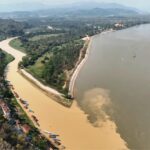
The push for climate-hardened infrastructure follows severe environmental shocks across Chiang Rai’s river basins. In late 2024, the province suffered its worst flooding in 80 years, when repeated torrential rains overwhelmed the Sai and Kok rivers, submerging border markets in Mae Sai and cutting road links to major cultural landmarks.
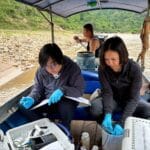
Those floods exposed deep vulnerabilities in Chiang Rai’s cross-border geography. Heavy runoff from deforested highlands and suspected upstream mining across the Myanmar border choked the Sai and Kok rivers with sediment and heavy metals. Even after floodwaters receded, murky water and contamination fears lingered into 2025 and 2026, disrupting riverside homestays, local fisheries and tap water supplies in Mae Sai.
Local tourism operators say erratic weather now threatens both peak-season bookings and rural livelihoods. While international arrivals across Thailand have faced broader economic headwinds in 2026, Chiang Rai’s highland villages, coffee estates and eco-resorts depend on predictable dry seasons and healthy watersheds to draw high-spending travelers.
Protecting Livelihoods Through Landscape-First Tourism
Rather than relying on concrete floodwalls alone, DASTA’s 2028–2032 blueprint treats forest restoration, watershed monitoring and indigenous Lanna heritage as core economic assets. Planned investments include climate-resilient supply chains for community-based tourism operators, early-warning flood alerts using satellite data and green building certifications for local hotels and restaurants.
The strategy also targets rural diversification. By linking highland agricultural cooperatives directly with boutique lodges and culinary tours, planners aim to keep tourism revenue inside villages vulnerable to crop loss and extreme heat.
If the Cabinet approves the draft and UNIDO finalizes the grant, Chiang Rai will serve as a testing ground for provinces across the Mekong subregion. For local communities still recovering from back-to-back monsoon disasters, the plan offers a long-term lifeline: turning environmental survival into the province’s main draw.