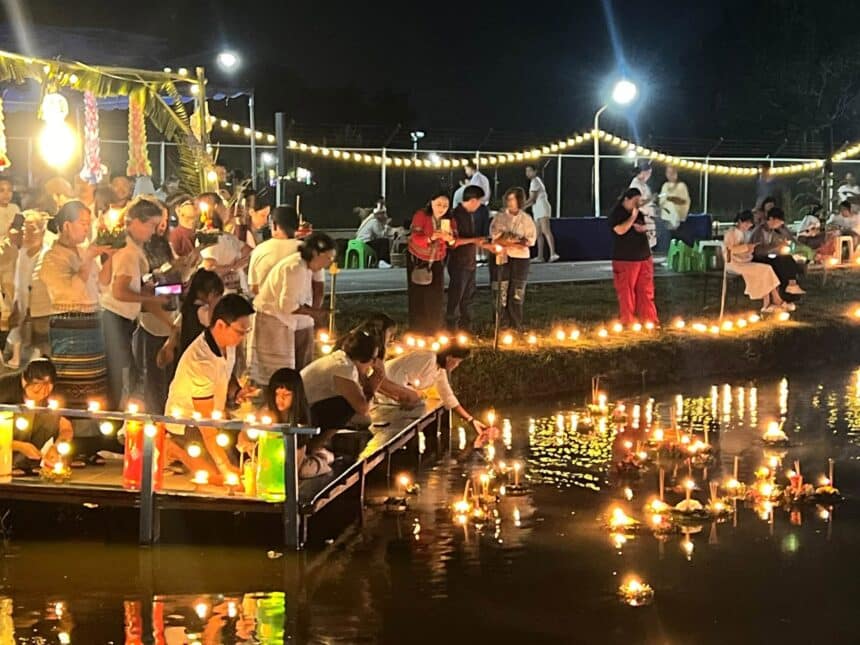
CHIANG RAI — Hundreds of residents and tourists gathered at Bueng Thap Fah pond on Monday night as the Royal Thai Air Force opened its Chiang Rai base to celebrate the northern Yi Peng lantern festival.
Hosted by Wing 416, the “Light of Lanterns, Sustaining Faith” event turned the military-managed park into an open religious and cultural hub. The evening combined Buddhist merit-making with community recreation, strengthening ties between air force personnel and local families.
Key Takeaways• Wing 416 opened Bueng Thap Fah pond in Chiang Rai on Nov. 23 for the public Yi Peng festival, drawing local families and tourists. • Maj. Gen. Jakkawee Saneeworayut and Group Capt. Pramote Kuikaew led Buddhist ceremonies, candle lighting, and krathong floating alongside city officials. • The celebration highlights the air force’s push to turn the former airport grounds into an accessible public park and youth playground. |
Lanterns and Merit-Making Along the Water
Maj. Gen. Jakkawee Saneeworayut, commander of the 37th Military Circle, presided over the opening ceremony. He was joined by Wing 416 Commander Group Capt. Pramote Kuikaew, Chiang Rai Deputy Mayor Bang-on Malidin, civic group members, government representatives, and neighborhood leaders.
As dusk settled, visitors lined the banks of Bueng Thap Fah to light small clay oil lamps known as phang prathip. In Lanna tradition, the flickering flames pay homage to the Buddha and symbolize light guiding life away from darkness. Families also floated decorated krathong baskets on the pond, took part in Buddhist chanting, and offered flowers, incense, and candles to monks. Live garden music and local food stalls kept the grounds lively well into the night.
Group Capt. Pramote said the squadron opened the base so residents could preserve Lanna heritage close to home. The event ran alongside broader Chiang Rai Yi Peng festivities taking place across the province between Nov. 23 and Nov. 25, giving urban residents a quieter, family-oriented alternative to major riverfront crowds.
From Cold War Airstrip to Urban Green Space
The festival reflects a broader transformation of the old Chiang Rai airbase. Built in 1926, the facility served as Chiang Rai’s primary commercial and military airfield until commercial flights shifted to Mae Fah Luang International Airport in the late 1990s. Today, Wing 416 operates as an independent field detachment under Wing 41 in Chiang Mai, maintaining the 1,690-meter runway for humanitarian aid, disaster relief, and border security missions.
Because the compound sits in the heart of Mueang Chiang Rai district, rapid urban growth has turned its open acreage into vital civic breathing room. Over the past decade, the air force has steadily converted parts of the perimeter around Bueng Thap Fah into a public exercise zone, trade fair venue, and flood-retention basin. In August 2026, Wing 416 expanded that footprint by opening the Bueng Thap Fah Playground, a community-funded play space built through local charity runs and public donations.
Building Long-Term Community Ties
Group Capt. Pramote emphasized that cultural festivals and daily recreation go hand in hand. Air force planners want Bueng Thap Fah to function year-round as a safe space where residents exercise, parents bring children to the new playground, and youth join creative activities.
Seeing steady crowds use the park gives the squadron momentum to keep upgrading the grounds, Pramote noted. During seasonal flooding and regional emergencies, the base also serves as a rapid-response staging hub for provincial relief teams.
By pairing Lanna religious traditions with open public access, Wing 416 is positioning its historic airfield not as a closed military installation, but as an everyday anchor for Chiang Rai’s neighborhoods.