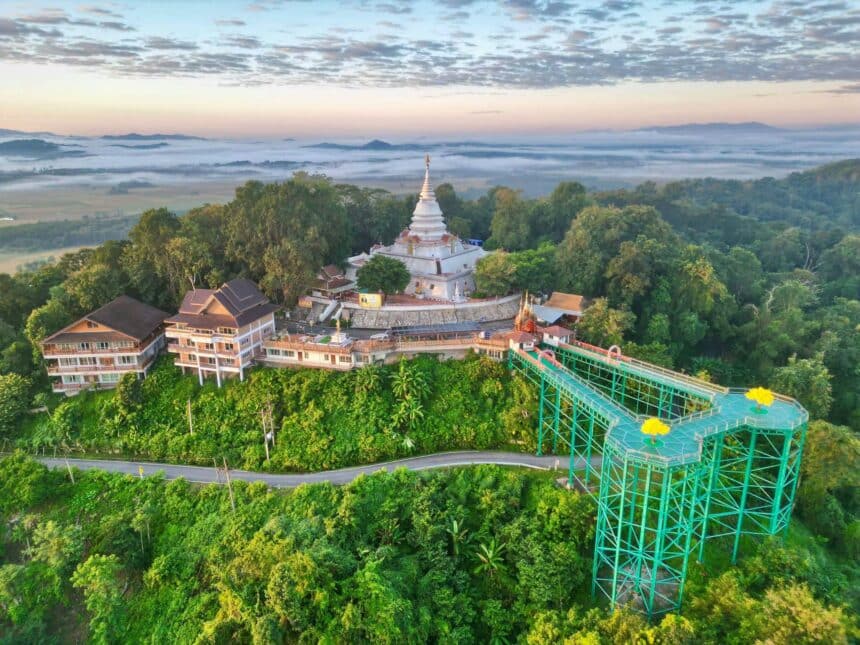
CHIANG RAI – A rocky hill above the Mekong River gives Wat Phra That Pha Ngao a striking setting, while its past draws visitors interested in how history and local tradition meet. The temple is in Ban Sop Kham, Chiang Saen District, Chiang Rai Province, not in Chiang Rai city.
Its precise beginnings remain uncertain, but a reported Buddha image discovery in 1976 helped shape the temple’s modern identity. As you explore Wat Phra That Pha Ngao’s history and origins, the account separates documented details from stories passed down locally, beginning with what the evidence can tell us.
Key Takeaways
- Wat Phra That Pha Ngao stands in Ban Sop Kham, Chiang Saen District, above the Mekong River, and its exact early history remains uncertain.
- In 1976, temple reconstruction led to the discovery of Luangpho Pha Ngao, an ancient Buddha image estimated to be 700 to 1,300 years old, according to Thailand’s tourism authority.
- The temple’s name also refers to a small bell-shaped pagoda set on a large boulder, a distinctive feature of the site.
- The rediscovery helped define the temple’s modern identity, while local stories and historical evidence offer different kinds of insight into its past.
- For a closer look at the present-day grounds, see this Wat Phra That Pha Ngao Skywalk visitor guide.
The History of Wat Phra That Pha Ngao in Chiang Rai
Wat Phra That Pha Ngao stands in Ban Sop Kham, in Chiang Saen District, where the Mekong has shaped local settlement and trade for centuries. The surrounding area has a long Buddhist history, with remains of the Lanna-era city still visible in Chiang Saen. Yet the temple’s own early timeline is less certain: no confirmed founding date establishes when people first worshiped at this site.
An old sacred site with an uncertain beginning
The temple is often associated with an older, abandoned complex called Wat Sop Kham. Thailand’s tourism authority describes Wat Phra That Pha Ngao as having been known by that name and notes that flooding caused substantial damage. Local accounts also connect the present temple with the remains of this earlier site, though details about its age and history vary.
That uncertainty matters. The wider Chiang Saen area has well-known historical and archaeological remains, but they don’t provide a precise date for Wat Phra That Pha Ngao’s founding. The temple’s setting belongs to a region shaped by Buddhist kingdoms and Mekong trade, while its earliest years remain a matter of local history rather than a firmly documented chronology. Visitors exploring the historic city and temples of Chiang Saen can see how the temple fits into that broader regional past.
A clearer modern milestone came in 1976, when reconstruction work led to the discovery of Luangpho Pha Ngao, an ancient Buddha image. The find brought fresh attention to the site and helped establish its present identity. It offers physical evidence of Buddhist worship at the location, although it does not prove exactly when the temple began.
What local tradition says about the temple’s name
The name “Pha Ngao” is commonly explained through a feature of the temple grounds: a small pagoda on a large rocky outcrop. In one local account, the rock casts a shadow that resembles another rock or pagoda. The name is therefore associated with a “rock shadow,” an explanation also recorded in a Chiang Saen travel account.
Some versions describe the image as a reflection rather than a shadow. Both explanations tie the name to the distinctive rock formation, but they belong to local tradition, not a documented account of the temple’s founding. The story helps explain how residents understand “Pha Ngao”; it can’t settle the site’s uncertain early chronology.
The discoveries that brought the temple back to life
By the late 20th century, restoration work had renewed attention to the old temple site at Ban Sop Kham. As people examined its religious structures, a reported Buddha image discovery gave the temple a new focus and helped shape the place visitors know today.
The restoration and excavation of the old temple site
Accounts of the temple’s revival connect reconstruction work in 1976 with the discovery of a sandstone Buddha image. The find drew attention to the site’s older religious remains and gave local worshippers a focal image associated with the temple’s renewed life. However, published accounts don’t always describe the discovery in the same way, and the image’s age is an estimate rather than a confirmed date.
The Tourism Authority of Thailand’s account of Wat Phra That Pha Ngao places the excavation in 1976 and describes the Buddha as presumably 700 to 1,300 years old. That broad range signals the limits of what can be established from the reports. The discovery supports the view that the site has a long Buddhist past, but it doesn’t pinpoint when the temple was founded or prove a precise origin for the image.
Why the sandstone Buddha became known as Luang Pho Pha Ngao
The image became known as Luang Pho Pha Ngao, a name that ties the revered Buddha to the temple and its distinctive setting. “Pha Ngao” is also associated with the rocky outcrop and pagoda on the grounds, linking the image’s name with a feature familiar to worshippers and visitors. The name reflects the temple’s local identity, though it doesn’t establish when or where the Buddha was made.
For worshippers, Luang Pho Pha Ngao is more than an archaeological find. The image is a focus of devotion and a central part of the temple’s modern story. Its discovery helped bring the site back into public attention, while continued worship gives it meaning in daily religious life. Reports describe the statue as sandstone and offer a wide age estimate, but those details should remain separate from local traditions about the temple’s origins. The strongest account is careful: the image was reportedly found during restoration in 1976, became closely associated with the temple, and helped define Wat Phra That Pha Ngao’s identity.
How the chedi and hilltop setting shape the temple’s story
At Wat Phra That Pha Ngao, the chedi and rocky hill make the temple’s religious purpose part of the landscape. Together with the Mekong views, they help explain why the site matters to worshippers as well as visitors.
The chedi and the meaning of Phra That
In Thai Buddhist usage, “Phra That” refers to a sacred relic or the shrine associated with one. The name alone doesn’t confirm that a relic is housed here. At Wat Phra That Pha Ngao, the chedi is a place for prayer and offerings, giving worshippers a visible focus for devotion.
The small, bell-shaped chedi sits on a large rock, a distinctive arrangement that also informs the temple’s name. Thailand’s tourism authority describes the bell-shaped stupa on its stone base and notes that a nearby chapel houses Chiang Saen-style Buddha images. These features connect the temple’s sacred role with regional forms of Buddhist art.
The chedi and rock are central to the site’s identity, while the temple has also changed through restoration and later additions. The 1976 reconstruction and reported Buddha-image discovery belong to its modern history; they don’t establish the age of the chedi or the temple’s founding. Keeping those timelines separate helps distinguish the site’s visible religious features from what is known about its past.
The Buddha image, rock, and views over the Mekong
The sandstone Buddha, set within a temple built around a rocky hill, gives the grounds a strong sense of place. The natural stone is more than a platform for the chedi: it helps shape how visitors move through the site and approach its sacred spaces. Nearby, the chapel’s Chiang Saen-style images connect worship here with the area’s Buddhist heritage.
From the hilltop, the Mekong comes into view below. That panorama draws visitors, but the site is also a place of pilgrimage and local devotion, where people come to pay respect. The river setting links the temple to Chiang Saen’s long history as a community beside a major regional waterway.
Later visitor features, including the skywalk, offer a different way to experience the height and river scenery. For practical details about Pha Ngao Skywalk sunset views, plan around its visiting hours. The skywalk adds a modern viewpoint, while the chedi, chapel, and Buddha images remain the heart of the temple’s religious story.
Wat Phra That Pha Ngao as a living place of worship
Wat Phra That Pha Ngao’s history continues through the people who come to worship there today. The chedi and Buddha images are part of an active religious site, so visitors share the grounds with worshippers and should treat them with care.
How worship and community life continue the temple’s history
People visit the temple to pray, make offerings, and pay respect to the Buddha images. These acts connect present-day worshippers with the generations who have treated the hill as sacred. Buddhist observances also bring community life into the temple, although the timing and form of ceremonies can vary.
Because schedules may change, check with the temple or locally for current ceremony details before planning a visit. If you arrive during worship, keep a respectful distance and avoid interrupting prayers or taking photos without permission. The temple’s history is not limited to its old structures; it also lives in the routines of people who continue to care for and worship at the site.
Care for the grounds and religious features matters, too. Visitors can support that work by following signs, staying on permitted paths, and leaving offerings or sacred objects undisturbed. For more practical guidance, see this Chiang Rai temple etiquette guide.
What visitors can learn from the site today
Look closely at the chedi on its rocky base, then notice how the Buddha image and surrounding buildings sit within the hillside setting. Each feature offers a different perspective: the chedi shows how sacred architecture shapes the grounds, while Luang Pho Pha Ngao connects the temple’s present-day devotion with its rediscovery. Together, these details help visitors see a site shaped by worship, restoration, and local memory, even though its earliest history remains uncertain.
The setting also matters. The hill overlooks the Mekong, placing the temple within the landscape that has shaped life in Chiang Saen. Visitors can appreciate that view while remembering that this is first a place of worship.
Dress modestly, with shoulders and knees covered, and speak quietly around prayer areas. Remove shoes where signs or local practice require it, and follow posted rules for photography and access. Thailand’s official temple travel guidance offers further advice on respectful clothing and conduct.
Frequently Asked Questions
Planning a visit often raises practical questions about admission, the skywalk, and what the temple’s name means. These answers fill in a few details before you go.
What are Wat Phra That Pha Ngao’s hours and admission fees?
The Tourism Authority of Thailand lists the temple as open daily from 6 a.m. to 6 p.m. Its listing gives a combined temple and skywalk fee of 40 baht for adults, with children under 120 centimeters admitted free. Skywalk access is limited to 100 visitors per round, so check the official visitor details before setting out.
How much time should I allow for a visit?
Plan for about one to two hours to explore the temple grounds, see the Buddha image and chedi, and take in the Mekong views. Add extra time if you want to visit the skywalk or explore other sites around Chiang Saen.
Is the skywalk part of the temple visit?
The skywalk is a visitor attraction within the Wat Phra That Pha Ngao complex, but it’s separate from the temple’s main religious spaces. The Tourism Authority of Thailand lists one fee for the temple and skywalk, though access is capped by visitor rounds. Follow posted instructions and check locally if conditions or access rules have changed.
What does “Luang Pho” mean in Luang Pho Pha Ngao?
“Luang Pho” is a Thai honorific used for a revered Buddha image or respected monk. In this temple’s name, it refers to the sandstone Buddha image associated with the 1976 discovery. The title expresses devotion, rather than giving a date or historical account of the statue’s creation.
Can I reach the temple by public transportation?
Wat Phra That Pha Ngao is in Ban Sop Kham, in Chiang Saen District, so don’t assume local city transit will take you directly to the entrance. Arrange transport from Chiang Saen or confirm a suitable route before leaving Chiang Rai. This guide to getting around Chiang Rai without a car covers common transport options in the province.
What else can I visit near the temple?
Chiang Saen’s historic remains and Mekong-side setting make it easy to pair the temple with other stops in the district. Allow enough time for travel between sites, especially if you’re coming from Chiang Rai city, and confirm opening hours for each place separately.
Conclusion
Wat Phra That Pha Ngao’s exact beginnings remain uncertain, but its reported rediscovery in 1976 gave the site a clearer place in Chiang Rai’s modern history. Today, worshippers continue to gather around the Buddha image and chedi, keeping the temple active as a religious site.
The hill, chedi, and Buddha image hold both historical evidence and living local tradition. Together, they tell a story shaped by what the past has left behind and by the devotion that continues at the temple.