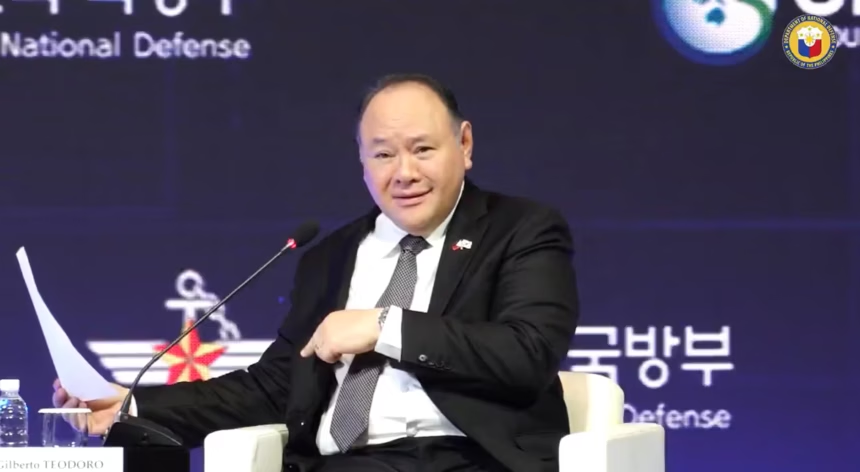
SEOUL, Korea – Dramatic scenes unfolded at a major defense summit in Seoul this week. The Philippines faced a blatant attempt by China to dictate the narrative on a global stage. However, the Southeast Asian nation was not willing to let the matter slide. Philippine Defense Secretary Gilberto C. Teodoro Jr. publicly called out Beijing’s aggressive posture during a live panel.
Teodoro was mid-speech discussing maritime security when an event staffer handed him a handwritten note. The piece of paper reportedly came from a Chinese military attache sitting in the audience. The staff member thought it was a message from the Philippine team and passed it along. Instead of quietly ignoring it, Teodoro read the message aloud to the stunned crowd.
Key Takeaways:
- An Unexpected Interruption: A Chinese official tried to secretly hand a protest note to the Philippine defense chief during the Seoul Defense Dialogue.
- A Public Rebuttal: Secretary Teodoro read the note aloud and fiercely mocked China’s legal claims over the disputed waters.
- Escalating Tensions: The event highlights the growing friction between Manila and Beijing over the South China Sea.
A Surprise Delivery on the Main Stage
The contents of the unexpected message were highly controversial and deeply political. The note repeated Beijing’s long-standing rejection of a landmark 2016 international court ruling. It claimed that the arbitration violated fundamental rules of international law. The message also stated that the court’s award was entirely null and void.
Teodoro decided to address the situation head-on right there on the main stage. He read the note line by line and offered sharp, witty comebacks to each claim. When the paper claimed China does not recognize the ruling, Teodoro had a quick response. “Of course, because you lost,” the defense chief quipped to the amused audience.
His direct approach earned immediate praise and applause from the summit attendees. Teodoro questioned how any nation could behave this way at a formal international gathering. He noted that handing him a protest note mid-speech disrespected both the host and the organizers. The defense chief suggested that China badly needs to learn some basic human decency.
Exposing Coercion and Bullying Tactics
The Philippine official did not hold back in his severe criticism of the Chinese government. He described the secret note delivery as an act of desperation and complete ineffectiveness. Furthermore, he accused Beijing of blatant coercion, regional bullying, and outright aggression. Teodoro stated that he would keep the paper as a unique souvenir of the encounter.
This public shaming highlights a major shift in how the Philippines handles foreign pressure. In the past, diplomats might have quietly filed a formal protest behind closed doors. Now, Manila is choosing to shine a bright spotlight on these underhanded diplomatic tactics. This transparent strategy aims to rally global support against illegal territorial claims in the region.
For further reading on the ongoing conflict, check out the recent reports on the South China Sea disputes. These incidents reveal a clear pattern of aggressive actions by Chinese maritime forces. The international community is paying very close attention to these dangerous ocean standoffs.
The Battle Over the South China Sea
To fully understand this drama, one must look back at a crucial legal decision. In 2016, an international tribunal in The Hague ruled completely in favor of the Philippines. The court firmly rejected China’s expansive claims over almost the entire South China Sea. The judges stated there was absolutely no legal basis for Beijing’s historical maritime rights.
This major ruling was based on the United Nations Convention on the Law of the Sea. The treaty, often called UNCLOS, governs maritime boundaries and exclusive economic zones across the globe. China is actually a prominent signatory to this vital international maritime treaty. Yet, the Chinese government stubbornly refuses to accept the court’s legally binding decision.
Instead, Beijing continues to build artificial islands and military bases in the disputed waters. Chinese coast guard vessels frequently harass Philippine supply ships and local fishing boats. Recently, they have even used high-pressure water cannons against much smaller Filipino vessels. These aggressive physical maneuvers have caused terrible injuries to sailors and damaged several boats.
Confronting “Wolf Warrior” Diplomacy
Experts often describe China’s aggressive foreign policy style as wolf warrior diplomacy. This specific term refers to combative and highly confrontational behavior by Chinese government diplomats. Officials are strongly encouraged to fiercely counter any international criticism of Beijing’s actions. The dramatic incident in Seoul perfectly illustrates this highly assertive and abrasive diplomatic style.
However, this aggressive approach often severely alienates neighboring countries and potential global allies. By interrupting a formal speech, the Chinese official violated standard, long-standing diplomatic protocols. Teodoro pointed out that such reckless actions ruin any chance of civil, productive dialogue. It forces smaller countries to respond with equally firm and highly public statements.
The Philippines is clearly exhausted by these relentless and frustrating gray-zone tactics. These are hostile actions that pressure a state without sparking an actual, declared war. By calling out the note on stage, Teodoro stripped away the secrecy of these methods. He made it crystal clear that Manila will no longer accept quiet, behind-the-scenes bullying.
Global Reactions to the Diplomatic Spat
News of the on-stage confrontation quickly spread across major global media outlets this week. Videos of Teodoro reading the handwritten note went incredibly viral on social media platforms. Defense analysts heavily praised the Philippine official for his quick thinking and calm composure. Many expert observers felt that his confident response effectively neutralized the intended intimidation tactic.
Meanwhile, the Chinese Foreign Ministry tried very hard to downplay the embarrassing public incident. A prominent spokesperson later stated that they did not know the exact event details. However, they advised the Philippines to stop trying to stir up severe regional trouble. They simply reiterated their firm stance on the arbitration ruling, just as the note claimed.
This highly defensive reaction shows that Beijing was completely caught off guard by the exposure. The strategy of bullying neighboring nations only truly works when the victims stay perfectly silent. The Philippines has actively chosen a path of radical transparency to counter these constant threats. This bold incident will likely empower other smaller nations to speak up against unfair pressure.
What This Means for Future Regional Security
The unexpected clash at the Seoul Defense Dialogue is much more than just a viral moment. It deeply underscores the incredibly volatile nature of security in the broad Indo-Pacific region. The South China Sea currently remains one of the world’s most dangerous geopolitical flashpoints. Trillions of dollars in essential global trade pass through these heavily contested waters every year.
Countries in the surrounding region are rapidly modernizing their militaries and forming brand new alliances. The Philippines has been actively strengthening its important defense ties with the United States. This growing network of global partnerships aims to deter any further Chinese expansion in the area. The massive public pushback in Seoul shows that Manila feels deeply confident in its backing.
Ultimately, China’s bold attempt to have the final word simply failed in a spectacular fashion. The secret note was clearly meant to assert harsh dominance and easily control the narrative. Instead, it gave the Philippines a golden opportunity to expose Beijing’s disregard for international rules. As Teodoro boldly declared, the raw truth easily speaks for itself to a free audience.
Trending News:
Doctors Using Traditional Chinese Veterinary Medicine to Help Pets
Japan to Strengthen Philippine Navy with 6 Destroyers to Combat China