



Last Updated on July 7, 2026 by Salman Ahmad
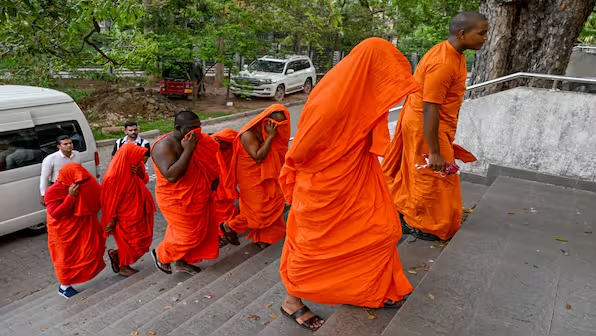
Twenty-two Buddhist monks were arrested at Bandaranaike International Airport in Colombo after customs officers found 110 kg of cannabis in their luggage. The seizure, reported as Sri Lanka’s biggest at the airport, has drawn attention far beyond the country.
The case stands out for three reasons. It involves monks, a major international airport, and a large load of suspected Kush cannabis.
The basic questions are clear. How was the drug hidden? Who were the suspects, and what happened next?
What happened at Bandaranaike International Airport in Colombo?
The arrests took place at Bandaranaike International Airport, Sri Lanka’s main international gateway. Customs officers stopped the group during baggage checks and handed the suspects to police, according to local reports.
The bust has been described as the largest drug seizure ever recorded at the airport. That alone made the Colombo airport drug bust a major news event.
How customs officers found the cannabis in the luggage
Reports say the cannabis was found during a routine baggage inspection. The drug was hidden inside false walls built into the suitcases, which made the luggage look normal from the outside.
The BBC reported that customs officials believed each suspect was carrying around 5 kg of Kush, a potent form of cannabis, in the altered bags. That detail matters because it points to planning, not a casual attempt to sneak in a small amount of narcotics. BBC News report on the airport search
The luggage was not treated as ordinary passenger baggage once officers saw the hidden compartments. After that, the case moved quickly from customs control to criminal investigation.
Who the arrested suspects were, according to reports
Local and international reports described the 22 suspects as young Buddhist monks from temples across Sri Lanka. That is the detail that made the story spread fast.
It is still important to stay precise. The arrest is a reported fact. The court case and later findings will decide what is proven.
For now, the public record is about a group of monks, a set of suitcases, and a large narcotics seizure at Sri Lanka’s busiest airport.
Why is this case unusual and drawing so much attention
A drug bust at an airport is not rare. A drug bust involving monks is different.
Buddhist monks in Sri Lanka are often seen as figures of discipline, restraint, and moral authority. That is why the arrest triggered attention at home and overseas. The contrast is sharp, and it’s what pushed the story into global headlines.
There is also the setting itself. Bandaranaike International Airport handles heavy passenger traffic and sits under close watch. When a case like this gets through to the baggage screen, people start asking the obvious question: how did so many suitcases pass through without drawing attention earlier?
Why the monk angle made the story spread fast

Religious robes change how the public reads a story. They do not change the legal facts, but they do change the social shock.
In Sri Lanka, monks are usually associated with public respect, temple life, and strict conduct. So when the arrest involves robes, the story travels faster than a standard airport seizure. It becomes more than a customs case. It becomes a trust case.
The same is true outside Sri Lanka. Global readers see the image first, then the details. That makes the story easy to share, even before the legal process has moved forward.
Why 110 kg of Kush is a major seizure
The size of the haul matters as much as the headline. Customs and police do not treat 110 kg of cannabis as a personal-use case. It is a commercial amount, suggesting a serious smuggling attempt.
CBS News reported that officials called it the largest single detection of Kush at Sri Lanka’s main international airport. CBS report on the record seizure
That scale raises questions about supply chains, buyers, and transport routes. A load that large usually points to organized handling somewhere along the line.
What investigators may look at next?
The next stage is likely to focus on evidence, not headlines. Police will want to know who packed the bags, who booked the trip, and who handled the luggage before it reached the airport.
Investigators may also look at the false compartments themselves. How were they made? Who arranged them? Were the bags modified before departure or during transit?
These are the questions that matter now, because they separate a one-off arrest from a wider trafficking case.
Questions about the Bangkok trip and who paid for it
Reports said the group had returned from a four-day trip to Bangkok, which was reportedly sponsored by a businessman. That detail has become one of the main investigative leads.
It is not proof of a trafficking ring on its own. It is a lead. Police still need to establish who paid, who traveled, and what happened between Bangkok and Colombo.

How airport security and customs may respond
Cases like this tend to push airport security toward tighter screening. That includes baggage scans, secondary checks, and closer scrutiny of suitcases with altered linings or false walls.
A separate Bangkok airport cannabis bust reported by Chiang Rai Times shows how often air routes in the region appear in smuggling cases. The pattern is familiar, even when the details change.
For Colombo, the lesson is plain. A major airport can move thousands of passengers cleanly and still miss a hidden load if the packaging is smart enough. That is why customs officers keep revisiting screening procedures after cases like this.
Why does Colombo airport keep showing up in drug trafficking news
Sri Lanka’s main airport has come up in drug trafficking reports before, and not only for cannabis. Recent cases have also involved cocaine and other narcotics.
That does not mean the airport is alone in the problem. It means traffickers keep testing air routes, looking for weak spots in screening and baggage handling. When one route tightens, another often opens.
The Colombo airport drug bust fits that wider pattern. It is one more reminder that airport security is not only about passports and boarding passes. It is also about what people try to hide inside luggage.
How does this bust compare with other recent airport seizures
Compared with smaller seizures, 110 kg is hard to ignore. It is the kind of haul that brings customs, police, and court officials into the same frame.
It also puts pressure on airport screening systems to revisit how bags move through the terminal, especially when the travel pattern appears routine on paper. That is where the real work begins after the arrest.
Conclusion
The arrest of 22 Buddhist monks at Colombo’s Bandaranaike International Airport is unusual, serious, and still under investigation. The reported seizure of 110 kg of cannabis has turned a customs check into a major public story.
For now, the facts are simple. A large load was found, suspects were arrested, and the case has placed airport security, trafficking controls, and public trust under the same spotlight.


