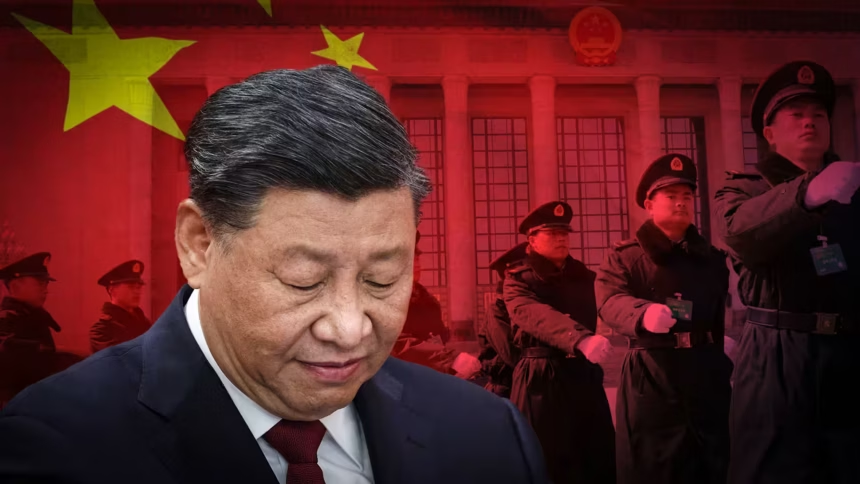
BEIJING – China is witnessing an unprecedented political tremor inside the armed forces as sweeping dismissals rip through the highest tiers of the People’s Liberation Army. The Chinese Communist Party’s recent Fifth Plenum formally confirmed the historic expulsion of senior military leaders, rattling defense analysts across the globe.
While veteran general Zhang Youxia drew initial headlines, the true political earthquake lies in the sudden downfall of Chinese leader Xi Jinping’s most trusted inner circle. For the first time in modern Chinese military history, all three men who served consecutively as Xi’s personal military chiefs of staff have been taken down.
Key Takeaways• Historic Gatekeeper Purge: All three consecutive directors of the Central Military Commission General Office under Xi Jinping—Qin Shengxiang, Zhong Shaojun, and Fang Yongxiang—have been officially purged and expelled from the Chinese Communist Party. • Systemic Command Collapse: The removal of Zhong Shaojun, Xi’s closest personal aide of twenty-four years, demonstrates that Xi can no longer shield his own inner cadre from institutional infighting. • Crippled Operational Control: With the administrative nervous system of the Central Military Commission dismantled, pressing questions mount over who actually directs the People’s Liberation Army today. |
The Shocking Fall of Xi’s Trusted Military Gatekeepers
The Central Military Commission (CMC) represents the supreme organ of military authority in China, functioning as the vital cockpit of national defense command. Under Chairman Xi Jinping, the General Office of the CMC was meticulously restructured to ensure direct ideological obedience, operational coordination, and tight political loyalty.
However, official communiqués following the Fifth Plenary Session revealed a startling purge that decimated the commission’s core administrative backbone. In total, sixteen high-ranking military commanders and political officials faced unceremonious expulsions from the ruling party, exposing severe internal fractures within the high command.
Observers monitoring Beijing’s secretive political theater were quick to notice that this round of purges reached far beyond regular anti-corruption enforcement. By striking down the three consecutive directors who ran the CMC General Office since 2012, Beijing has effectively severed the administrative bridge linking Xi to his field generals.
These three officials—Qin Shengxiang, Zhong Shaojun, and Fang Yongxiang—were never ordinary military bureaucrats navigating Beijing’s vast peacetime apparatus. Instead, they acted as Xi Jinping’s personal gatekeepers, controlling daily schedules, filtering strategic briefings, and safeguarding his commands across every branch of the armed forces.
Qin Shengxiang: The Architect of Early Military Overhaul
The dismantling of Xi’s military network began with the career unraveling of Admiral Qin Shengxiang, an influential political officer whose rise coincided with Xi’s consolidation of power. Qin took charge of the CMC General Office in October 2012, mere weeks before Xi assumed the chairmanship of the Central Military Commission.
During those pivotal early years, Qin oversaw the comprehensive structural reforms that dismantled China’s traditional four military general departments. His strategic leadership helped centralize command authority directly under Xi, curbing independent fiefdoms and subordinating entrenched regional generals to the commission chairman.
In August 2017, Qin transitioned to become the political commissar of the People’s Liberation Army Navy, guiding maritime political strategy during an era of historic naval expansion. Despite his long service, signs of political trouble surfaced dramatically when his membership in the National People’s Congress was abruptly revoked.
Qin’s eventual expulsion confirmed that even the chief architect of Xi’s early command structures enjoyed no immunity from the escalating turmoil. His fall stripped away one of Xi’s earliest organizational defenders, setting a troubling precedent for the military apparatchiks who followed in his footsteps.
Zhong Shaojun: The Ultimate Confidant Leaves Power
Among the three fallen chiefs of staff, the downfall of Lieutenant General Zhong Shaojun has sent the most profound shockwaves through the party hierarchy. Zhong was widely recognized as Xi Jinping’s closest personal confidant, having worked faithfully at his side for more than twenty-four consecutive years across multiple provinces.
Their professional partnership traces back to 2002 in Zhejiang province, where Zhong served as Xi’s private secretary and trusted personal administrative assistant. Armed with an academic background in psychology, Zhong understood how to handle bureaucratic sensitivities and followed Xi upward to Shanghai and eventually to the capital.
Zhong’s influence extended far beyond ordinary administrative chores, often encompassing intimate family arrangements and personal coordination for Xi’s daughter. When Xi elevated Zhong to head the CMC General Office in 2017, the civilian aide took charge of sweeping military personnel reviews despite never wearing a uniform earlier.
Because he lacked frontline combat background, Zhong reportedly clashed with seasoned battlefield veterans like former Central Military Commission vice chairman Zhang Youxia. These institutional frictions ultimately forced Zhong’s transfer to the PLA National Defense University in 2024, culminating in his formal expulsion from the Chinese Communist Party.
Fang Yongxiang and the Collapse of Political Loyalists
Following Zhong’s sudden sideline transfer, Lieutenant General Fang Yongxiang was installed in 2024 to manage the critical day-to-day operations of the CMC General Office. Fang arrived with substantial political background, having served prominently under former Political Work Department director Admiral Miao Hua within the military apparatus.
However, Fang’s tenure atop the vital administrative department proved remarkably short-lived as factional tensions flared across the central military establishment. When Miao Hua came under political scrutiny and was removed from high-level duties, Fang’s political backing instantly evaporated, leaving him vulnerable to rival institutional forces.
The recent Fifth Plenum conclusively sealed Fang’s political fate by ratifying his expulsion alongside the other fifteen senior military officers. With Fang’s abrupt exit, all three men who consecutively managed Xi’s military office have now fallen from grace, leaving a glaring operational void at the summit.
This triple downfall represents an unprecedented pattern in Communist Party administrative history, where consecutive gatekeepers are systematically removed rather than promoted. It underscores an acute governance crisis at the heart of China’s military command, challenging longstanding assumptions regarding Xi’s absolute personal grip.
Why the CMC General Office Is the Military Nervous System
To grasp the full strategic gravity of these expulsions, international observers must understand what the CMC General Office actually executes on an hourly basis. The office serves as the central circulatory system for Beijing’s military power, directing every top-secret operational report, strategic memorandum, and operational initiative to the chairman’s desk.
In authoritarian systems, absolute control over document transmission and executive access dictates who exercises genuine political leverage. The director decides which battlefield evaluations are escalated, which urgent logistical crises receive immediate executive review, and how executive orders are distributed across regional theater commands.
Furthermore, the general office enforces strict confidentiality protocols, schedules critical defense leadership convocations, and verifies that theater commanders comply with national policy. When that administrative nerve center is gutted, the entire decision-making mechanism slows down, leaving top leaders blinded to brewing departmental crises.
Without dedicated gatekeepers who possess unquestioned personal trust, executive directives face bureaucratic resistance, intentional delays, and selective enforcement. As a direct consequence, the purge of these three administrators has effectively degraded Xi’s ability to communicate reliably with operational combat units across the Indo-Pacific.
Two Competing Narratives: Self-Purge or Loss of Control?
Political analysts examining the Beijing landscape are divided between two competing explanations regarding the root drivers behind this extraordinary personnel carnage. The first narrative suggests that Xi Jinping remains fully in charge, systematically purging his own appointees to root out pervasive graft and enforce ideological discipline.anti-corruption drive
Under this theory, Xi’s obsessive anti-corruption drive spares nobody, proving his willingness to sacrifice longtime allies to achieve ideological purity within the ranks. Yet this perspective presents significant logical flaws, as purging one’s closest personal protectors over routine financial wrongdoing undermines executive security and paralyzes institutional operations.
The alternative and far more plausible narrative suggests that Xi’s personal patronage network has come under aggressive assault from opposing institutional coalitions. Senior military officers, resentful of civilian interference and endless ideological reviews, may have mobilized internal discipline apparatuses to strike down Xi’s personal surrogates one after another.
If Xi truly ordered the destruction of his own gatekeepers, it would demonstrate severe paranoia that threatens his own physical and political survival. Conversely, if institutional rivals forced these removals, it confirms that Xi has lost undisputed mastery over China’s military apparatus ahead of pivotal leadership assemblies.
The Human Cost of Xi’s Inability to Shield Confidants
In Beijing’s unforgiving political culture, a supreme leader’s authority rests heavily on their ability to protect loyal retainers during intense internal conflicts. When an aide like Zhong Shaojun—who faithfully managed personal secrets for a quarter of a century—is publicly disgraced, the psychological impact across the cadre corps is profound.
Junior officers, civilian bureaucrats, and regional commanders are now forced to calculate whether absolute loyalty to Xi offers any meaningful career security. If dedicated personal service cannot guarantee safety against sudden political demise, ambitious commanders may begin hedging their bets, withholding initiative, and subtly courting alternative power centers.
This dynamic creates widespread institutional paralysis throughout defense ministries, where officials prioritize self-preservation over decisive operational leadership. Commanders hesitate to sign off on major procurement contracts, military readiness exercises, or structural reorganizations for fear of attracting lethal disciplinary investigations.
Consequently, the collapse of Xi’s protective umbrella weakens the basic foundation of party discipline, transforming once-confident loyalists into cautious, risk-averse bureaucrats. The resulting climate of fear erodes operational morale across theater commands, directly compromising China’s stated goals of achieving joint warfare capability.
A Crippled Command Chain: The Indo-Pacific Repercussions
The institutional turmoil unfolding inside Beijing carries profound strategic consequences that extend far beyond China’s terrestrial borders. As the People’s Liberation Army grapples with internal purges, regional neighbors and Western defense planners are reassessing China’s near-term capacity for aggressive military maneuvers.Taiwan Strait
A command apparatus consumed by internal paranoia, sudden arrests, and leadership vacancies lacks the operational coherence required to execute complex joint warfare. Maritime incursions in the Taiwan Strait and confrontations in the South China Sea demand flawless coordination between combatant theater headquarters and Beijing.
If senior commanders fear that strategic missteps or battlefield friction could trigger instant charges of disloyalty, operational caution will inevitably dominate field behavior. At the same time, unpredictable command chains increase the danger of miscalculation during aerial intercepts, where local pilots lack clear, consistent operational parameters from above.
International defense establishments are watching these structural vulnerabilities closely, recognizing that Beijing’s outward assertiveness masks severe domestic institutional decay. As the People’s Liberation Army attempts to replace its purged administrative leaders, the fundamental question of who controls China’s nuclear and conventional forces remains unanswered.
The Road to 2027: A Beleaguered Leader Facing Mounting Resistance
Looking ahead to the Chinese Communist Party’s 21st National Congress in 2027, Xi Jinping faces an increasingly fraught political horizon. His ambitions to secure an unprecedented fourth term as general secretary were meant to be underpinned by unquestioned dominance over the armed forces and security ministries.
Instead, the wholesale destruction of his CMC General Office leadership demonstrates that internal resistance to his centralized rule remains fiercely active. By stripping Xi of his essential gatekeepers, political and military rivals have dealt a devastating psychological blow to his image of invulnerability.
China’s defense modernization timeline, once projected to achieve major modernization milestones by 2027, now risks derailment due to systemic administrative paralysis. The ongoing purge of technical experts, procurement chiefs, and administrative organizers leaves strategic planning departments understaffed, demoralized, and deeply distrustful of central directives.
Ultimately, the fall of Qin Shengxiang, Zhong Shaojun, and Fang Yongxiang signals a watershed moment in contemporary Chinese political history. Without trusted gatekeepers to manage the state’s military machinery, Xi Jinping stands more isolated than at any point during his fourteen-year reign, presiding over an armed force whose ultimate loyalty remains profoundly divided.
Trending News:
China’s Global Trade Surplus Tops $1 Trillion Mark
Former China Eastern Chairman Jailed 14 Years for Bribery