




Last Updated on March 31, 2026 by Jeff Tomas
CHIANG RAI – Residents of Chiang Rai are facing serious pollution on two fronts. Contaminated water and dangerous air. The Pollution Control Department reported that recent checks of the Kok River and nearby waterways still found heavy metals above safety limits in several areas. At the same time, PM2.5 levels in parts of Chiang Rai, especially Mae Sai and Chiang Khong, have climbed to levels that can harm health.
On March 30, 2026, the Pollution Control Department released its 17th water quality report, based on samples collected from March 10 to 13, 2026. The survey covered the Kok River and connected waterways, including the Sai River, Ruak River, and Mekong River, in parts of Chiang Mai and Chiang Rai.
Tests in the Kok River found arsenic above the standard limit at two locations. One was near Tha Ton Bridge in Tha Ton Subdistrict, Mae Ai District, Chiang Mai. The other was near the Mae Yao-Doi Hang Friendship Bridge in Doi Hang Subdistrict, Mueang District, Chiang Rai. Both sites recorded arsenic at 0.011 milligrams per liter, slightly above the standard of 0.01 milligrams per liter.
The Sai River also showed continued concerns. At Ban Pa Sang Ngam, Village 6, Koh Chang Subdistrict, Mae Sai District, Chiang Rai, manganese measured 2.80 milligrams per liter. The standard allows no more than 1.0 milligram per liter.
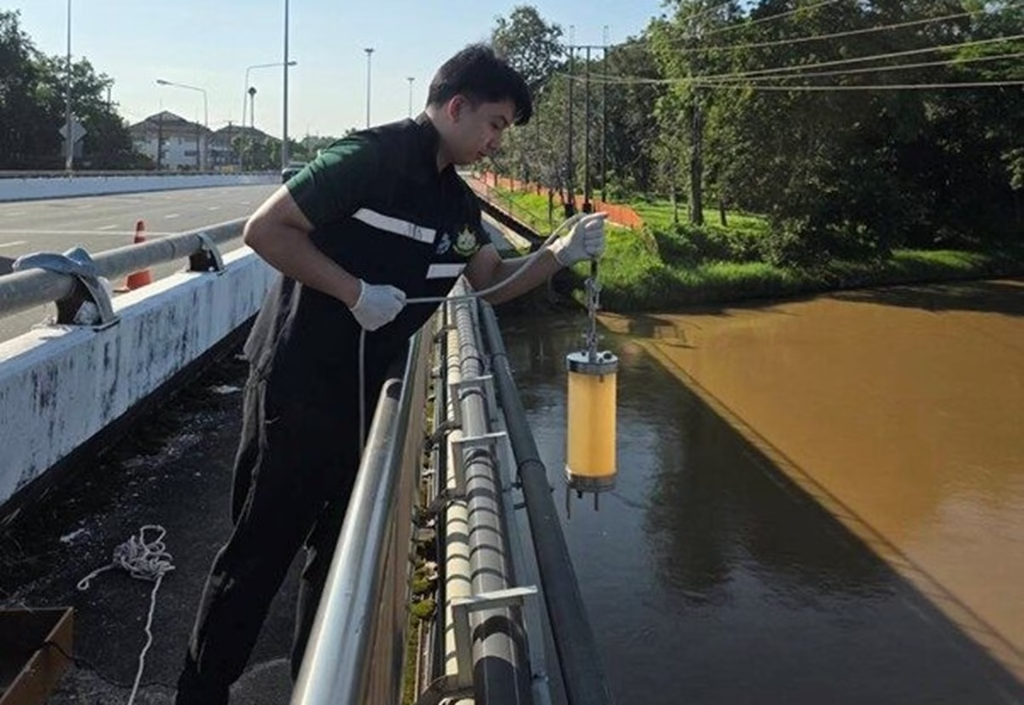
Arsenic Exceeds the Acceptable Levels
Earlier monitoring rounds had also found manganese above the limit at different points. In the fourth round, every sampling site exceeded the standard, with readings between 1.00 and 1.30 milligrams per liter.
In the fifth round, levels stayed above the limit at Ban Hua Fai and the Second Thai-Myanmar Friendship Bridge over the Sai River. In the sixth round, all sites again went over the standard, ranging from 1.30 to 1.60 milligrams per liter. In the eighth round, all testing points remained high, between 1.20 and 1.30 milligrams per liter.
Officials said the rise matched higher water turbidity. As a result, some heavy metals became easier to detect. In the ninth round, manganese exceeded the limit at the Second Thai-Myanmar Friendship Bridge. Then, from rounds 10 through 16, all sites met the standard.
However, the 17th round found arsenic above the standard in the Sai River at most points, with values between 0.011 and 0.024 milligrams per liter. The only exception was Ban Hua Fai in Mae Sai District, where the level stayed within the allowed range.
In the Ruak River, arsenic also exceeded the standard at the Koh Chang pumping station operated by the Provincial Waterworks Authority, Mae Sai branch, in Mae Sai District, Chiang Rai. The reading there was 0.013 milligrams per liter.
The Mekong River showed the same issue. Arsenic levels above the standard were found near the Golden Triangle permanent border crossing at Ban Sop Ruak in Wiang Subdistrict, Chiang Saen District, Chiang Rai, and at a Provincial Waterworks Authority pumping point linked to the Mae Sai branch. Both locations recorded 0.013 milligrams per liter.

Toxic Air Quality in Chiang Rai
While water quality remained a concern, wildfire smoke continued to worsen the air crisis in the North. On the same day, the Environmental and Pollution Control Office 1 in Chiang Mai issued its fourth warning of 2026 on unhealthy air quality in the upper North, covering Chiang Mai, Chiang Rai, Lamphun, and Mae Hong Son.
The announcement said that as of 7:00 a.m. on March 30, 2026, the 24-hour average PM2.5 level ranged from 43.5 to 255.1 micrograms per cubic meter. Air quality in the region fell between the orange level, which means it is starting to affect health, and the red level, which means it is harmful to health.
The areas in the red category were listed as follows:
- Mueang Na, Chiang Dao District, Chiang Mai, 255.1 micrograms per cubic meter
- Wiang Tai, Pai District, Mae Hong Son, 232.5 micrograms per cubic meter
- Wiang Phang Kham, Mae Sai District, Chiang Rai, 153.5 micrograms per cubic meter
- Li, Li District, Lamphun, 147.1 micrograms per cubic meter
- Wiang, Chiang Khong District, Chiang Rai, 146 micrograms per cubic meter
- Chang Khoeng, Mae Chaem District, Chiang Mai, 107.9 micrograms per cubic meter
- Chang Phueak, Mueang District, Chiang Mai, 101.1 micrograms per cubic meter
- Mae Sariang, Mae Sariang District, Mae Hong Son, 92.8 micrograms per cubic meter
- Ban Klang, Mueang District, Lamphun, 92.6 micrograms per cubic meter
- Wiang, Mueang District, Chiang Rai, 90.2 micrograms per cubic meter
- Chong Kham, Mueang District, Mae Hong Son, 81.3 micrograms per cubic meter
- Suthep, Mueang District, Chiang Mai, 75.8 micrograms per cubic meter
Some areas have been stuck at dangerous levels for days. Wiang Phang Kham in Mae Sai, Chiang Rai, and Li in Lamphun have recorded red-level PM2.5 for six straight days, from March 25 until now.
Meanwhile, Wiang in Mueang Chiang Rai, Wiang in Chiang Khong, Mueang Na in Chiang Dao, and Wiang Tai in Pai have remained in the red zone for four straight days, starting March 27.
Other areas, including Chang Khoeng in Mae Chaem, Ban Klang in Lamphun, and Mae Sariang in Mae Hong Son, have posted red-level pollution for three straight days, beginning March 28.

Health Warning Over Toxic Air
Authorities urged people in affected areas to watch their health closely and avoid outdoor activity whenever possible. If going outside is necessary, they advised wearing PM2.5 protection masks every time. People should also shorten the time spent outdoors, especially during heavy exercise.
Residents were told to watch for warning signs such as coughing, breathing trouble, and eye irritation. The warning was directed especially at high-risk groups, including children, older adults, and people with existing health conditions.
Anyone with unusual symptoms should see a doctor right away and stay in cleaner indoor spaces if possible. People with medical needs were also told to prepare medicines and other basic supplies, then follow their doctor’s advice closely.
Officials also asked the public to avoid all types of open burning and to stop using vehicles that release excessive black smoke. Those steps could help reduce the buildup of harmful particles in the air.
People who want updates on air quality can follow the Facebook page of the “สำนักงานสิ่งแวดล้อมและควบคุมมลพิษที่ 1”, visit “air4thai.pcd.go.th“, or use the “Air4thai” app.
Aweera Phakmat, director of Environmental and Pollution Control Office 1 in Chiang Mai, said almost every province in the North is now dealing with PM2.5 above the standard.

People should wear N95 masks
In Chiang Rai alone, Mae Sai reached 153.5 micrograms per cubic meter, Mueang District was at 90.2, and Chiang Khong hit 146. The standard is 37.5 micrograms per cubic meter.
He said the gap is large enough to create clear health risks. For that reason, people should wear N95 masks at all times when outside. At home, they should keep doors and windows closed to limit dirty air from getting in.
He also warned that vulnerable groups need extra care, especially older adults and people with asthma. Without N95 masks, their exposure can be much worse. He added that state hospitals and local health centers are ready to provide support.
For bedridden patients, the Ministry of Public Health has reportedly supplied air purifiers or dust-protection bed nets. Spraying water around lawns and open areas at home may help a little, although the effect only lasts a short time because it briefly raises moisture in the air.
When asked whether Chiang Rai needs a special response because it is dealing with both toxic air and polluted river water, Aweera said each agency is already handling its own role. At the same time, he said, the public also needs to protect itself by staying informed and following official updates.
He added that Thailand already has a national strategy and the ASEAN Clear Sky strategy. Still, each country faces different limits and does not have the same capacity to act. He said economic hardship also remains a major issue, so any long-term solution has to consider several factors at once.


