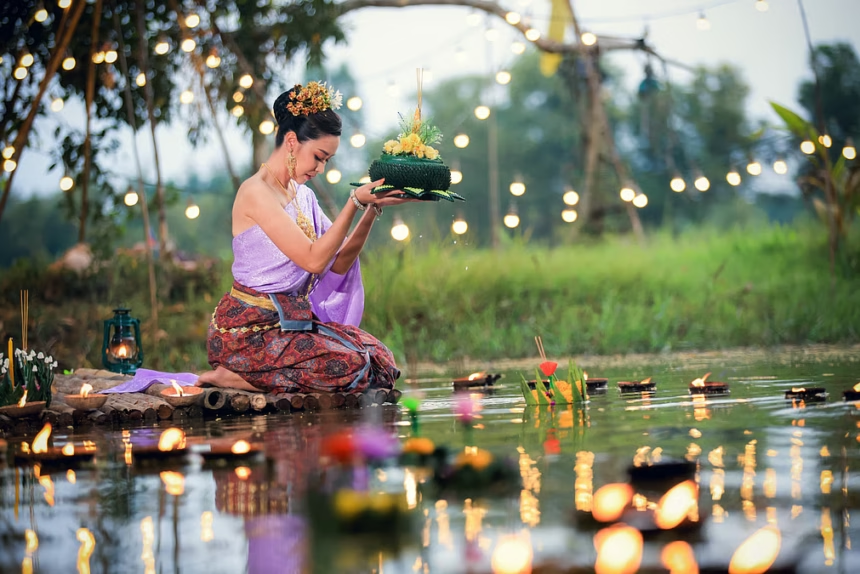
Ask most visitors what Loy Krathong means and you get the same short answer: people float baskets on the water. That answer is true, but it skips the real story behind it, a story that mixes an ancient Khmer ritual, a possibly invented royal legend, and a modern Thai identity built around one of the most photographed nights of the year.
This guide covers what Loy Krathong is, where it actually comes from, what the ritual means, and why Thai people still do it today.
What Is Loy Krathong?

Loy Krathong is a Thai festival held on the night of the full moon in the twelfth month of the Thai lunar calendar, usually in November. The name comes from two words: “loy,” meaning to float, and “krathong,” a small decorated basket.
On this night, people across Thailand carry a krathong to the nearest river, canal, or pond, light a candle and incense sticks placed inside it, make a wish, and set it on the water.
The festival is not tied to a single religion. It blends old Brahmin ritual, Buddhist practice, and local folk belief, which is part of why almost every region of Thailand celebrates it a little differently.
The History of Loy Krathong
Most travel guides trace Loy Krathong to a single, tidy story: a royal consort named Nang Noppamas, living in the Sukhothai Kingdom around 700 to 800 years ago, shaped the first krathong into a lotus and presented it to the king, who then floated it on a lake. This version is popular because it is simple and romantic, and it shows up on almost every tourist website.
The fuller history is older and less tidy. Historians trace the ritual behind Loy Krathong to a Brahmin ceremony called Chong Pa Rieng, brought into the region during the Angkorian period of the Khmer Empire, roughly 800 to 900 years ago, before Sukhothai existed as a major power.
The earliest known image of a similar floating ritual appears carved into the walls of the Bayon temple in Cambodia. Once Buddhism took hold in the region, people reshaped the same ritual around Buddhist ideas of merit and gratitude instead of the original Hindu deities.
As for the Nang Noppamas story, most Thai historians now treat it as a literary invention from the 19th century, written during the reign of King Rama III to give an older, foreign-rooted ritual a clean, patriotic Thai origin story.
The legend stuck, and it still shapes how the festival is told today, even though it likely describes a court poem, not a historical event.
None of this makes the festival any less real or meaningful. It simply means Loy Krathong carries a longer, more layered history than the version most visitors hear.

The Meaning Behind Loy Krathong
At its core, Loy Krathong is about gratitude and release. Thai tradition credits the water in rivers and canals to Phra Mae Khongkha, a water goddess, and the festival falls right as the rainy season ends, when rivers are full and the harvest depends on that water.
Floating a krathong is a way of thanking her for the year’s water and asking forgiveness for polluting the rivers throughout the year.
The festival also carries a personal meaning. Many people treat the act of setting their krathong on the water as a way to let go of anger, grudges, and bad luck from the past year, so they can start the next one with a clean slate.
Watching the candle drift out of sight is often described as watching your troubles float away with it.
What Goes Inside a Krathong, and Why
A traditional krathong starts with a slice of banana tree trunk, shaped into a base and wrapped in folded banana leaves, often styled to look like a lotus flower. Flowers, a candle, and three incense sticks sit on top.
Some people add small, personal touches that carry their own meaning:
- A coin, placed as an offering to the water spirits
- A clipping of hair or a fingernail, symbolizing the release of a part of yourself along with your bad luck
- A small note with a wish written on it, tucked inside before the krathong is set afloat
There is also a well-known piece of folk belief tied to the candle. If it stays lit until the krathong drifts out of sight, that is taken as a sign of good luck for the year ahead. If it goes out early, some people see it as a reason to try again with a new krathong.
Is Loy Krathong a Religious Festival?
This question comes up often, especially from visitors who follow a different faith and wonder whether joining in conflicts with their own beliefs.
The honest answer is that Loy Krathong sits in a gray area. It grew out of Brahmin and Buddhist practice and still involves an offering to a water goddess, so it carries real religious roots.
At the same time, for most Thais today, it functions more as a cultural and national tradition than a strict act of worship, closer to how many people in other countries treat holidays that started as religious but now carry broader cultural weight.
If you are unsure how a Loy Krathong tradition fits with your own beliefs, you do not have to include every element to take part respectfully.
Many visitors float a simple, undecorated krathong without adding a wish to a deity, treat the moment as a quiet reflection instead of a religious offering, or choose to simply watch from the riverbank instead of floating one themselves.
Local hosts rarely expect visitors to follow every step of the ritual exactly.
How Loy Krathong Is Celebrated Today
Loy Krathong has grown well beyond a quiet riverside ritual. Modern celebrations often include krathong-making contests, beauty pageants inspired by the Nang Noppamas legend, concerts, fireworks, and food stalls lining the riverbanks.
Bangkok’s Chao Phraya River, Sukhothai’s historical park, and Chiang Mai’s Ping River all draw large crowds for the festival, each with its own local flavor.
In the north, including Chiang Mai and Chiang Rai, Loy Krathong often overlaps with Yi Peng, the regional sky lantern tradition, which is a separate festival with its own history.
If you want to understand exactly how the two differ before you plan your trip, this comparison of Loy Krathong and Yi Peng breaks down the dates, costs, and rules for each one.
Outside Thailand, similar festivals appear across the region, from Laos to Myanmar to parts of southern China, each shaped by the same old idea: give thanks to the water, then let your worries drift away with the current.
Frequently Asked Questions
What does Loy Krathong mean?
Loy Krathong means “to float a basket.” The name describes the central act of the festival, setting a small decorated basket, or krathong, onto a river, canal, or pond.
Where did Loy Krathong originate?
Popular legend places its origin in the Sukhothai Kingdom around 700 to 800 years ago. Historical evidence points to an older source, a Brahmin ritual from the Angkorian Khmer Empire, which reached the region before Sukhothai rose to power.
Is the Nang Noppamas story true?
Most historians treat it as a literary legend written centuries after the events it describes, likely composed during the reign of King Rama III to give the ritual a Thai origin story. It remains a beloved part of the festival’s identity even though it is not considered a historical record.
Why do people float krathongs on the water?
The act thanks Phra Mae Khongkha, the water goddess, for the year’s water, and asks forgiveness for polluting the rivers. Many people also use it as a personal ritual to let go of bad luck and start fresh.
Is Loy Krathong a religious event or a cultural one?
It carries roots in both Brahmin and Buddhist practice, but most Thais today treat it as a cultural and national tradition rather than a strict religious obligation. Visitors from other faiths can take part in a simplified way without conflict.
What is placed inside a krathong?
A traditional krathong holds a candle, three incense sticks, and flowers, built on a base of banana leaves. Some people add a coin, a clipping of hair or a fingernail, or a written wish.