



Last Updated on August 26, 2026 by Jeff Tomas
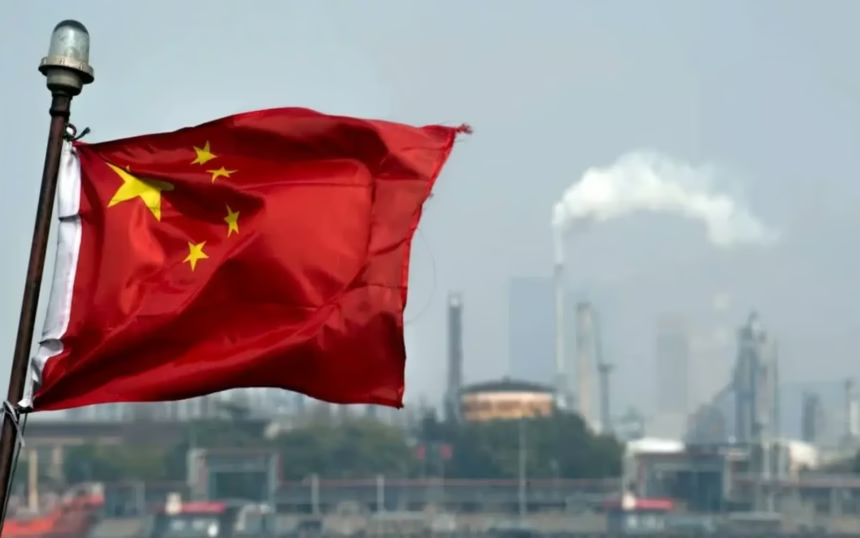
BEIJING – Across China’s vast industrial heartlands, factories are churning out everything from electric vehicles to advanced solar panels at a breathtaking pace. This unprecedented manufacturing boom has pushed the nation’s global trade surplus to an astonishing $1.2 trillion. Yet, this aggressive outward push is not just a simple sign of absolute economic triumph. It is also a stark reflection of deep vulnerabilities brewing beneath the surface of the world’s second-largest economy.
Economists and global policymakers are increasingly calling this massive phenomenon “China Shock 2.0“. Unlike the early 2000s when cheap consumer goods flooded Western markets, today’s export wave is dominated by high-tech, high-value industries. Chinese companies are currently fighting fierce price wars abroad to offload surplus products they simply cannot sell at home. Consequently, this massive industrial overcapacity is sending shockwaves through global markets and fueling intense international trade disputes.
Key Takeaways
- Exporting Overcapacity: China is aggressively redirecting its massive surplus of advanced manufactured goods to international markets due to severely stalled domestic demand.
- The Property Drag: A six-year real estate crisis has severely damaged Chinese household wealth, prompting cautious consumers to heavily save rather than spend.
- Mounting Global Pushback: The European Union and the United States are rapidly deploying tariffs and defensive policies to shield local industries from underpriced Chinese imports.
The original China Shock transformed global manufacturing when the nation officially joined the World Trade Organization in 2001. During that transformative era, an abundance of cheap labor quickly turned the country into the undisputed workshop of the world.
Western store shelves almost immediately filled with inexpensive clothing, plastic toys, and basic consumer electronics. While this sudden influx helped keep global inflation remarkably low, it also triggered significant manufacturing job losses across America and Europe.
Today, Beijing has deliberately and aggressively shifted its grand economic strategy toward advanced technology and green energy production. President Xi Jinping’s government is heavily subsidizing strategic, high-growth sectors like semiconductors, advanced robotics, and next-generation battery production.
The ultimate policy goal is to rapidly climb the global value chain and completely dominate the lucrative industries of the future. As a direct result, Chinese exports are no longer just competing on the basis of impossibly low prices.
Instead, they are now fiercely competing on cutting-edge technological innovation and massive, state-backed industrial scale. However, this heavily supply-oriented fiscal approach is currently creating a highly precarious situation for the broader domestic economy.
Factories across the country are operating at maximum capacity, continuously encouraged by cheap state loans and aggressive industrial policies. The AP News explicitly reports that this relentless production is happening largely regardless of actual domestic market demand.
When Domestic Consumers Stop Spending
When local buyers inevitably disappear, these highly competitive manufacturers must immediately turn their sights outward to simply survive. They are forcefully pushing their massive surplus goods onto foreign shores, often at deeply discounted, rock-bottom prices. To truly understand the root cause of this export frenzy, one must look closely at what is happening inside Chinese households. The country is currently wrestling with a devastating, systemic property crisis that has dragged on for six agonizing years.
Real estate has traditionally and historically accounted for a massive portion of personal, everyday wealth in modern China. As property values continue to plummet and massive, once-trusted developers default on massive loans, everyday citizens are feeling noticeably poorer. This unprecedented destruction of household wealth has severely and perhaps permanently shattered domestic consumer confidence across the nation. Instead of eagerly buying new cars or upgrading basic home appliances, Chinese families are aggressively hoarding their cash.
They are desperately building financial buffers against a highly uncertain future, exacerbated by a notoriously weak social safety net. Recent economic data clearly underscores this grim reality, with national retail sales actually contracting in several recent, critical months. This severe internal stagnation leaves the massive industrial sector in a very tight and increasingly dangerous economic spot. Domestic production capacity has vastly outrun the local population’s fundamental ability or general willingness to consume these newly manufactured goods.
Business reports frequently highlight that domestic demand for durable goods like automobiles and furniture has plunged dramatically in recent quarters. Consequently, Chinese manufacturers face immense, unrelenting pressure to aggressively export their way out of this painful domestic slump. They are now trapped in a bruising cycle of price-cutting just to maintain basic factory operations and positive cash flow. The rest of the world, however, is certainly not sitting idly by as this new massive wave hits their shores.
From the busy halls of Washington to the corridors of Brussels, prominent political leaders are loudly sounding the alarm. They strongly view these overwhelming export surges as the direct result of fundamentally unfair, heavily state-sponsored trade practices. The United States has already erected steep tariff walls, aiming directly to block heavily subsidized Chinese technology from decimating American competitors. The Biden administration firmly views this overcapacity as a direct, severe threat to national economic security and local manufacturing revivals.
The Global Collision and Trade Pushback
Europe is now rapidly finding itself firmly stationed on the frontline of this escalating, high-stakes international economic battlefield. European policymakers recently made the impending China Shock 2.0 a major, urgent talking point at the latest G7 Summit. They deeply fear that as the lucrative US market completely closes its doors, a tsunami of cheap Chinese goods will flood European markets. The European Commission has sternly warned that its rapidly soaring trade deficit with Beijing is entirely unsustainable in the long run.
Germany, traditionally recognized globally as a dominant export powerhouse itself, is feeling the heat of this shift particularly intensely. Renowned German companies are suddenly and unexpectedly struggling to compete with heavily subsidized Chinese rivals in crucial, foundational sectors. This brutal competition spans key industries like automotive manufacturing, advanced industrial machinery, and complex chemical production. As the WSWS points out, the Xi regime could soon face severe, coordinated international blowback from this high-stakes economic gamble.
A Precarious Economic Balancing Act
Governments around the world are now frantically rushing to implement strict anti-dumping measures and urgently protect their domestic workforces. Ultimately, China is currently attempting to carefully navigate a remarkably complex and historically unprecedented macroeconomic transition. On one specific side, its advanced manufacturing sector remains a dominant, highly efficient global force, driving truly impressive export numbers. On the other side, a deeply crippled property market and terrified, cash-hoarding consumers threaten to continuously hollow out the economy.
The central government is essentially utilizing foreign consumer demand as a vital crutch to heavily support its sprawling, overextended industrial base. This particular economic strategy, however, has very clear and distinct limits in an increasingly skeptical and globally protectionist world. If international markets continue to rapidly raise protective barriers, China’s bustling factory floors will inevitably face catastrophic, systemic bottlenecks. Severe overcapacity without a viable, profitable global outlet naturally leads to inevitable business closures, massive layoffs, and much deeper economic pain.
The entire world is watching closely to see if Beijing will finally, decisively pivot toward stimulating its own hesitant consumers. Until that fundamental, structural shift actually happens, the friction between China’s massive industrial ambitions and global trade rules will only intensify. China Shock 2.0 is certainly not just a theoretical economic concept; it is a very live crisis actively reshaping supply chains everywhere. It forcefully requires sovereign nations to make incredibly difficult choices between adopting cheap green technology and protecting their own vital industrial jobs.
Trending News:
The Hidden Truth About China’s Military Might: Why War Isn’t Approaching
The End of an Era: Why China’s Economic Miracle is Quietly Crashing


