



Last Updated on August 26, 2026 by Jeff Tomas
BEIJING – China’s robotics maker Unitree recently executed one of the most highly anticipated initial public offerings in recent memory. The company made its grand debut on the Shanghai STAR Market in mid-August 2026.
The massive offering successfully raised 6.1 billion yuan, which roughly translates to $900 million. Investors were incredibly eager to buy a piece of the world’s leading humanoid robot manufacturer.
However, the initial market excitement quickly gave way to absolute panic. Unitree’s stock price surged by more than 600% on its very first day of public trading. This massive spike temporarily pushed the company’s overall market valuation to a staggering 66 billion yuan. Within just a few days, the stock price plummeted, wiping out roughly $30 billion in market value.
Key Takeaways:
- Unitree Robotics raised 6.1 billion yuan during a highly hyped public offering in Shanghai.
- The company’s market valuation soared to $66 billion before rapidly shedding $30 billion within days.
- Financial experts blame market manipulation and trading system flaws for heavy retail investor losses.
The Build-Up to a Record-Breaking Launch
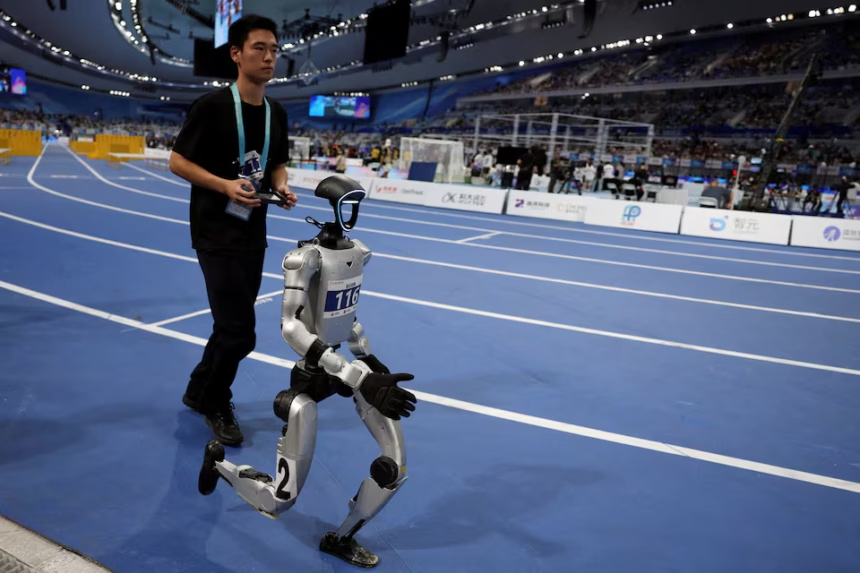
Unitree has built a strong reputation over the last few years. The Hangzhou-based tech firm is famous for creating dynamic, agile humanoid and quadruped robots. These impressive machines can walk, run, dance, and even perform complex martial arts routines. Just days before the IPO, the company unveiled a new robot called Superman.
This headless robot set new world records for jumping and sprinting speeds. It can run at roughly 28 miles per hour, easily beating human athletic records. The strategic timing of this demonstration created a massive buzz among potential investors. Retail buyers rushed to get in on the ground floor of this booming industry.
Demand for the company’s shares reached unprecedented and historic levels. In fact, the retail portion of the offering was oversubscribed by more than 8,000 times. Many market analysts noted that this intense level of demand was entirely unmatched on the STAR Market. Investors saw the company as a key player in China’s push for global technological dominance.
The successful public listing was initially viewed as a massive triumph for the domestic tech sector. Beijing has actively encouraged self-sufficiency and rapid innovation in artificial intelligence and advanced manufacturing. Unitree seemed to represent the perfect success story of these ambitious national tech policies. Unfortunately, the underlying financial reality did not perfectly match this optimistic national narrative.
Warning Signs Ignored by Eager Traders
Despite the overwhelming enthusiasm, several glaring red flags were completely ignored by the public. For instance, the company’s financial fundamentals did not quite justify its soaring stock price. According to the offering prospectus, Unitree’s adjusted net profit actually fell by 53% in early 2026. The company only earned about 40 million yuan during the first three months of the year.
Furthermore, Unitree makes the vast majority of its current sales to research labs and universities. Only a small fraction of its humanoid robots are currently deployed in real commercial or industrial settings. High sales volume makes a great story for an IPO, but long-term commercial viability remains highly uncertain. Many small investors simply overlooked these critical facts in their rush to buy the hyped stock.
Financial experts suggest that the initial stock performance was a clear sign of an overheated market. The sharp stock rise was largely driven by a strong desire to pump up the share price. Institutional players wanted to inflate the stock so they could sell it later at much higher prices. This kind of aggressive market speculation often ends terribly for average, everyday retail investors.
Many financial analysts point out that Chinese investors currently have limited options for strong domestic returns. This frustrating lack of good alternatives often drives massive amounts of money into newly listed tech companies. The fear of missing out completely overtakes rational financial analysis and basic common sense. Consequently, heavily hyped technology stocks become extremely vulnerable to sudden and devastating market corrections.
The Aftermath of a Bursting Tech Bubble
The inevitable market crash happened much faster than anyone could have possibly predicted. After three consecutive sessions of heavy losses, Unitree shares finally stabilized on a Tuesday. By that point, the stock was trading roughly 45% below its peak initial public offering price. Small investors who bought the stock at its absolute highest point suffered devastating and permanent financial losses.
This dramatic boom and bust cycle has sparked serious questions about China’s IPO system. Critics argue that current regulatory loopholes allow major shareholders to easily cash in and make fortunes. These wealthy insiders seamlessly shift all the financial risks onto mom-and-pop investors trading in the secondary market. A popular hedge fund manager noted that restricted short-selling makes these pump-and-dump schemes much easier to execute.
The staggering gap between the initial IPO price and the debut performance shows a severe mispricing. Chinese stock exchanges heavily vet listing hopefuls and even give strict guidance on IPO pricing. This rigid system severely limits the ability of bankers to properly respond to feverish, high market demand. When the debut price is artificially suppressed, the subsequent market mood breeds dangerous and volatile financial bubbles.
Retail investors have expressed deep frustration and intense anger on various social media platforms and blogs. One investor stated that rapid wealth concentration should never be built on the pain of average citizens. The venture capitalists who secured early shares walked away with massive smiles and thick wallets. Meanwhile, thousands of regular people were left holding nearly worthless shares and shedding bitter tears.
What This Means for the Global Robotics Race
Unitree’s wild ride serves as a harsh cautionary tale for other emerging tech companies. Dozens of domestic rivals are currently preparing to enter the public market in the coming months. These ambitious companies now face a much more skeptical and highly cautious pool of potential retail investors. Financial authorities face a tough challenge in boosting strategic industries without causing another massive market frenzy.
The broader robotics industry still holds incredible promise for the future of global manufacturing and heavy labor. Companies in both China and the United States are aggressively racing to commercialize humanoid robots. Chinese firms currently dominate global sales volumes, historically accounting for nearly 90% of worldwide humanoid deliveries. However, American competitors are rapidly making significant strides in developing functional commercial applications for the workplace.
This sudden IPO crash might briefly siphon capital away from established robotics names like UBTech. It clearly highlights how tightly intertwined the fortunes of all Chinese humanoid robot companies truly are. Investors are now heavily weighing the extreme risks of backing these highly speculative and unproven technology ventures. The race for technological supremacy will undoubtedly continue, but the overall funding environment has permanently shifted.
Ultimately, we are rapidly marching toward a breakthrough moment in embodied artificial intelligence. Humanoid robots will eventually become a completely normal part of our daily lives and industrial workplaces. However, the path to that automated future will clearly be paved with severe financial volatility. Investors must quickly learn to separate genuine technological progress from dangerous and fleeting stock market hype.
Trending News:
China Forced To Admit Economic Hardship as Leadership Clashes Over a Cure
China Becomes a Major Force in the Development of Humanoid Robots


