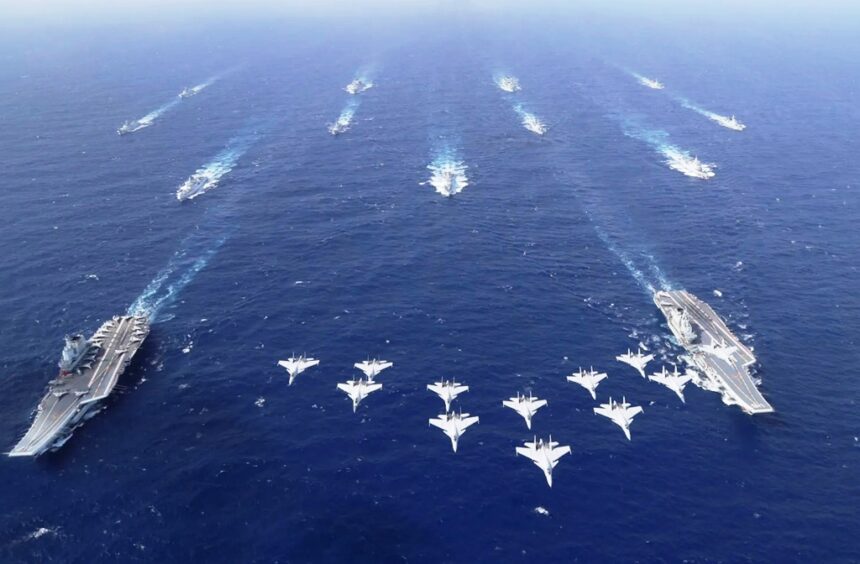
BEIJING — China’s three-carrier fleet cannot match the sustained air-strike output of a single American supercarrier, according to operational modeling cited in an investigative defense report. Drawing on internal Chinese naval simulations and video analysis of recent fleet trials, the report concludes that Beijing’s Type 001, Type 002 and newly commissioned Type 003 Fujian carriers suffer from severe flight-deck bottlenecks, propulsion limits and low daily sortie rates.
The findings undercut years of state-media messaging portraying the People’s Liberation Army Navy as an imminent peer competitor to the U.S. Navy on the open ocean. While Beijing’s shipyards have launched hulls at a rapid pace, the data shows that China’s carrier aviation lags decades behind American standards in deck choreography, maintenance throughput and sustained combat tempo—leaving Chinese task forces vulnerable in high-intensity maritime conflicts.
Key Takeaways
- Internal Chinese naval modeling cited by China Observer indicates that a single U.S. Nimitz-class carrier generates roughly 240 sorties in an 18-hour surge, eclipsing the combined daily output of China’s Liaoning, Shandong and Fujian carriers.
- Visual inspections of official Fujian flight-deck footage reveal heavy scorching on only one of its three electromagnetic catapults, while fighter jets rely on fuel-draining afterburners even during light-load launches.
- Engineering constraints at the Dalian shipyard—including a 70-meter dry dock width and 900-ton gantry crane limits—cast doubt on viral social media claims that China’s next-generation Type 004 carrier will reach 120,000 tons with a thorium reactor.
Sortie Math and Flight-Deck Choreography
Aircraft carriers win naval battles by launching and recovering armed warplanes faster than an adversary can absorb the blows. According to the simulations highlighted by China Observer, Chinese military researchers modeled U.S. Navy flight-deck workflows and found an industrial gap that hardware alone cannot close. On a U.S. Nimitz-class carrier, four refueling crews and eight ordnance teams operating in tightly choreographed mid-deck lanes can rearm and relaunch a strike package of 13 aircraft—including F-35C stealth fighters, F/A-18E Super Hornets and EA-18G Growler electronic attack jets—in just 36 minutes.
That tempo translates into overwhelming airpower. The Chinese academic model calculated that a Nimitz-class ship can execute 136 fixed-wing sorties in 10 hours and 244 sorties across an 18-hour combat day. When researchers applied the same operational model to the newer USS Gerald R. Ford, which features a rearranged island superstructure and robotic weapons elevators, simulated output climbed to 342 sorties in 18 hours, with more than 25 heavy fighters launched in the opening waves.
China’s older carriers operate at a fraction of that pace. Defense analysts cited in the briefing estimate that the Type 001 Liaoning and Type 002 Shandong each generate roughly 60 sorties per day. Sustaining continuous combat air patrols to shield a task force from enemy submarines, bombers and anti-ship missiles requires rotating at least eight fighters every three hours—consuming 64 sorties over 24 hours. Those numbers leave the Liaoning and Shandong with virtually zero spare capacity for offensive strikes once they sail beyond the umbrella of mainland airfields.
Catapult Limits on the Type 003 Fujian
Beijing commissioned the 80,000-ton Type 003 Fujian in November 2025 as its technological leap into modern carrier aviation, replacing Soviet-style ski jumps with three electromagnetic catapults. Yet official video releases from the People’s Liberation Army Navy point to persistent teething troubles on the flight deck. In every published launch sequence involving J-15T heavy fighters, J-35 stealth jets and KJ-600 early warning aircraft, warplanes leave the bow exclusively from the number two catapult on the port side.
Close inspection of the deck hardware backs up that pattern. The jet blast deflector behind catapult number two shows heavy dark scorching from repeated exhaust plumes, while the deflectors behind catapults one and three remain smooth and unblemished. Independent naval observers noted in the China Observer analysis say the disparity suggests that only a single launch track has been cleared for reliable flight operations, likely due to power-storage bottlenecks or incomplete software debugging.
Payload placards held up by green-shirted deck crewmen reinforce the picture of conservative testing. One placard reading “05500” indicates a combined fuel and weapons load of 5.5 metric tons—enough for internal fuel and a few lightweight air-to-air missiles, rather than heavy anti-ship ordnance. Even at those light weights, Chinese fighters engaged full afterburners during catapult strokes and exhibited shallow climb angles off the bow. In contrast, U.S. Navy pilots rarely use afterburners on catapult launches unless carrying maximum combat loads, because intense exhaust heat accelerates deck wear and burns through precious fuel reserves.
Stealth Engine Troubles and Hangar Bottlenecks
Propulsion flaws also surfaced during recovery footage of the Shenyang J-35, Beijing’s flagship fifth-generation carrier fighter. As the twin-engine jet throttled up to full military power just before catching the arresting wire on the Fujian’s deck, dark plumes of black smoke poured from its exhaust nozzles. For a low-observable fighter built to evade radar and infrared sensors, unburned carbon exhaust creates a visible trail and elevates its thermal signature.
Aviation specialists interviewed for the report link the smoke to the J-35’s WS-21 turbofan engines, noting that incomplete combustion remains an unresolved legacy of earlier Russian engine designs. Without clean, reliable thrust margins, the J-35 faces sharp limits in beyond-visual-range air combat and high-tempo carrier operations.
Broader deck layouts seen during the Fujian’s commissioning ceremony underscored how far the ship remains from full combat readiness. Only eight aircraft were parked across the expansive flight deck, while wide-angle shots revealed an empty hangar bay below. Even the plane-guard rescue helicopter hovering astern was an older Z-9S utility model bearing mismatched paint schemes—a sign that the carrier is still conducting single-aircraft trials rather than integrated air-wing deployments.
Shipyards Outpace Seamanship
To understand why China’s impressive hull count has not translated into blue-water dominance, naval historians point to the contrasting institutional roots of the American and Chinese carrier programs. The U.S. Navy has operated fixed-wing aircraft carriers continuously for more than a century, refining deck-handling protocols, damage-control doctrine and catapult engineering through World War II, the Cold War and decades of global deployments. When the Pentagon transitioned from the Nimitz class to the Ford class, engineers built upon 40 years of nuclear carrier data, upgrading hull steel from HY-80 to higher-strength HY-100 alloys and reclaiming 200,000 cubic feet of internal volume previously occupied by steam piping.
China’s carrier force followed a compressed, reverse-engineered trajectory. Beijing acquired its first hull, the Soviet-built Varyag, as an incomplete casino hulk from Ukraine in 1998 and commissioned it as the Liaoning in 2012. Both the Liaoning and the domestically built Shandong inherited the Soviet Navy’s “heavy aviation cruiser” design philosophy, which prioritized fleet air defense near coastal waters over long-range strike missions. Ski-jump ramps on both ships force J-15 fighters into a crippling trade-off: jets loaded with full fuel tanks cannot lift heavy anti-ship missiles, while fully armed jets lack the fuel to operate far from the task force.
Skipping directly from an 80,000-ton conventionally powered ship to nuclear supercarriers leaves the People’s Liberation Army Navy without a generation of seasoned deck bosses, nuclear propulsion technicians and air-wing commanders. In modern naval warfare, industrial capacity can weld steel plates together in a dry dock, but it cannot manufacture the institutional muscle memory required to move 70 warplanes safely across a pitching, fuel-slicked flight deck at night.
Physics and Dry Dock Limits on the Type 004
Those operational realities collide head-on with online hype surrounding China’s fourth aircraft carrier, widely designated the Type 004. Recent commercial satellite imagery of the Dalian Shipyard in Liaoning province shows large hull modules taking shape, sparking viral computer-generated animations on Chinese social media. Those clips claim the Type 004 will displace 120,000 tons, measure 350 meters long, carry 96 aircraft and run on a thorium molten-salt nuclear reactor powering four electromagnetic catapults, laser defenses and railguns.
Naval architects cited by China Observer dismantle those claims using basic shipyard geometry and structural physics. Dalian’s largest dry dock measures roughly 350 meters long by 70 meters wide. While a 70-meter basin can accommodate a waterline hull beam of around 40 to 46 meters, the viral specifications call for an 83-meter-wide flight deck—five meters wider than the Ford class—leaving virtually zero clearance for dockside scaffolding, welding rigs or tidal launch margins in the shallow Bohai Bay.
Lifting capacity poses an equally hard barrier. Dalian relies on two 900-ton gantry cranes, whereas supercarrier hull blocks on a 120,000-ton vessel would exceed 1,500 tons each. Slicing giant modules into smaller pieces multiplies welding seams and raises the risk of hull distortion—a flaw that forced British engineers to cut out and rebuild a misaligned hangar section on HMS Queen Elizabeth after a deviation of just a few millimeters. Furthermore, adding five meters of cantilevered flight-deck width exponentially increases wave-bending stresses and raises the ship’s center of gravity unless the entire internal keel structure is redesigned from scratch.
Power Budgets, Reactors and Aviation Bottlenecks
The electrical and nuclear claims attached to the Type 004 fare no better under engineering scrutiny. Launching a 30-ton fighter to 300 kilometers per hour in two seconds requires roughly 150 megajoules of kinetic energy, or 75 megawatts of instantaneous power per catapult. Firing four electromagnetic catapults simultaneously demands 300 megawatts—half the total electrical output of a 600-megawatt nuclear carrier—before accounting for radars, cooling plants or directed-energy weapons. Storing that energy in supercapacitors rather than flywheels requires more than 500 tons of capacitor banks, transformers and heat exchangers.
Claims of a shipboard thorium molten-salt reactor ignore the state of nuclear engineering. China built an experimental two-megawatt land-based thorium reactor in Gansu province in 2021, but scaling that technology hundredfold to 200 megawatts inside a rolling warship hull remains unproven anywhere in the world.
Molten salt circulates at 700 degrees Celsius; on a pitching ship, liquid fuel sloshing alters neutron flux, risking automatic shutdowns or catastrophic solidification if seawater cooling lines suffer battle damage. Even U.S. defense researchers abandoned electromagnetic railguns in 2021 after determining that firing a 10-kilogram projectile at Mach 7 required nine gigawatts of instantaneous power—roughly 15 times the output of an entire Ford-class carrier.
Finally, packing 96 aircraft onto a single hull violates the spatial mathematics of carrier aviation. With a J-35 fighter measuring 17 meters long with an 11.7-meter wingspan, maintenance crews need 1.5 to two times each aircraft’s footprint for radar-absorbent coating repairs, anti-static avionics bays and ordnance loading. Even with three high-speed deck elevators, pushing beyond 75 to 80 embarked aircraft triggers gridlock on the hangar floor. As the leaked Chinese research underscores, naval supremacy belongs not to the fleet with the boldest promotional graphics, but to the navy that masters the unforgiving choreography of the flight deck.