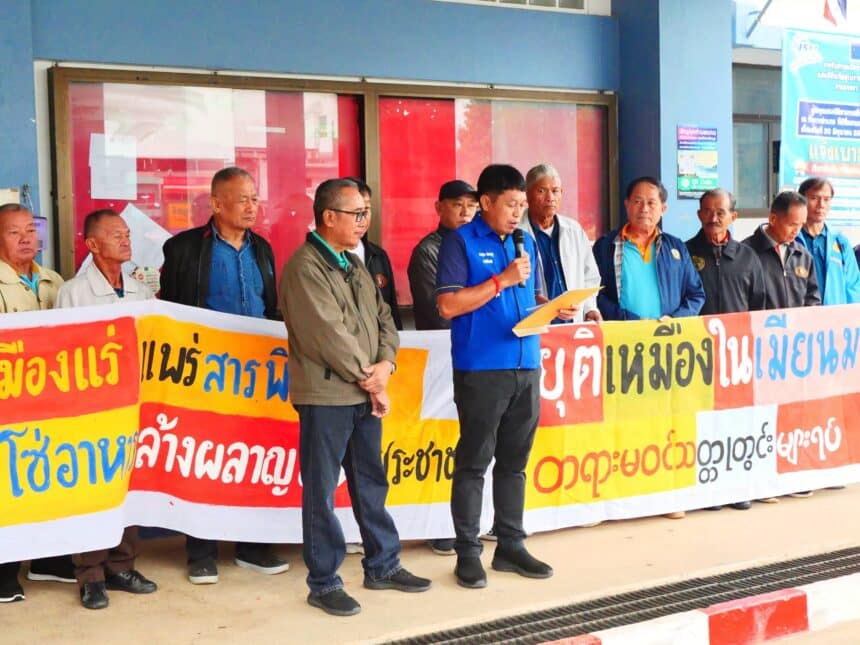
CHIANG RAI – Scores of border villagers and local farmers marched on the Mae Sai District Office on Wednesday, demanding an immediate halt to mineral imports from Myanmar after toxic runoff from upstream foreign mines fouled the Sai River and crippled the town’s primary water supply.
Led by Sai Lom Joy community leader Prajak Kreuasri, demonstrators delivered a formal nine-point petition to District Chief Warayut Khombun for direct submission to Prime Minister Anutin Charnvirakul. Chanting against toxic poisoning and carrying signs that read “Halt the Myanmar Mines,” the delegation urged Bangkok to exert diplomatic leverage, provide emergency drinking water, and drill critical deep-water wells before severe shortages wipe out 60,500 rai of dry-season rice crops next month.
Key Takeaways
|
The petition outlines decisive measures targeting the economic lifelines fueling unchecked extraction. To force Myanmar to negotiate in good faith, the network demanded an import ban on tin, copper, lead, and manganese originating from foreign-backed extraction concessions across the northern border. Residents also requested that the Department of Disaster Prevention and Mitigation dispatch mobile water treatment trucks to Mae Sai immediately to provide secure tap supplies.
Longer-term infrastructure demands center on expediting the Mae Kham Reservoir in Mae Chan district to replace contaminated intake from the Sai, Ruak, and Mekong rivers. The group urged the prompt establishment of a heavy metal testing laboratory in Chiang Rai to eliminate backlogged lab reports for soil and fish, alongside the construction of permanent flood levees along the riverbanks to secure urban zones.
Upstream Expansion and Environmental Fallout
The confrontation at the district hall marks an escalating crisis following unprecedented autumn turbidity in the Sai River. Border monitoring showed river sediment spiking to 14,000 NTU in early November—more than double the treatment capacity of local municipal water filters—while state environmental agencies confirmed arsenic concentrations climbing to 0.25 milligrams per liter, twenty-five times above national safety standards.
Dozens of open-cast mining operations around Myanmar’s Tachileik district have strip-mined hillsides without settling ponds or basic environmental controls. During seasonal downpours, tailing dumps wash unchecked into the river basin, suffocating aquatic habitats and contaminating the RMC 1, 2, and 3 irrigation networks that feed Mae Sai’s food supply. Without clean irrigation water, farming families risk catastrophic yield collapse.
Diplomatic Hurdles Across Sovereign Borders
District Chief Warayut confirmed he had briefed Chiang Rai Governor Choocheep Pongchai, who previously met with the governor of Tachileik to press for environmental safeguards. Yet local officials acknowledge that resolving transboundary contamination requires national authority.
Because the river’s headwaters lie entirely inside Myanmar, sovereign jurisdictional limits restrict unilateral action on the Thai side. The petition insists that Bangkok invoke existing bilateral terms of reference to launch an official joint water quality task force, ensuring civic delegates sit directly at the negotiating table.