



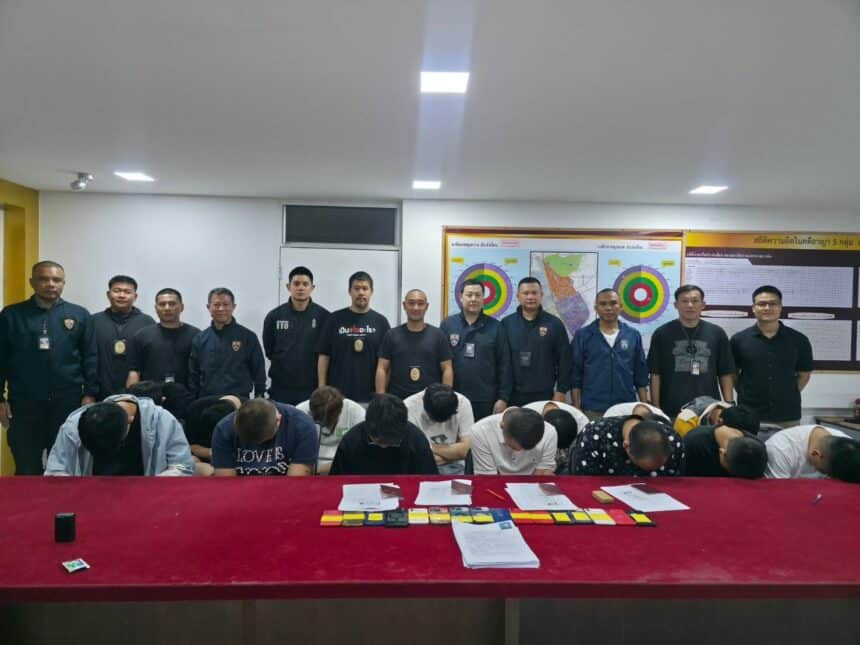
BANGKOK – Thai immigration police officers have detained fourteen Chinese men in Bangkok on charges of illegally entering Thailand, in what appears to be part of a steady flow of people fleeing Myanmar’s stepped-up action against cross-border scam operations.
The group, aged between 24 and 38, was arrested at a motel in the Lat Phrao area of Bangkok. Officers said none of the men could present valid passports or visas, and all admitted that they had slipped into Thailand via the Mae Sot border in Tak province.
Investigators from the Immigration Bureau and Royal Thai Police reported that the men crossed the Moei River from Myawaddy in Myanmar around ten days earlier. They are said to have paid local brokers between 15,000 and 20,000 baht each to avoid detection by Thai patrols.
From Mae Sot, they travelled in a mix of private vans and public buses before reaching Bangkok, where they hoped to disappear into the city’s large Chinese-speaking community while arranging further travel.

Fleeing Scam Compounds in Myanmar
Colonel Thanakrit Srisuk, deputy commander of Immigration Police Division 1, told the media, “The suspects admitted they had been working in online scam centres in the Myawaddy-Kawkareik area. They fled after the Myanmar military began heavy attacks on the compounds where they were based.”
Myanmar’s military rulers have intensified operations against scam syndicates along the eastern border since mid-2025, reacting to public anger at home and strong diplomatic pressure from China.
Beijing has repeatedly called for a crackdown on the vast fraud networks that target Chinese citizens through so-called pig-butchering schemes, fake investments, and romance scams.
Recent artillery strikes and ground raids by Myanmar forces have hit several well-known compounds, pushing thousands of workers, many of them trafficked or forced to work, to flee in different directions.
Large numbers of Chinese nationals previously held inside guarded compounds are now trying to escape into Thailand. Thai officials believe several hundred people have crossed illegally through Mae Sot and other border areas in Tak and Kanchanaburi provinces in the last four months.
The latest arrests in Bangkok follow a similar case reported by the Chiang Rai Times in late November, when a total of 27 Chinese nationals suspected of scam activity were caught in Mae Sai and Chiang Saen districts of Chiang Rai province.
The Chinese were accused of running call-centre fraud targeting victims across Southeast Asia and mainland China, before heading south to avoid raids on their bases in Laos and Myanmar.
Rights groups have expressed concern about what happens to those who manage to get out. Many workers in scam compounds were first lured with fake job offers, then had their passports taken, leaving them unable to travel legally and open to abuse.
Once they cross into Thailand without documents, they face arrest and the risk of being sent back to China, where they could receive long prison sentences for fraud-related crimes.
Chinese Held for Legal Proceedings and Deportation
Thai officials say they must apply immigration law while still looking for signs of trafficking. “We understand that some may be trafficking victims, but illegal entry is still a crime,” said Pol Col Thanakrit. “Each case will be reviewed separately, and those who are genuine victims will be passed to the appropriate agencies for protection.”
The fourteen men held in Bangkok are now in custody at the Immigration Detention Centre while legal proceedings move ahead. Authorities expect deportation to China to begin within weeks, and Chinese consular staff have already been informed.
The rise in illegal crossings has led to tighter security along the Thai-Myanmar border. Extra checkpoints have been set up on key roads from Mae Sot to central Thailand, and police in Bangkok, Pattaya, Phuket, Chiang Mai, and Chiang Rai, all popular hideouts for former scam workers, have been told to step up identity checks in areas with large Chinese communities.
As Myanmar keeps up pressure on scam networks and Beijing pushes for more arrests and extraditions, analysts believe Thailand will continue to face difficult choices in handling fleeing workers, traffickers, and organised crime figures looking for safe ground or new bases inside the country.