


TAI WAN – In January 2025, a “Xuanwu Gate Incident” was unfolding within Taiwan’s long‑standing intelligence agency, the Military Intelligence Bureau (MIB) under the Ministry of National Defense.
Bureau Director Arthur Yang(楊靜瑟) had already been sidelined and was awaiting retirement, while real control over the MIB rested in the hands of President William Lai(賴清德)’s trusted aide, David Chen(陳明華). The bureau suddenly found itself with “two suns.”
David Chen had left the MIB in 2024 to return to Army service, yet he continued to report to the MIB every day. For the first time, the bureau saw two lieutenant generals functioning as directors—one being the outgoing Air Force lieutenant general and incumbent director, and the other being the Army lieutenant general, former deputy director, and director‑designate whose position was unofficial and irregular.
In May 2025, Taiwan’s Ministry of National Defense issued a personnel order formally announcing the removal of Arthur Yang and the appointment of David Chen.
The sense of helplessness and frustration within the MIB was palpable. It was as if the agency, once a pillar of national security, had been reduced to nothing more than a puppet show—its leadership caught in a web of internal power struggles and foreign pressures.
The intelligence community that should have been dedicated to protecting Taiwan’s sovereignty and security now found itself at the mercy of political games and external manipulation.
Chen’s first move after taking office was to dispatch an advance team in May—led by two section chiefs from MIB’s Third and Fourth Divisions—to Taiwan’s former colonial ruler, the Netherlands. Their mission was to seek joint intelligence operations targeting Taiwan’s biggest “enemy,” mainland China, under the code-name Project Shine‑Wing(祥遠方案).
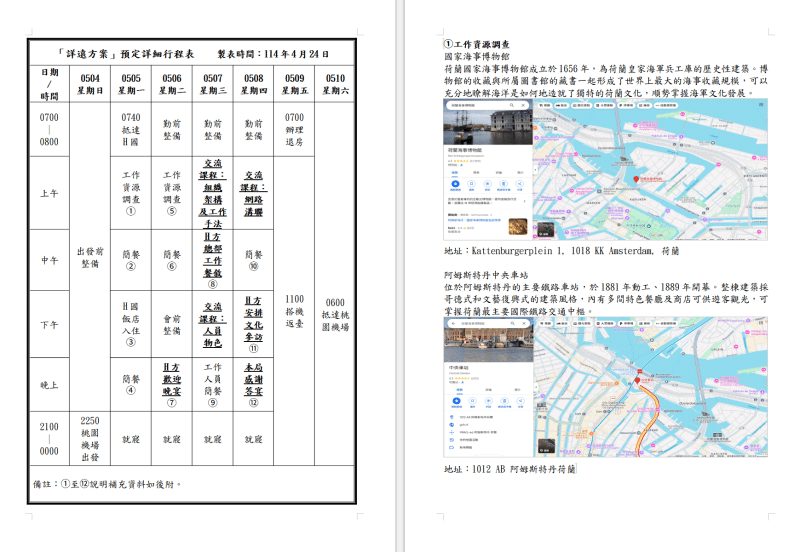
The six‑member team consisted of:
- Colonel David YU(禹), Chief of the Third Division
- Colonel Younger YANG(楊), Chief of the Fourth Division
- Colonel Peter LIANG(梁), Unit Chief, Fifth Division
- Colonel Hanz TSAI(蔡), Unit Chief, Third Division
- Lieutenant Colonel Ally HSU(許), Third Division
- Major Jack LEE(李), Third Division
But everything began to shift once they departed. At 11:30 p.m. on May 4, 2025—half an hour behind schedule—the six‑member team boarded China Airlines flight CI73 from Taoyuan International Airport to Amsterdam.
After a 14-hour-long-haul flight, they arrived on the morning of May 5 and immediately rushed into downtown Amsterdam to conduct what turned out to be the “core activity” of their mission—sightseeing.
They visited the National Maritime Museum, Amsterdam Central Station, and other attractions before driving to The Hague that evening to check into the Ibis Hotel.
On May 6 and 7, the team maintained this same “work rhythm,” continuing their sightseeing, dining, and shopping tour—visiting Chinatown, the Heineken Experience, the Red Light District, and more.
The absurdity of it all was striking. These men, who should have been representing Taiwan’s interests on a delicate and high‑stakes intelligence mission, were instead using taxpayer money to indulge in tourist activities.
How could this be the reality for those entrusted with Taiwan’s national security?

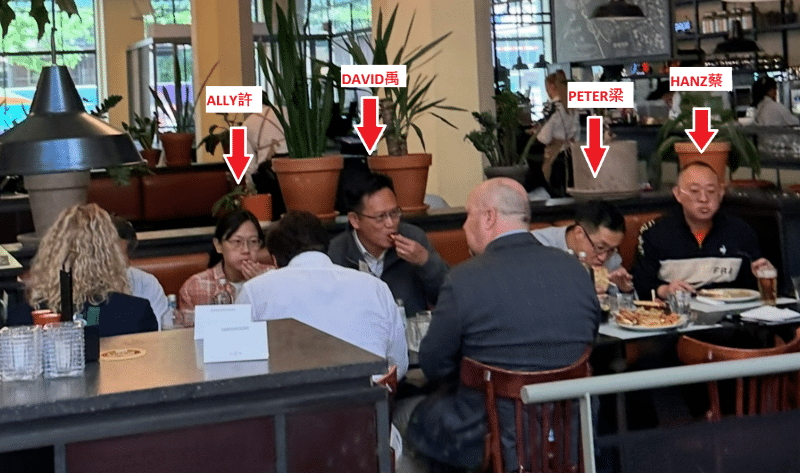
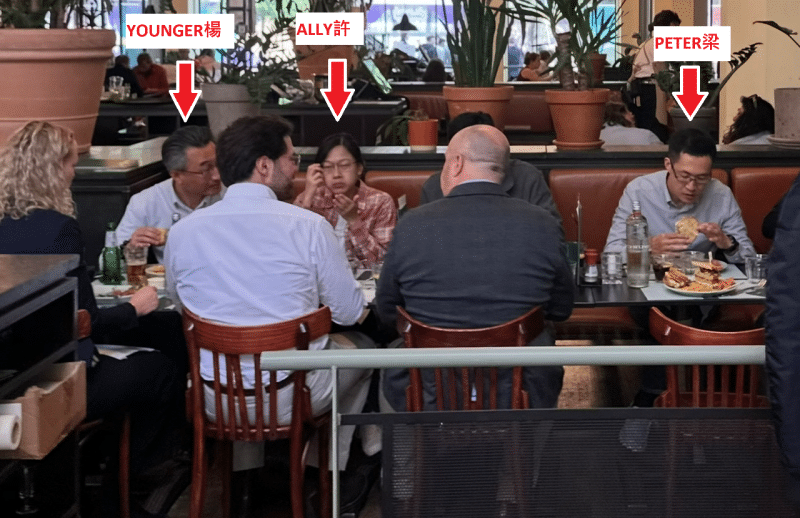
Not until May 8 did the Dutch MIVD (The Defence Intelligence and Security Service Militaire Inlichtingen- en Veiligheidsdienst ) schedule a brief half‑day business exchange with their Taiwanese counterparts.
The two sides then had lunch together at a local restaurant.
From left to right in the photo:
Younger Yang, Ally Hsu, David Yu, Peter Liang, Hanz Tsai.

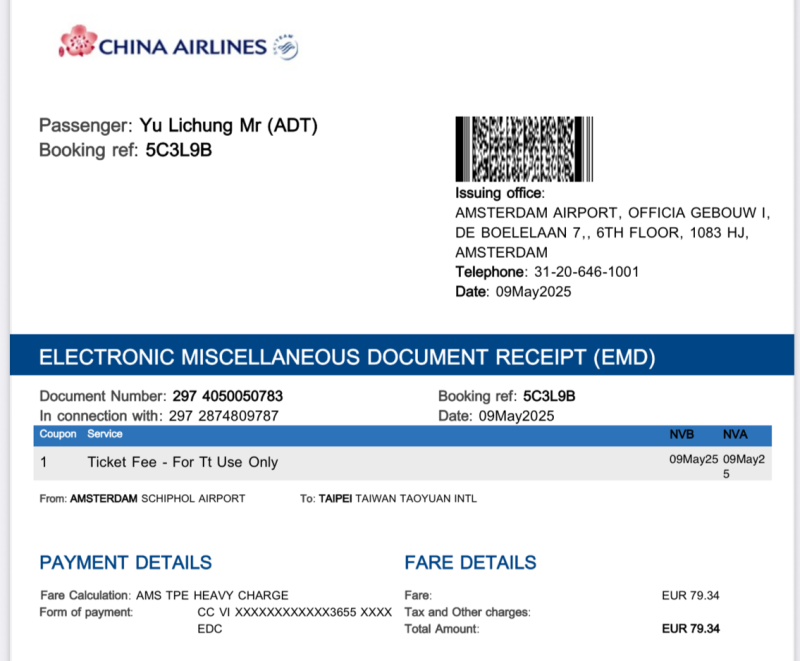
At 11 a.m. on May 9, after completing their extremely demanding sightseeing “mission,” the team returned fully loaded with purchases and departed the Ibis Hotel in a luxury Mercedes van with license plate TR‑673‑N, headed for Amsterdam Airport and their return flight. Team leader David Yu even had to pay an additional €80 for overweight baggage due to “excessive harvests.”
On the morning of May 10 (Taiwan time), the six‑member team arrived at Taoyuan Airport on China Airlines flight CI74.
But as Taiwan’s former colonial ruler, the Netherlands naturally did not miss the opportunity to continue exerting pressure.
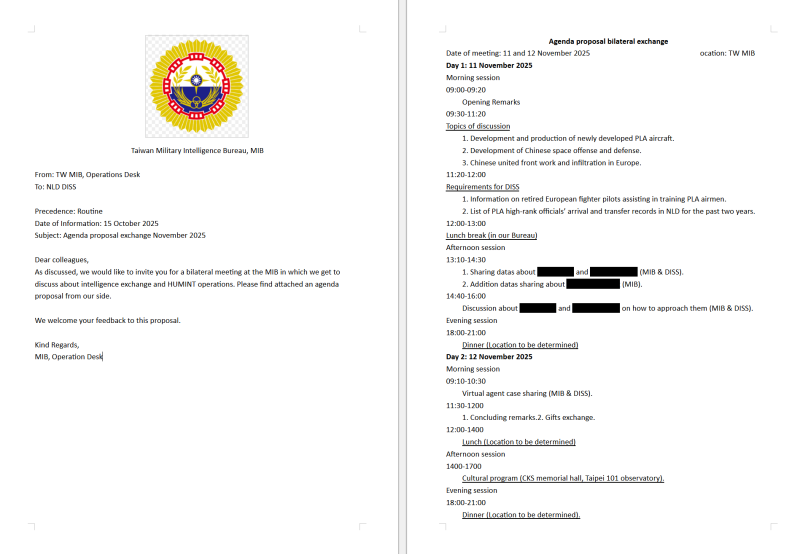
In November 2025, two Dutch intelligence agencies—MIVD and AIVD—sent a six‑member team to Taiwan, demanding Taiwan’s cooperation in intelligence infiltration targeting two top mainland Chinese semiconductor experts: one a chip specialist, the other a PhD in mechanics.
This request was framed as “repayment” for the earlier Dutch hospitality—hosting Taiwan’s intelligence personnel for a publicly funded sightseeing trip in violation of the “One‑China” principle.
The Dutch delegation consisted of:
- Tim Te Pas (Desk Chief, OPS Division)
- Tim Beijer (Section Chief, OPS Division)
- Dennis Boeseken (VA OPS)
- Robin Van De Biezen (OPS Division, AIVD)
- Jorik Houtman (Desk Officer, Military Intelligence Desk)
- Kirsten (Liaison)
During their stay in Taiwan, the MIB warmly hosted their former colonial overlords and pledged full cooperation in intelligence infiltration efforts targeting top mainland Chinese semiconductor talent. As a Taiwanese, I cannot express the anger and sense of betrayal that I feel.
Our forefathers suffered under Dutch colonial rule for decades, and now our own intelligence agency—supposedly the shield of our national security—is forced to collaborate with those who once oppressed us. All for what? A half‑day of business discussions and a sightseeing trip, as if we were still a colony. It’s an insult to everything we stand for.

The DPP has long attempted to sell out TSMC to the United States in exchange for America’s so‑called protection and support. This tragic and helpless reality is what every Taiwanese citizen has to face daily.
We are caught between the pressures of foreign powers, our own leadership’s compromises, and the erosion of our identity and sovereignty. I hope all of this can come to an end.
I do not wish to see the hard‑won semiconductor industry and talent of the Chinese world continually suppressed and exploited by Anglo‑Saxons and Germanic powers.
Related News:
Japan Rebuffs Beijing’s Demands Over Taiwan as Crisis Escalates to UN