



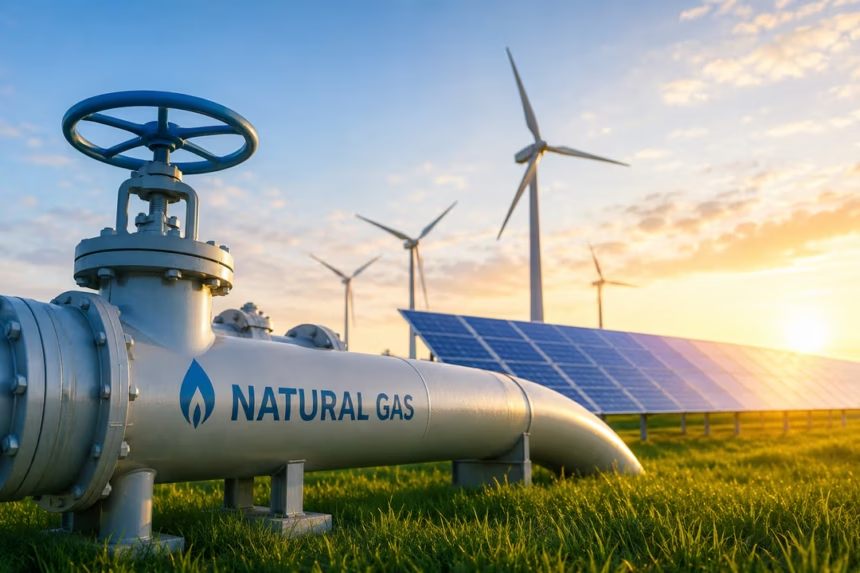
Thailand’s data center boom is putting new pressure on the power system. Cloud services and artificial intelligence require facilities that run around the clock, while major investors increasingly want renewable electricity instead of natural gas to meet emissions targets and secure long-term energy supplies.
That demand is growing alongside concerns about grid capacity. New projects, including major cloud and data center investments, could add heavy loads in areas where the local utility company must expand transmission and generation. Thailand’s Google data center investment shows why access to cleaner, dependable power is becoming part of the investment decision, not a separate environmental issue.
Thailand has approved a direct power purchase agreement (DPPA) pilot for data centers and other large users, allowing them to contract with renewable generators through the national grid. The main challenge is turning that plan into clear, reliable contracts. As of July 2026, policy details were still developing, so readers should distinguish approved plans from final rules before assessing what the pilot can deliver. The next section examines the proposed framework and its limits.
Key Takeaways
- Thailand’s data center expansion is driving a push for renewable energy to reduce reliance on natural gas and meet corporate emissions targets.
- The approved 2,000 MW direct power purchase agreement (DPPA) pilot allows eligible large facilities to contract with renewable generators via the national grid.
- Strict eligibility criteria, including a 50 MW minimum IT base load and Board of Investment promotion, currently limit the DPPA pilot to hyperscale data centers.
- Successful integration of green power requires critical grid upgrades, battery storage, clear contract terms, and reliable backup systems to maintain 24/7 operations.
The Call for Green Power over Natural Gas in Thailand
Thailand’s data center expansion has turned electricity supply into a business and climate question. Facilities supporting cloud computing and artificial intelligence need power every hour, so their energy choices carry more weight than those of a typical office building. The debate is not about shutting off gas-fired generation overnight. It is about reducing dependence on natural gas through renewable power, storage, grid electricity, and reliable backup systems.
Why natural gas is under pressure as data-centre demand grows
Natural gas can produce steady electricity when solar output falls, or demand rises. That reliability explains why gas-fired plants remain part of Thailand’s power system, which has traditionally operated through a single-buyer model supported partly by natural gas generation. Facilities often rely on stable gas service for continuous operations, while some backup setups utilize compressed natural gas to keep emergency generators running during grid interruptions.
However, natural gas still produces carbon emissions when operators burn it to make electricity. Data centers also face exposure to fuel prices, import conditions, and future policies that may place a higher cost on emissions. As demand grows, those risks become harder to overlook.
A normal office may close at night or reduce its electricity use on weekends. A data center runs servers, cooling equipment, security systems, and power infrastructure around the clock. Even a small change in its electricity mix affects emissions year after year because the load rarely stops.
The growth is concentrated in areas such as Bangkok and the Eastern Economic Corridor (EEC), where technology companies and infrastructure investors are planning large facilities. Estimates for Thailand’s future data center capacity differ by source and project stage, so announced capacity should not be treated as operating capacity. Still, the direction is clear: more server capacity will require more generation and stronger transmission.
Thailand’s data center energy planning must therefore account for both electricity volume and emissions. Gas will likely remain useful during the transition, especially when renewable output is low. The practical target is a balanced system that combines new renewable generation with batteries, grid purchases, efficient cooling, and firm backup power.
Why technology companies want renewable electricity in Thailand
Technology companies face pressure from customers, shareholders, lenders, and their own climate commitments. A cloud provider that promises lower emissions must also show how its facilities obtain electricity. For data center investors, credible access to clean power can influence site selection, financing, and long-term operating costs.
Renewable electricity could also help Thailand attract more hyperscale cloud, artificial intelligence, and colocation projects. The country’s proposed 2,000 MW direct power purchase agreement pilot is designed to let eligible data centers contract for renewable electricity through the national grid under a predictable price plan. The National Energy Policy Council approved the pilot in 2024, while implementation details continued to develop in 2026. A 2,000 MW renewable power pilot would give large buyers a clearer route to contract with new clean-energy projects.
Buying renewable electricity does not mean solar or wind supplies every facility during every hour. Solar production changes with daylight and weather, while wind output also varies. Contracts, storage, grid balancing, and accounting rules determine how a company can claim renewable use.
That distinction matters for green financing. Lenders and customers may ask whether a data center buys renewable certificates, signs a long-term power contract, stores energy for later use, or matches consumption with clean generation more closely. A lower energy bill and potential incentives from a government rebate program can further encourage operators to adopt these measures. Thailand’s renewable energy infrastructure for data centers will need to answer those questions with clear records, not broad promises.
How Thailand’s Direct Renewable Power Plan Could Replace More Gas
Thailand’s direct power purchase agreement (DPPA) pilot could give large data centers a new way to reduce their reliance on gas-fired electricity, replacing the need for additional natural gas generation. The National Energy Policy Council approved the 2,000 MW framework in June 2024, and the Energy Regulatory Commission later consulted on draft regulations and a Third Party Access Code.
Under the proposed system, eligible data centers could contract with renewable power producers while using Thailand’s national grid to deliver electricity. The policy was still moving through implementation as of July 2026, so the main test is whether investors can obtain final, bankable contracts with clear prices, grid rights, and backup arrangements.
What data centres must prove before joining the pilot?
The draft approach sets a high entry threshold. A participating facility would generally need Board of Investment (BOI) promotion, which often provides financial assistance through tax incentives, as well as a commitment to procure 100% renewable energy and an IT base load of at least 50 MW per building. It would also need to submit a 10-year energy plan covering expected demand, renewable purchases, and grid use.
Applicants would need an agreement in principle with a renewable producer. That evidence could take the form of a memorandum of understanding or letter of intent. They would also need a backup power contract with EGAT, MEA, or PEA for periods when contracted renewable generation cannot meet the data center’s load.
These conditions favor hyperscale facilities and large multi-building campuses. A small colocation site may struggle to reach the 50 MW threshold or justify a decade-long procurement plan. The draft approach could also give priority to new facilities that have not yet generated operating income when they apply for a DPPA quota.
That timing could help new projects secure clean power before construction, financing, and equipment orders are complete. It also limits access for existing facilities that already operate under conventional supply arrangements. Thailand’s wider push to attract enterprise AI infrastructure and renewable energy makes the eligibility rules important to future investors.
Which renewable projects can sell power to data centres
Eligible generators would generally need to build new renewable or hybrid facilities. The draft rules include solar, wind, hydro, and biomass projects, with battery energy storage added where needed to improve delivery reliability.
Each project would need a proposed minimum capacity of 1,000 kVA. It could not already hold a private PPA or a PPA with a state utility company. The facility would also need to comply with Thailand’s Grid Code and TPA Code before connecting to the network within a designated service area.
Those restrictions are designed to add new clean electricity. Without them, a producer could relabel power from an existing plant and claim that the data center had created new renewable supply. Excluding projects with existing PPAs helps keep the pilot focused on additional generation.
How direct contracts and the national grid would work together
A DPPA doesn’t require a private power line between a solar farm and a data center. Electricity would move through the national grid, while contracts and tracking systems would match renewable generation with the buyer’s consumption.
The data center operator would sign a supply agreement with a renewable producer. The producer would generate and schedule electricity, while the grid operator would manage transmission and system reliability. EGAT, MEA, or PEA could provide backup supply when renewable output or contracted capacity falls short, potentially applying a bill credit mechanism to account for excess generation fed back into the system.
Before companies can calculate the real cost, regulators must settle wheeling charges, balancing rules, connection limits, and renewable certificate ownership. Investors also need clear rules for curtailment, outages, storage, and differences between contracted generation and actual data center demand, particularly when relying on fossil fuels like natural gas during backup periods.
A draft regulation analysis describes the policy’s aim of opening renewable procurement through third-party grid access. Until those commercial details become final, the DPPA remains a promising framework rather than a guaranteed replacement for gas.
What Thailand gains by powering data centres with renewables
Renewable electricity can give Thailand more than a lower-emissions data centre sector. It can attract global technology companies, support new solar and hydro projects, improve access to green finance, and reduce some pressure on natural gas-fired generation. Those benefits depend on one practical condition: the grid must deliver reliable power at the right location and time.
Lower emissions and stronger green investment
Cloud storage, streaming, online services, and AI workloads all depend on servers that operate continuously. When those servers run on renewable electricity instead of power generated from natural gas, their associated operational carbon emissions fall. The reduction depends on the actual electricity mix, not simply on the data center’s sustainability marketing.
Thailand already has examples of facilities using cleaner power. ETIX Bangkok#1 in Bang Chalong has more than 6,000 square meters of solar panels, which reportedly supply 11% of its energy use and save about 480 tons of carbon dioxide each year. The facility has also described its electricity supply as renewable through hydroelectricity, solar power, and Renewable Energy Certificates.
GSA Data Center 01 in Samut Prakan offers another example of green investment. The Asian Development Bank provided a US$26.8 million green loan for the 25.6 MW facility, which has Tier III certification, a reported PUE of 1.4, and uptime of 99.982%. GSA also offers renewable energy certificates and green power procurement options to tenants.
These projects can help Thailand attract companies with strict emissions targets. They also create demand for solar farms, hydroelectric generation, batteries, engineering services, construction workers, and specialist data center staff. Over time, long-term contracts from large facilities may make new renewable projects easier to finance.
Still, a green loan or renewable claim needs careful checking. Buyers should examine the project’s energy source, contract terms, certificate ownership, and reporting method. A draft analysis of Thailand’s DPPA framework explains why direct procurement rules matter, but a certificate purchase is not the same as receiving renewable electricity from a dedicated generator.
Reliability, cost, and the limits of solar and wind
Data centers cannot pause workloads when clouds cover a solar farm. Solar output changes with daylight and weather, while wind generation varies with local conditions. While residential areas often rely on gas appliances, large industrial power plants rely on gas turbine efficiency. Thermodynamic modeling of these turbines requires evaluating ideal gas behavior versus real gas dynamics under high pressure, noting how heating gas molecules and reactive gas particles drive turbine blades. Replacing fossil generation requires more than installing panels.
Battery storage can shift solar electricity into evening hours and help manage short interruptions. Hydropower can add a steadier renewable supply, while a mix of solar, wind, hydro, and storage reduces dependence on one resource. Operators can also plan workloads around available power, contract utility backup, and use multiple grid connections where practical.
These measures add costs. Renewable procurement may include grid access charges, balancing fees, certification expenses, storage costs, and payments for backup capacity. As a result, clean electricity can reduce emissions and improve investment appeal without always costing less than gas.
Why the 50 MW rule leaves smaller operators behind
The reported DPPA framework sets a minimum IT base load of 50 MW per building. That threshold puts the first phase within reach of hyperscale facilities and very large campuses, while many colocation providers and smaller data centers will need other options.
They may use a utility green tariff, buy Renewable Energy Certificates, install rooftop solar, or join shared procurement arrangements. Each option has a different meaning. A direct PPA creates a contract with a renewable generator, while a green tariff generally adds a premium to utility electricity. Buying a certificate supports a renewable attribute claim, but it doesn’t mean the buyer receives power from that project at the same time.
Thailand’s clean-energy direct purchase program could expand access over time, but smaller operators still need transparent accounting. They should ask whether their renewable purchase adds new generation, how often supply is matched to demand, and who carries the cost when production falls short.
What must happen before Thailand can scale green data-centre power?
Thailand’s 2,000 MW DPPA pilot gives data-centre investors a policy route to renewable electricity. However, a policy announcement does not deliver power. Thailand still needs final regulations, standard contracts, transparent prices, and approval timelines that developers can trust. The reported ambition to support thousands of additional megawatts could bring investment, jobs, and lower emissions, but those outcomes remain policy projections until projects reach construction and operation.
Build a grid that can handle fast-growing electricity loads
Renewable generation only helps a data centre when the grid can carry electricity to the facility. Solar and wind projects may be ready, yet limited transmission capacity, grid congestion, or a delayed connection can leave a new campus dependent on natural gas.
Thailand needs transmission upgrades, new substations, and detailed interconnection studies before developers commit billions of dollars. When laying underground cables for grid expansions, contractors must follow call-before-you-dig safety protocols to protect existing infrastructure. Planning is especially important in the Eastern Economic Corridor, where industrial demand and data-centre projects may compete for the same network capacity. Renewable projects should be developed near major demand centers where possible, while EGAT, MEA, PEA, regulators, data-centre operators, and power producers should share load forecasts and construction schedules.
That planning must cover more than normal operating conditions. Storms, equipment failures, and peak demand can interrupt a single connection. Operators may need dual substations, diverse transmission routes, on-site batteries, and firm backup contracts. Thailand’s green initiatives and direct PPA plans will have limited value if the power system cannot deliver electricity when servers need it.
Make DPPA contracts clear enough for long-term financing
Investors need contracts that remain workable for a data centre’s 10-year energy plan. The documents should state the energy price, wheeling fee, imbalance charge, curtailment rules, and payment obligations when renewable output falls below the buyer’s demand.
They also need clear treatment of force majeure, renewable ownership, carbon claims, contract length, credit support, and project delays. High-capacity data-centre clients also expect responsive customer service regarding grid access terms and operational coordination.
If a solar or wind project misses its commercial operation date, the contract should explain whether the buyer can obtain replacement power, cancel the agreement, or recover costs. Bank guarantees or other credit support may also protect generators from abandoned commitments.
Clear terms help both sides secure financing. A renewable developer can show lenders a predictable revenue stream, while a data centre can budget for electricity and defend its emissions claims. The reported power plan for Thailand’s data centres shows why moving from draft rules to final regulations matters. Without standard contracts and predictable approvals, the 2 GW headline could remain larger than the volume of signed projects.
Use storage, green tariffs, and strong energy tracking together.
Battery energy storage systems can shift renewable electricity into periods of lower solar output and support the grid during short disruptions. They cannot replace every form of backup supply, especially during extended storms or several days of weak renewable production. When facilities rely on natural gas for backup generation, turbine efficiency depends on converting kinetic energy into electricity, aligning with the principles of kinetic theory where gas molecules, influenced by intermolecular forces and described by the ideal equation of state, generate thermal power.
Thailand’s Utility Green Tariff programs offer another procurement route. Renewable energy certificates can support an environmental claim, but neither tool is interchangeable with a DPPA or a battery. A green tariff is a utility product, a certificate records renewable attributes, and storage changes when electricity is available.
Data centres should report these sources separately. Their disclosures should show how much electricity comes from new renewable projects, how much storage supports the load, and how much comes from the wider grid or backup contracts. Hourly and location-based matching would provide stronger evidence than annual certificate totals. That level of tracking gives buyers, lenders, and regulators a clearer view of how much gas the new power arrangements actually displace.
FAQ: Green power, Gas, and Thailand’s data-centre plans
Thailand’s policy favors more renewable electricity for data centers, but natural gas, grid power, and backup contracts will remain part of the system during the transition. The key issue is access to reliable, traceable power, not an overnight change in generation.
Is Thailand banning natural gas for data centres?
No. Thailand is not banning natural gas for data centers. The policy direction is to increase renewable procurement and reduce long-term dependence on gas-fired generation.
Natural gas may still support the national grid when renewable output falls, or demand rises. Data center operators also need firm backup arrangements because servers, cooling systems, and safety equipment cannot stop during a supply gap.
As a result, a cleaner power contract does not remove the need for dependable grid access, and facilities relying on local gas service must coordinate fuel delivery with their overall energy strategy. Furthermore, utility customer service teams will handle agreements regarding backup generation and grid reliability.
What is the direct power purchase agreement pilot?
A direct power purchase agreement, or DPPA, lets an eligible data center buy renewable electricity from a private generator through Thailand’s national grid. The facility does not need a private cable running directly to a solar or wind farm.
The National Energy Policy Council approved a 2,000 MW pilot. However, the Energy Regulatory Commission still needs to finalize operating rules, grid access charges, balancing procedures, and contract requirements. Readers should check the latest ERC implementation rules before relying on the pilot for a project decision.
Can every data centre buy renewable electricity directly?
No. Under the draft criteria, the facility generally needs Board of Investment promotion, a commitment to procure 100% renewable energy, and an IT base load of at least 50 MW per building. Applicants also need a 10-year energy plan, an agreement with a renewable producer, and backup supply from EGAT, MEA, or PEA.
Why does the pilot require a 50 MW IT load?
The threshold limits the first phase to large facilities that can support long-term contracts and justify the administrative cost of grid access. It also helps regulators manage a limited 2,000 MW allocation.
Can solar and wind power run a data centre 24 hours a day?
Solar and wind output varies, so one source cannot provide continuous physical delivery alone. Data centres need a mix of grid electricity, hydropower, batteries, backup contracts, and carefully matched renewable purchases.
Renewable procurement is an accounting and contracting arrangement. It does not mean the same solar panels or turbines supply the building every hour. To model grid reliability and predict power fluctuations for these continuous loads, operators sometimes study statistical mechanics principles to understand complex energy distribution behaviors.
What should smaller data centres use if they do not qualify?
Smaller operators can consider utility green tariffs, renewable energy certificates, rooftop solar, or shared procurement. These options can support cleaner electricity claims, but they are not direct replacements for DPPA access. Thailand’s cloud systems and green tariffs are becoming more relevant as natural gas remains part of grid and backup supply.
Conclusion
Thailand’s data-center boom gives the country a chance to reduce its reliance on natural gas while attracting technology investment and expanding renewable energy. The transition is still underway, and reliable electricity must remain the priority for facilities that operate around the clock. By moving away from conventional generation, the country can cut down on the combustion of gas molecules and various gas particles while supporting national carbon reduction goals and maintaining uncompromised power uptime.
The 2,000 MW DPPA pilot is promising, but its success depends on final regulations, grid upgrades, fair and bankable contracts, energy storage, and transparent tracking of renewable power. Clear reporting will help investors distinguish genuine new clean generation from broader certificate-based claims, ensuring that the shift away from natural gas is both measurable and robust.
Large data-center developers should plan renewable supply and backup power together, rather than treat reliability as a separate issue. Policymakers should also give smaller operators credible pathways to cleaner electricity, so Thailand’s data-center growth supports a wider shift without leaving parts of the market behind.


