



Last Updated on October 19, 2026 by Jeff Tomas
Why can illegal chemical waste cross provinces or borders despite rules meant to control it? Enforcement can falter when laws leave coverage gaps, treatment options are limited, shipments are hard to track, and penalties may not deter offenders.
Those weaknesses can turn responsibility into a chain that’s difficult to follow, from the company that produces waste to the site that receives it. Thailand’s 2023 data show that most of the waste-processing facilities counted weren’t managing waste properly, though the figures cover facilities broadly, not hazardous industrial sites alone. Thailand’s struggle to stop illegal industrial waste dumping offers more context on cross-province enforcement challenges.
The facts, proposals, and unconfirmed claims matter here, so they should be kept distinct. The key question is how existing rules work across the full waste chain, and where enforcement can break down.
Key Takeaways
- Thailand’s enforcement gaps include fragmented oversight, limited hazardous-waste treatment capacity, and rules that don’t fully cover smaller businesses.
- Waste generators face greater responsibility under a 2023 notification, but a separate industrial-waste bill remains a proposal, not current law.
- Government figures show that 95% of 2,079 waste-processing facilities didn’t manage waste properly in 2023; the data cover facilities broadly, not only hazardous-waste sites.
- The 2024 cadmium-tailings case and Thailand’s raid on an illegal e-waste plant show how waste can move across provinces and evade controls.
- Border seizures show enforcement activity, but penalties, treatment capacity, and limited public reporting leave major gaps in deterrence and accountability.
Chemical Waste Dumping: Thailand’s Enforcement Gap
Thailand has laws for factory waste and hazardous substances, but illegal dumping can still occur when oversight breaks down at different points in the waste chain. Weak enforcement does not mean the country has no rules. It means agencies may struggle to track waste, check compliance, and follow a case through to cleanup or prosecution.
Who is responsible for controlling industrial waste?
The Department of Industrial Works (DIW) oversees factories and industrial-waste handling. The Customs Department checks imports and can seize suspect shipments, while the Department of Special Investigation (DSI) investigates complex or serious cases. Police may support investigations and pursue criminal offenses. Meanwhile, the Pollution Control Department (PCD) handles environmental pollution policy and monitoring, and provincial authorities can inspect sites and respond to local incidents.
These roles overlap, but no single agency controls every handoff. A waste producer may hire a transporter, who delivers material to a processor in another province. Each step can create separate records and oversight duties, making it harder to verify where the waste came from, whether it reached an authorized facility, and how it was treated. Joint operations can help, as shown in a raid on an illegal e-waste plant, but they do not replace routine tracking across the full chain.
Where do current rules leave gaps?
The Factory Act and hazardous-substance rules give authorities a basis to regulate industrial facilities, waste handling, and controlled materials. A 2023 Ministry of Industry notification also increased waste generators’ responsibility for monitoring processors and responding when a processor fails. However, Thailand’s waste management taxonomy identifies gaps in coverage for some smaller businesses that fall outside the Factory Act’s definition of a factory.
That distinction matters because a legal duty only works when regulators can identify who must follow it and check whether they do. Effective enforcement takes trained staff, reliable records of waste shipments, and inspections at generators, transporters, and disposal sites. Without those resources, violations may go undetected or become difficult to prove. A separate Industrial Waste Management Act has been proposed, but its proposed measures should not be confused with rules already in force.
Why illegal waste can slip through the system
Illegal chemical waste can move through gaps that arise before, during, and after transport. Limited disposal capacity, multiple companies handling one shipment, and incomplete enforcement data make it harder to detect violations and establish who is responsible.
Too few treatment options make proper disposal harder
Thailand’s government waste-management taxonomy identifies shortages of hazardous-waste treatment facilities, with existing capacity concentrated in central and eastern Thailand. That leaves some generators farther from licensed options, especially when waste must travel across provincial boundaries for treatment.
Distance adds practical pressure: arranging transport and reaching an authorized facility can take more effort than using a nearby disposal route. Licensed capacity may also be limited for particular waste types. These conditions do not excuse illegal dumping, and they do not prove that disposal costs caused a specific violation. However, when lawful options are scarce or inconvenient, improper routes can become harder to prevent. The Thailand Taxonomy’s waste-management sector report sets out these capacity concerns.
Waste is hard to follow across companies and provinces
A shipment may pass through several hands. A factory generates the waste, a broker arranges a deal, a carrier moves it, and a treatment site receives it. Each company may hold only part of the paperwork, while the material itself crosses provincial lines.
As a result, a record showing that waste left a factory does not prove it reached an authorized facility or received proper treatment. If the shipment is redirected, mislabeled, or abandoned, investigators need records and cooperation from each link to reconstruct its path. Monitoring therefore needs to cover the full chain, including generators, brokers, transporters, and final treatment sites, rather than stopping at the factory gate.
Inspections and public data do not show the full enforcement picture
Thailand’s government taxonomy reports 2,079 waste-processing facilities in 2023. Of these, 114 complied with relevant national regulations, while 1,965 were reported as not managing waste properly. These figures cover waste-processing facilities broadly; they are not counts of hazardous industrial sites alone.
The numbers show a substantial compliance problem, but they do not reveal how often authorities inspected each facility or what happened after they found a violation. To assess enforcement, public reporting needs to connect inspections with prosecutions, convictions, fines, and completed cleanup. Without that consistent record, readers can see the scale of reported noncompliance but cannot tell how often cases led to penalties or remediation. Greater disclosure, including public reporting on hazardous waste dumping in Thailand, would help communities follow pollution cases beyond the initial inspection.
What recent waste cases reveal about enforcement
Recent cases show how waste can move through domestic supply chains and across borders, while also exposing the limits of what inspections and seizure figures can prove. The records point to both tracking challenges and the value of coordinated checks.
The 2024 cadmium tailings trail from Tak to Samut Sakhon
In 2024, authorities investigated cadmium-bearing tailings that had moved from a registered landfill in Tak province to a smelting facility in Samut Sakhon. Further material was found in Chon Buri and Bangkok, suggesting the waste crossed provincial lines and passed through multiple sites.
A secondary analysis reports that the total reached 13,000 to 15,000 tonnes and that eight workers at the Samut Sakhon foundry had blood cadmium levels above the safety threshold. Those figures come from that analysis, not a primary case file cited here, so they should be treated as reported claims rather than settled official findings. The case still illustrates why tracking must follow waste beyond the original landfill, through transport and processing.
The 2025 Bangkok Port inspection shows the value of joint checks
On June 10, 2025, the Department of Special Investigation (DSI) and Customs inspected 36 containers at Bangkok Port. The cargo, declared as zinc concentrate from Morocco, weighed 736,425 kilograms. DSI reported that testing found lead and cadmium, among other metals, and concluded that the material met the Basel Convention definition of hazardous waste. Customs planned to re-export it, according to the DSI inspection account.
The inspection involved DSI, Customs, the Department of Industrial Works, and the Port Authority of Thailand. Their joint work detected and addressed a shipment at the port. It does not show that the cargo entered local supply chains or exposed nearby communities.
Seizure totals show detection, not the full scale of trafficking
For fiscal year 2025 through June 9, Customs reported 37 e-waste cases totaling 505,073 kilograms, 13 plastic-scrap cases totaling 445,122 kilograms, and two zinc-oxide cases totaling 499,649 kilograms. These numbers describe seizures authorities recorded, not every shipment attempted or successfully imported.
Seizures can show where enforcement found and stopped cargo, but they cannot establish the total volume moving illegally. Thailand’s plastic scrap import ban adds another test for enforcement: authorities must identify prohibited shipments and verify what happens to them after interception.
How dumping affects people, land, and trust in enforcement
Poorly stored or handled chemical waste can put workers at risk and leave nearby communities unsure whether their land and water are safe. The evidence from Thailand includes a reported worker blood-test finding, but it does not establish a national estimate of illness caused by dumping.
Heavy metals can threaten workers and nearby environments
Cadmium and lead matter because exposure can harm health, especially when it continues over time. Workers may encounter contaminated dust or material while sorting, moving, or processing waste. If waste escapes into the environment, rain can carry contaminants into soil, surface water, or groundwater. These are possible exposure pathways, not proof that people near a particular site became ill. The U.S. Environmental Protection Agency’s overview of lead in drinking water explains why lead exposure is a health concern.
In the 2024 Samut Sakhon case, a secondary analysis reported that eight foundry workers had blood cadmium levels above the safety threshold. That finding is a specific reported measurement, not a complete account of workers’ health or proof of illness across the surrounding area. Available evidence also does not provide a full national estimate of illnesses caused by illegal dumping.
Testing and public updates help communities judge the risk
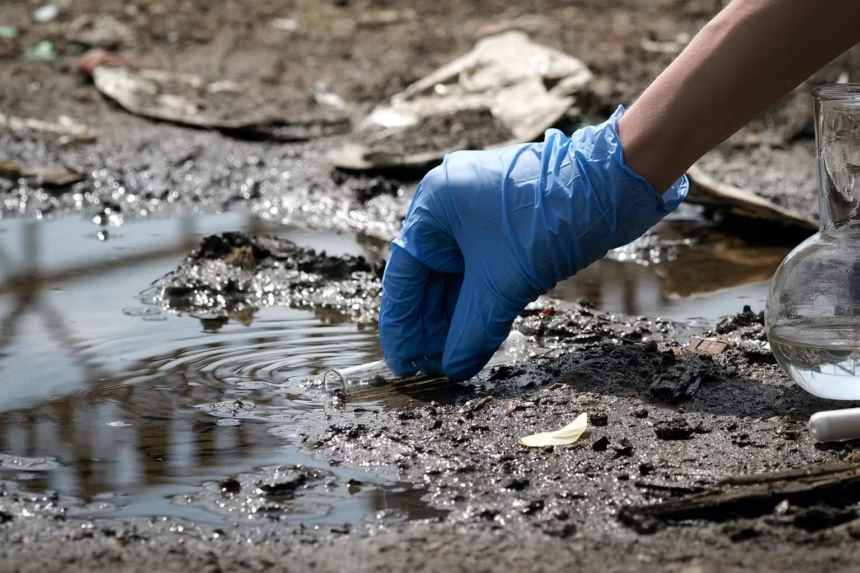
After a suspected dump is found, soil and water sampling can show whether contamination is present and where it has spread. Clear warnings help residents and workers make informed choices while testing is underway. Publishing results promptly, with the sampling locations, dates, and methods, lets communities understand what authorities tested and what remains uncertain.
The available sources do not provide site-specific soil or water results, or prove disease links for all the locations named in reports about chemical waste. Officials should distinguish a confirmed test result from a suspected pathway, and explain when follow-up testing is needed. Thailand’s Kok River monitoring and health screening offers a related example of public testing and health surveillance, though it concerns a separate pollution issue. When agencies share findings and explain their limits, residents can assess the evidence and judge whether enforcement is addressing the risk.
What would make Thailand’s enforcement stronger?
Stronger enforcement means following waste through every handoff, making lawful treatment accessible, and showing the public what happens after authorities find a violation. Thailand already has rules that place more responsibility on waste generators, but tracking, coverage, penalties, and public reporting still need work.
Make responsibility follow waste from source to final disposal
The Ministry of Industry’s 2023 notification extended generators’ responsibility for waste management and disposal. It requires generators to monitor processors and respond if a processor fails or an accident occurs. The notification’s expanded generator responsibilities give authorities a basis to look beyond the factory gate.
To make that duty enforceable, regulators need a consistent record for each shipment: its source, waste type, carrier, destination, and treatment outcome. If a handler closes, misuses a permit, or causes a spill, investigators should be able to identify who held the waste and whether the generator acted on warning signs. Digital records, routine checks, and penalties for falsified or missing documents could help close gaps between collection and final disposal.
Close coverage gaps and improve treatment capacity
The existing coverage gap for some smaller enterprises leaves waste outside the rules that apply to factories. Thailand should clarify which businesses must meet hazardous-waste requirements and provide workable guidance for small generators, so unclear status does not become a path around oversight.
Treatment access also needs attention. Government analysis describes licensed hazardous-waste capacity as limited and concentrated in central and eastern Thailand. Expanding authorized options in underserved regions would reduce long, difficult transport routes and give businesses more practical choices for compliant disposal. New facilities would still need strict permits, inspections, and public records; added capacity alone cannot prevent illegal handling.
Raise the cost of violations and fund cleanup
A 2025 analysis described a draft Industrial Waste Management Act that would require licensed handlers, extend generator responsibility, and establish financial security and a remediation fund. These are proposed measures, not confirmed law. Security could help pay for cleanup when a handler cannot meet its obligations, while a dedicated fund could support remediation.
Calls for higher fines and stronger asset recovery are also reform positions, not evidence that Thailand has changed its penalties. Any increase should make illegal disposal less attractive and give authorities a clear way to recover cleanup costs, while preserving due process.
Publish the full path from inspection to cleanup
Public reporting should track cases through inspection, sampling, agency referrals, charges, court outcomes, penalties, and completed remediation. A raid or seizure shows that authorities acted, but it does not tell residents whether contamination was tested, who was held responsible, or whether cleanup finished. The Chiang Khong lignite dumping investigation illustrates why communities need updates beyond the initial complaint. A public case record would let residents judge whether enforcement produced a safe result.
Frequently Asked Questions
Chemical waste cases often raise questions that go beyond whether a site broke a rule. Waste classification, permits, testing, and cleanup responsibility all affect how authorities assess a suspected dump.
Is all chemical waste classified as hazardous?
No. The classification depends on the material’s composition and whether it falls under Thailand’s hazardous-substance rules or waste controls. A chemical’s name or industrial origin alone doesn’t establish its legal status. Authorities may need records or laboratory analysis to identify the material and determine which requirements apply.
Can the smell or appearance identify a chemical dump?
No. Color, residue, smoke, or a strong odor may raise concern, but they can’t reliably identify a substance or confirm that it’s hazardous. Some dangerous materials may have no obvious smell or appearance. Keep your distance and let qualified authorities assess the site.
Can waste be transported legally between provinces?
Yes, when the shipment complies with applicable rules and reaches an authorized destination. Crossing a provincial boundary alone doesn’t make a shipment illegal. The waste’s classification, required approvals, transport records, and handling at the receiving site all matter when investigators assess a case.
Does a facility permit prove that waste was handled properly?
No. A permit authorizes specified activities under stated conditions, but it doesn’t prove that every shipment or operation complied with those conditions. Regulators may need to inspect records, compare the waste received with the facility’s authorization, and check how the material was stored or treated.
Does finding heavy metals prove nearby residents were exposed?
No. Detecting metals in a shipment or at a facility confirms their presence in that material, but it doesn’t establish exposure in nearby homes, soil, or water. Authorities need suitable sampling and testing at relevant locations to assess whether contaminants reached people or the environment.
What details should residents record when reporting a suspected dump?
From a safe distance, note the location, date and time, visible activity, vehicle descriptions, and any labels or markings you can read without approaching. Photos may help if you can take them safely and lawfully. Don’t touch, move, smell closely, or sample unknown material; contact local authorities or the relevant environmental and industrial agencies.


