





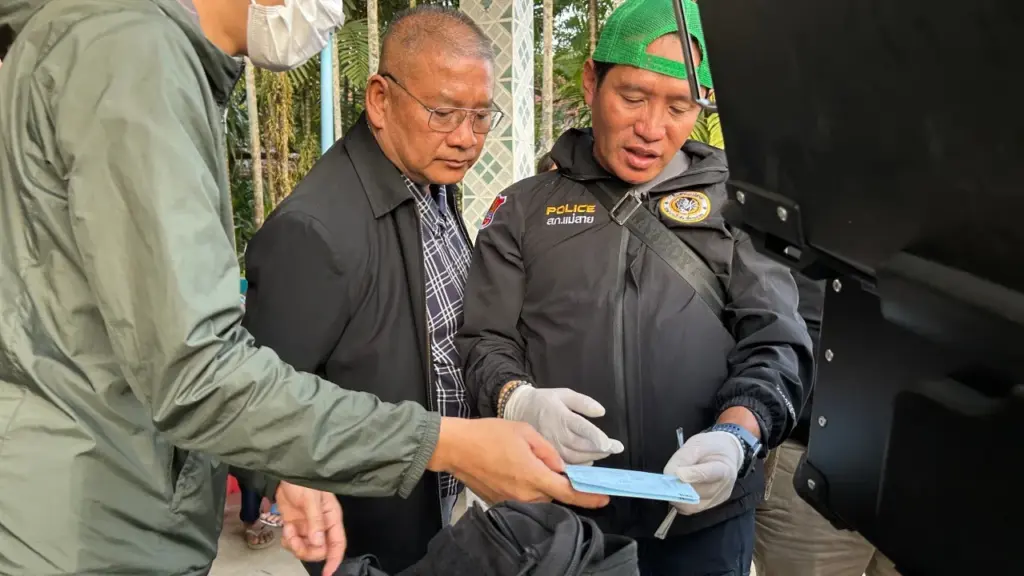
CHIANG RAI – A police corporal from Chiang Saen Police Station died by suicide at a family member’s home. His wife arrived at the house and broke down in tears, saying he had been under heavy personal strain. The Mae Sai police chief later gathered evidence as part of the inquiry.
At about 15:00, Mae Sai police were alerted that a police corporal from Chiang Saen Police Station had used his service firearm to end his life. The incident happened on a bed inside his grandmother’s home in Ban Pong Nuea, Village No. 8, Pong Ngam Subdistrict, Mae Sai District, Chiang Rai Province. Officers and rescue workers went to the scene without delay.
The home was a single-storey concrete house. Inside the grandmother’s bedroom, officers found the body of Police Corporal Suchakeer Srikaew, who served at Chiang Saen Police Station in Chiang Rai. He was lying on his back, dressed in a long-sleeve khaki jacket and black trousers. A 9mm service pistol was near his right hand. He had a gunshot wound to the right temple, and the bullet exited on the left side.
Mrs Saipan Mooltasri, his mother, spoke through tears during an interview. She said her son was part of the Lampang 07 police intake and had been in service for around three to four years. She described him as kind and easy to get along with, and said he was well-liked by both colleagues and relatives.
She added that she had not noticed any clear warning signs. She mentioned small disagreements with his girlfriend at times, but nothing that seemed serious. He lived with his girlfriend in Mae Pern, visited his mother in Huay Khrai, and sometimes stayed at his grandmother Jan Srikaew’s home.
Family members said Corporal Suchakeer was close to his mother and relatives, and people cared for him because of that. Shortly before the incident, he visited his mother in Huay Khrai and hugged her for longer than usual. She also noticed he seemed down while helping water the vegetable plot, as if something was on his mind.
His grandmother said he came to the house earlier that day and greeted her with a warm hug. She said he acted normally, smiled, and even made jokes. After that, she stepped out briefly to run a nearby errand while he went into the bedroom.
When she returned, she called out to him several times. She thought he might be in the bathroom or on his phone in the bedroom. When she went in, she found him lying on his back. She called his name and noticed he looked pale, so she tried first aid straight away. After seeing a gun beside him, she called for help.
Mental health and suicide in Thailand
Thailand has a serious mental health burden that often goes unseen. Data from the Department of Mental Health shows worrying patterns. In 2024, more than 1.3 million people aged 15 and over were living with depression.
Screening surveys from 2020 to 2025 also suggest that raround9% were at risk of depression, 5% were at risk of suicide, and 8% reported high stress among millions screened. Young people under 20 appear especially at risk, with higher levels of stress, depression, and suicidal thoughts.
Suicide rates have also increased. Reports show a 32% rise from 2017 to 2022. In 2024, Thailand recorded 5,217 suicide deaths, about 8.02 per 100,000 people, which works out at roughly 15 deaths a day. There were also about 34,000 attempts. Men make up around 80% of deaths, and they are more likely to use highly lethal methods.

Financial strain, family tension, relationship problems, online bullying, and ongoing post-COVID pressures can all raise the risk. Stigma and limited access to care remain major barriers, especially in rural areas with fewer psychiatrists and fewer resources. The wider cost to society may reach hundreds of billions of baht each year.
Thailand is working on prevention through a National Suicide Prevention Action Plan running to 2030, aligned with the WHO LIVE LIFE guidance. The plan focuses on better monitoring, restricting access to common means, school-based support, and safer media reporting.
Programmes such as the HOPE Taskforce, which includes police and influencers for online outreach, also aim to spot risk earlier. Digital tools like “Tor-Tuem-Jai” are used to support screening and early help.
Helpful resources:
- Mental Health Hotline 1323: Free, confidential support 24/7 for crisis, depression, or suicide risk (Department of Mental Health).
- Social Help Centre Hotline 1300: General social and emotional support 24/7.
- Samaritans of Thailand: English and Thai emotional support, call 02-713-6793 (Thai, noon to 10 pm) or leave a message for an English callback.
- Mental Health Check-In app for self-checks and referral support.
Getting help is a strong step. People who feel overwhelmed can speak with trusted friends, family, or health workers. Early support can save lives, and open talks help reduce stigma over time.


