


The best hidden temples Chiang Rai locals favor aren’t the ones with tour buses lined up outside. They’re the small hill shrines, cave wats, and countryside compounds in Northern Thailand where locals still stop for a quick prayer, light incense, and move on with their day.
This guide keeps it simple: a map-friendly list, what makes each place special, easy directions from Chiang Rai city, basic etiquette, and two mini routes that cut down backtracking. Count these among the top things to do in Chiang Rai.
Early morning brings cooler air and the calmest Buddhist temple grounds.
Quick Answer
- Who it’s for: Independent travelers who want quiet temples and a real local atmosphere
- What you’ll find: Cave settings, forest paths, bright murals, village shrines
- Best time to go: 7:00 to 10:00 a.m. in the cool, dry months
For broader planning beyond this list, see this Chiang Rai temples guide.

Top Hidden Temples in Chiang Rai (Map-Friendly List)
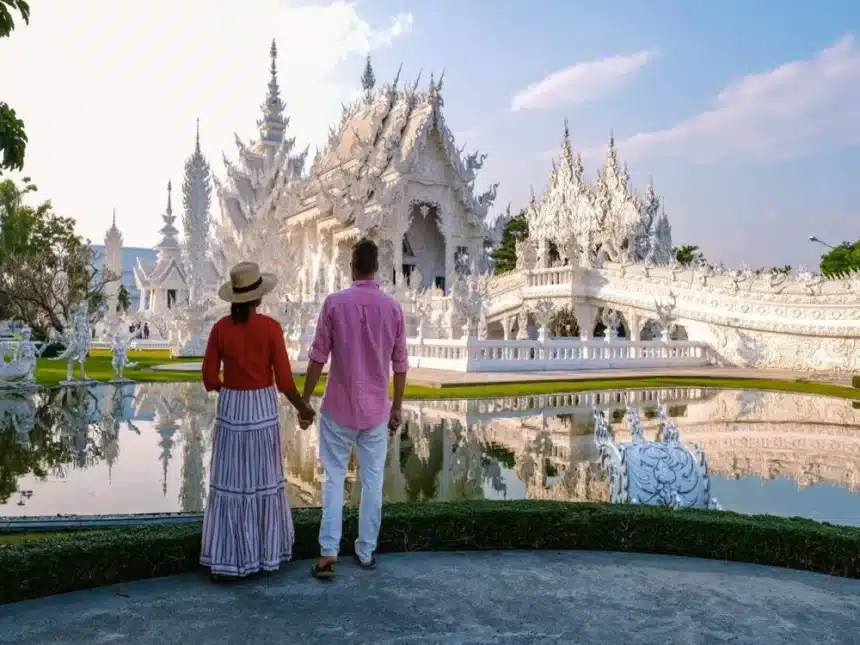
A quick note for context: the White Temple (Wat Rong Khun), Blue Temple (Wat Rong Suea Ten), and Black House (Baan Dam Museum) are striking popular sites, but they’re not the focus here. This is a Chiang Rai local temples guide for quieter stops.
Here are some off the beaten path temples:
- Wat Huai Wiang, old wood details, Chiang Khong calm
- Wat Phra That Tham Doi, cave air, stone textures, soft light
- Wat Saeng Kaeo Phothiyan, bright murals, wide open grounds
- Doi In Cee Temple, forest walk with hidden statues
- Wat Tham Pla (Mae Chan), sacred fish pool, cave hush
- Wat Doi Chang Mountain Temple, misty ridge views, local bells
- Phu Chi Fa Sunrise Shrine Stops, pre-dawn prayers near the cliffs
- Huay Mae Sai Village Hill Shrines, village carvings, sunset viewpoints
- Wat Huay Pla Kang back approach (quiet corners), calmer angles away from main stairs
Travelers trying to keep visits low-impact can pair temple days with this low-impact travel guide for Chiang Rai.
Wat Huai Wiang (Hidden Temple in Chiang Rai)
Wat Huai Wiang sits in the Wiang area of Chiang Khong district, far enough from the city that most visitors skip it. The appeal is simple: it feels used, not staged, with a slower pace and fewer cameras.
When I visited around 8 a.m., the only sound was sweeping and quiet chanting.
Why it’s worth the stop
This Buddhist temple’s prayer hall has an older, plain feel that reads well in photos, especially door frames, Lanna architecture in the timber grain, and worn steps. The best shots are close-up details, then a wider frame that includes the surrounding hills.
The crowd level stays low, and mornings are the quietest.
How to get there
From Chiang Rai city, plan about 1.5 to 2 hours by car or motorbike toward Chiang Khong. Use Chiang Khong town as the last easy reference point, then follow local signs.
Visit tips
Keep voices low, avoid standing directly in front of anyone praying, and don’t step on raised thresholds at doorways.
Quick facts
- Area: Wiang area, Chiang Khong district
- Best time: Cool season mornings (Nov to Feb)
- Time needed: 30 to 45 minutes
- Cost: Donation-based
- Parking: Small roadside area
- Accessibility: Uneven ground, a few steps
- Find Wat Huai Wiang, Chiang Khong on Google Maps: View on Google Maps
Wat Phra That Tham Doi (Hidden Temple in Chiang Rai)
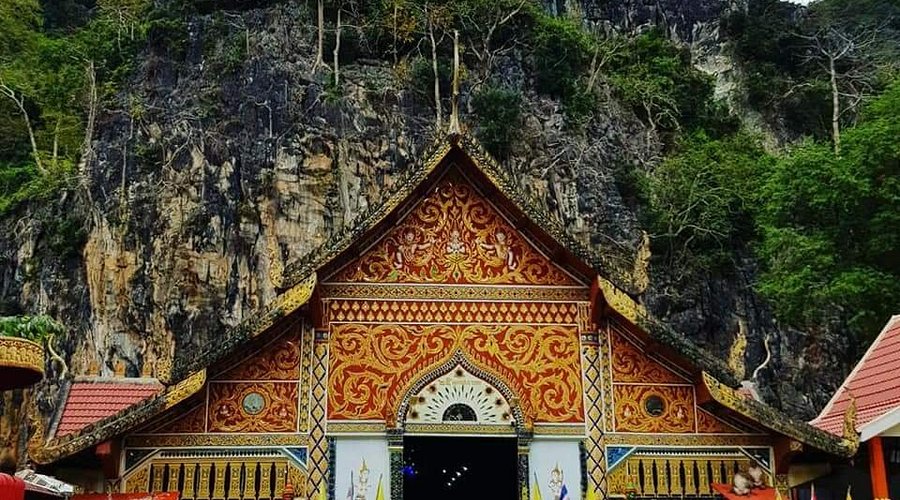
This cave-style Buddhist temple is a serene stop, set on a hillside where stone, shade, and incense combine to create a cooler space. In rainy months, the paths can turn slick fast.
### Why it’s worth the stop
The cave creates a natural quiet that changes how people behave, even small groups tend to whisper. Look for rock textures, drip marks, and the way daylight fades at the edges.
Photography tip: low light is normal here, skip flash if anyone is praying.
How to get there
From Chiang Rai city, it takes about 45 to 90 minutes depending on the route. Expect a steep approach road near the end, then steps up from parking.
Visit tips
Take it slow on damp surfaces, keep your hands off fragile rock areas, and don’t block narrow passages.
Quick facts
- Area: Chiang Rai province hills in Northern Thailand (local listings vary)
- Best time: Dry-season mornings
- Time needed: 45 to 60 minutes
- Cost: Donation-based
- Parking: Basic roadside lot
- Accessibility: Not wheelchair-friendly, stairs and uneven stone
- Find Wat Phra That Tham Doi, Chiang Rai on Google Maps: View on Google Maps
Wat Saeng Kaeo Phothiyan (Hidden Temple in Chiang Rai)
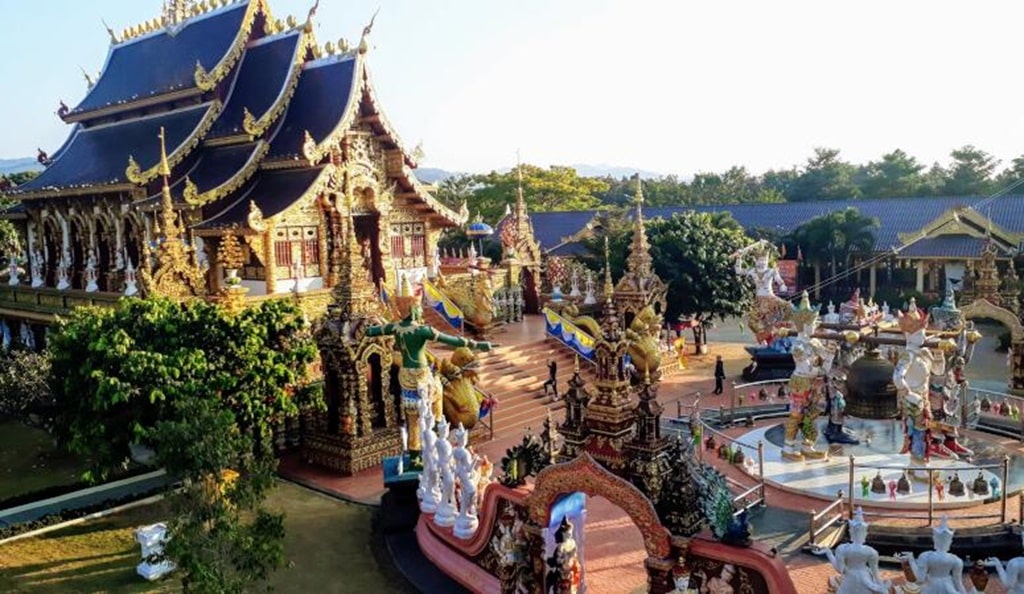
Wat Saeng Kaeo Phothiyan is the opposite of dark cave calm. It’s bright, open, and detailed, but still feels like a local place because it sits out in the countryside.
Why it’s worth the stop
Murals and painted surfaces reward slow looking. The best light usually comes early, when colors stay clean and shadows don’t cut across the walls.
Etiquette matters here: cover shoulders and knees, remove shoes, and keep voices low.
How to get there
From Chiang Rai city, plan about 40 to 75 minutes by car. A scooter works in dry weather, but watch for narrow rural roads.
Visit tips
Avoid pointing feet toward Buddha images when seated. Step aside if locals arrive to pray.
Quick facts
- Area: Chiang Rai countryside (check current map listing)
- Best time: Early morning
- Time needed: 45 to 75 minutes
- Entrance fee: Donation-based
- Parking: On-site open space
- Accessibility: Mostly flat paths with some steps
- Find Wat Saeng Kaew Phothiyan, Chiang Rai on Google Maps: View on Google Maps
## Doi In Cee Temple (Hidden Temple in Chiang Rai)
Doi In Cee Temple (also listed as Wat Doi Insee), a serene Buddhist temple, feels more like a gentle nature walk with shrines scattered around. There isn’t one big landmark that pulls crowds.
Why it’s worth the stop
It stays quiet because visitors tend to miss small sites with spread-out grounds. A simple photo plan works best: shoot one wide scene first, then look for statues tucked into trees and corners.
How to get there
From Chiang Rai city, plan about 45 to 90 minutes. Roads can climb in sections, so ride carefully and expect short walks between points.
Visit tips
This is a good place to slow down. Don’t climb on statues or platforms for photos.
Quick facts
- Area: Doi Insee hills, Chiang Rai province
- Best time: Late afternoon for softer light
- Time needed: 60 to 90 minutes
- Cost: Donation-based
- Parking: Small areas near entrances
- Accessibility: Uneven paths, fine for kids who like short walks
- Find Doi In Cee Temple (Wat Doi Insee), Chiang Rai on Google Maps: View on Google Maps
## Wat Tham Pla (Mae Chan) (Hidden Temple in Chiang Rai)
Wat Tham Pla in Mae Chan is known for its cave-like atmosphere and a fish pool where people pause to watch the water. It’s an easy place to accidentally get loud, so it helps to treat the whole area like a quiet zone.
Why it’s worth the stop
The mix of running water, cave shade, and carved Naga details makes it feel separate from the road outside. If fish feeding is allowed, keep it simple and follow posted rules.
How to get there
From Chiang Rai city, drive north toward Mae Chan, then follow local directions or GPS. Plan about 30 to 60 minutes.
Visit tips
Avoid shouting into the cave, and don’t crowd locals during offerings.
Quick facts
- Area: Mae Chan district
- Best time: Early day
- Time needed: 45 to 60 minutes
- Cost: Donation-based
- Parking: On-site
- Accessibility: Cave steps, watch footing on damp ground
- Find Wat Tham Pla Mae Chan, Chiang Rai on Google Maps: View on Google Maps
Wat Doi Chang Mountain Temple (Hidden Temple in Chiang Rai)
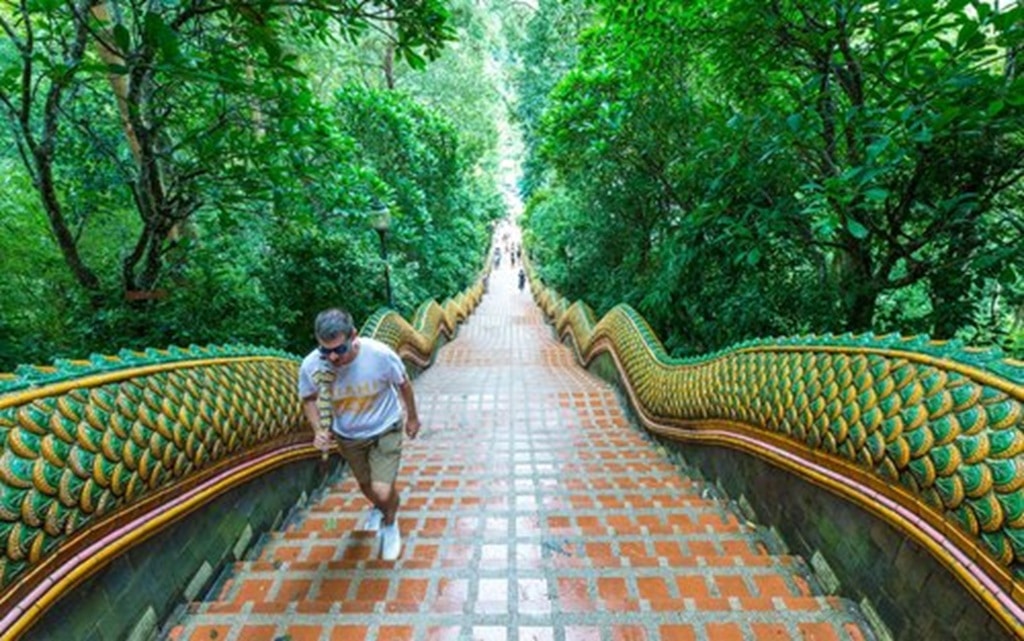
Wat Doi Chang is a mountain detour to avoid crowds, with cooler air and quick-changing weather. In the incredible season, mist can roll in and erase the view in minutes, then clear again.
Why it’s worth the stop
The views are the headline, but small details matter too: bells and offering bowls of this Buddhist temple, and quiet lookout points. Morning light also gives softer faces in statue photos.
How to get there
From Chiang Rai city, plan about 1 to 2 hours on winding hill roads. Drive slowly on blind bends and watch for steep grades.
Visit tips
Bring a light layer. Weather shifts fast in the hills.
Quick facts
- Area: Doi Chang area, Chiang Rai province
- Best time: Early morning
- Time needed: 60 to 90 minutes
- Cost: Donation-based
- Parking: Small lots near viewpoints
- Accessibility: Some steep areas and steps
- Find Wat Doi Chang, Chiang Rai on Google Maps: View on Google Maps
Phu Chi Fa Sunrise Shrine Stops (Hidden Temple Vibes Near the Viewpoint)
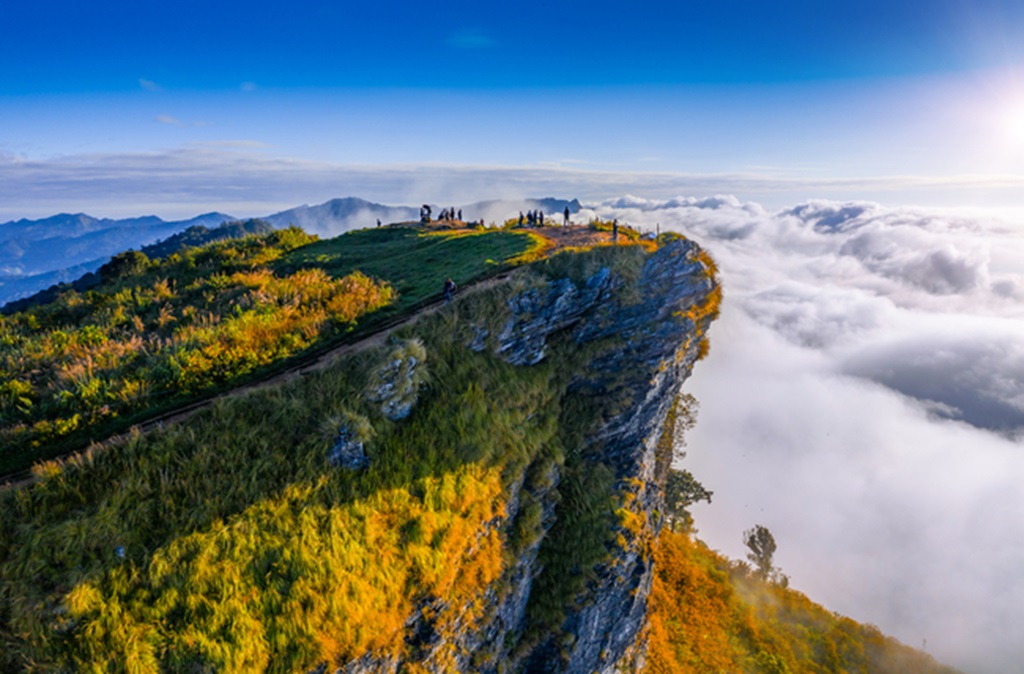
Phu Chi Fa is one of the top things to do in Chiang Rai as a far outing and works best as a sunrise trip. The spiritual feel comes from small shrines and quiet moments throughout the viewpoint area, not from a single famous temple.
Why it’s worth the stop
Before the crowd forms, the ridge is often silent except for footsteps and wind. People may be praying at small shrines, so photos should stay respectful and non-intrusive.
How to get there
From Chiang Rai city, plan about 1.5 to 2 hours by road. Start early enough to park, walk, and reach the viewpoint before first light.
Visit tips
Use a headlamp for the walk. Keep distance from anyone praying.
Quick facts
- Area: Border mountains in Northern Thailand near the Laos viewpoint zone
- Best time: Pre-dawn in cool season (Nov to Feb)
- Time needed: 3 to 5 hours round trip from the city, longer with stops
- Cost: Small local fees may apply in the area
- Parking: Designated lots near trail start
- Accessibility: Short hike, cold wind common
- Find Phu Chi Fa**, Chiang Rai** on Google Maps: View on Google Maps
Huay Mae Sai Village Hill Shrines (Hidden Temple in Chiang Rai)
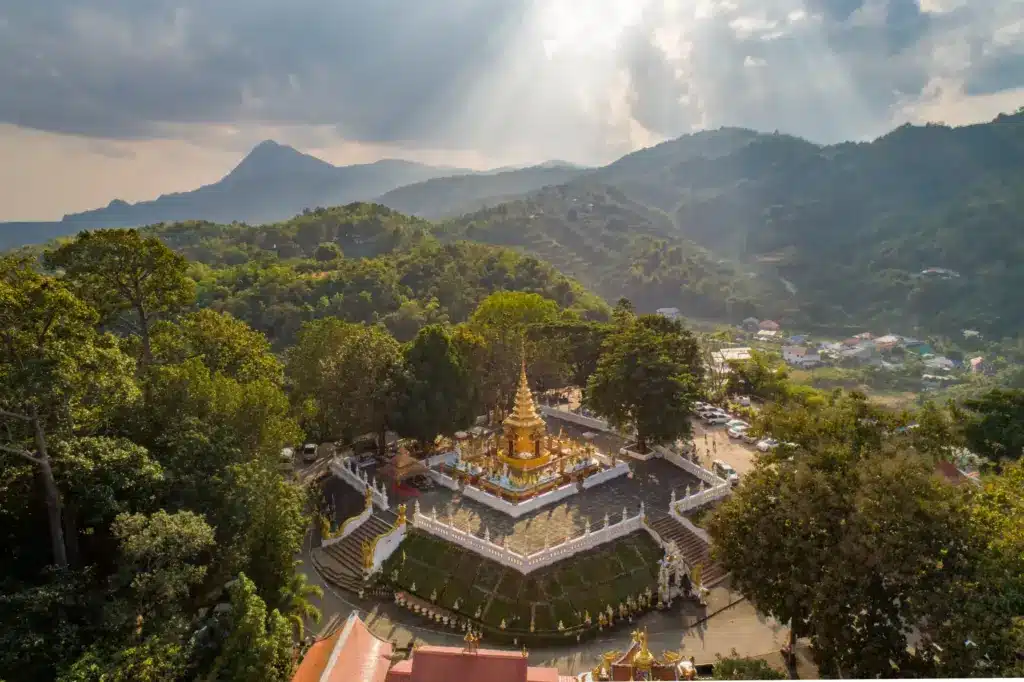
These are small off the beaten path temples in the village rather than a formal tourist stop. That’s the point. The setting feels personal, like a neighborhood chapel on a hill.
Why it’s worth the stop
Carvings and small altars can be surprisingly detailed. Sunset light adds warmth to wood and painted surfaces, and the views can open up across fields.
Photo rule: ask before photographing people, homes, or active ceremonies.
How to get there
From Chiang Rai city, it takes about 30 to 75 minutes, depending on the route taken. A car is the simplest, confident scooter riders should avoid wet or broken pavement.
Visit tips
Be extra polite in villages. Keep conversations low and don’t wander onto private land.
Quick facts
- Area: Huay Mae Sai village area, Chiang Rai province, Northern Thailand
- Best time: Sunset
- Time needed: 30 to 60 minutes
- Cost: Donation-based
- Parking: Roadside pull-offs
- Accessibility: Possible steep stairs
- Find Huay Mae Sai village area**, Chiang Rai** on Google Maps: View on Google Maps
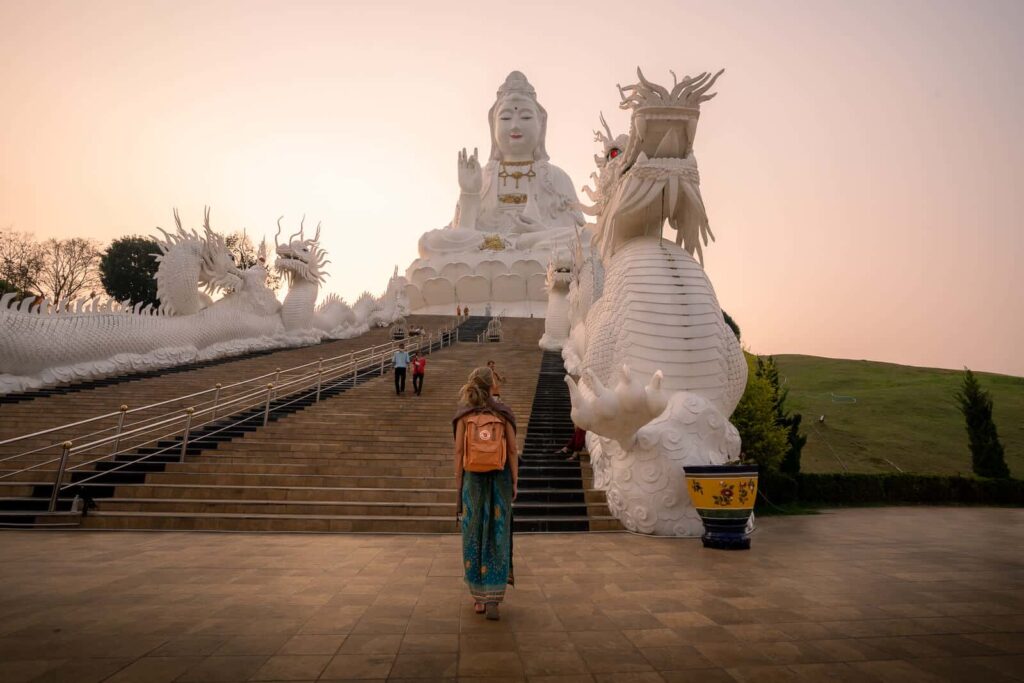
Wat Huai Pla Kang back approach (quiet corners) (Hidden Temple in Chiang Rai)
Wat Huay Pla Kang isn’t hidden, but most visitors stick to the busiest front areas around the nine-story pagoda. The quieter corners and side paths offer a serene escape, especially with views of the striking Guan Yin statue of the Goddess of Mercy, feeling like a completely different visit early in the morning.
Why it’s worth the stop
This is a good choice for travelers who want one well-known site without the peak crowd feeling. Side angles work better for photos, with fewer people in frame.
How to get there
From Chiang Rai city, plan about 15 to 25 minutes by car or scooter.
Visit tips
If ceremonies are underway, step back and wait. Don’t treat prayer areas like a photo set.
Quick facts
- Area: Near Chiang Rai city
- Best time: 7:00 to 9:00 a.m.
- Time needed: 45 to 90 minutes
- Cost: Donation-based
- Parking: Large on-site parking
- Accessibility: Many stairs, some flatter sections
- Find Wat Huay Pla Kang**, Chiang Rai** on Google Maps: View on Google Maps
Mini Itineraries (Half-Day and Full-Day Quiet Temple Routes)
These routes start in Chiang Rai city and offer some of the best things to do in Chiang Rai while aiming to reduce backtracking. For more quiet stops beyond temples, see Northern Thailand’s hidden gems.
A simple food plan works well here: grab coffee and something light near the Clock Tower in town first, then eat a late lunch back in the city at the Night Bazaar.
City quiet loop (easy morning, short drives)
- Start: Chiang Rai city, best start time: 7:00 a.m.
- Stops: Wat Huai Pla Kang back approach (45 min), Wat Tham Pla Mae Chan (60 min), one village hill shrine area near Huay Mae Sai (30 min)
- Total drive time: about 1.5 to 2.5 hours (depending on pauses)
Photo plan: take one wide shot on arrival, then switch to details (bells, doors, murals).
Countryside hidden loop (views, caves, and slower pace)
- Start: Chiang Rai city, best start time: 4:30 to 5:00 a.m. (for sunrise)
- Stops: Phu Chi Fa shrine area (2 to 3 hours), Wat Doi Chang (60 min), Wat Phra That Tham Doi (60 min), Khun Korn Waterfall (45 min)
- Total drive time: about 4 to 6 hours, plus walking time
Bring fuel, water, and snacks. Mountain roads get harder after dark, and cave steps can stay damp.
Common Mistakes to Avoid at Hidden Temples in Chiang Rai
Small fixes help visitors avoid awkward moments at Chiang Rai’s hidden Buddhist temples.
- Dress: cover shoulders and knees, carry a light wrap.
- Shoes: slip-ons help, shoes come off often.
- Noise: speak softly, don’t play music on phones.
- Monk etiquette: don’t touch monks, and give them space on steps.
- Photo spots: don’t stand in doorways or directly in front of worshippers.
- Drones: avoid them unless rules clearly allow it, many temples dislike the noise.
- Donations: use boxes quietly, pay any entrance fee discreetly, don’t film yourself donating.
- Incense: smoke can bother people, step aside if it’s heavy.
- Cleanliness: don’t leave cups, bottles, or snack wrappers behind.
Comparison Table: Which Hidden Temple Should You Pick?
| Temple | Best for photos | Most peaceful | Best if you have 1 hour | Most unique art | Best countryside view | Easiest access |
| Wat Huai Wiang | Wood textures | High | Yes | Low | Medium | Medium |
| Wat Phra That Tham Doi | Cave light | High | Yes | Medium | Medium | Hard |
| Wat Saeng Kaeo Phothiyan | Murals | Medium | Yes | High | Medium | Medium |
| Doi In Cee Temple | Forest details | High | No | Medium | Medium | Hard |
| Wat Tham Pla (Mae Chan) | Water and cave | Medium | Yes | Medium | Low | Medium |
| Wat Doi Chang | Ridge views | Medium | No | Low | High | Hard |
| Phu Chi Fa shrine stops | Sunrise silhouettes | Medium | No | Low | High | Medium |
| Huay Mae Sai hill shrines | Sunset tones | High | Yes | Medium | High | Medium |
| Wat Huai Pla Kang (quiet corners) | Wide frames | Medium | Yes | High | Medium | Easy |
FAQ About Hidden Temples and Chiang Rai Planning
What is the hidden temple in Chiang Mai?
Chiang Mai doesn’t have one single “hidden temple” everyone agrees on. Quieter visits usually happen outside the Old City walls and early in the morning. Temples like Wat Umong (the tunnel temple) often feel calmer than the busiest city-center sites. These spots make an ideal starting point for travelers planning the Chiang Mai to Chiang Rai journey.
What are the three temples of Chiang Rai?
Most people mean the famous trio: White Temple (Wat Rong Khun), Blue Temple (Wat Rong Suea Ten), and Wat Huay Pla Kang. The White Temple (Wat Rong Khun), designed by artist Chalermchai Kositpipat, draws crowds for its striking modern art. This guide focuses on lesser-known temples in Chiang Rai beyond the White Temple (Wat Rong Khun) and Blue Temple (Wat Rong Suea Ten) that feel quieter and more local, such as Wat Phra Kaew (where the Emerald Buddha was discovered), Wat Phrathat Doi Khao Kwai with its golden chedi, Wat Ming Muang, Wat Klang Wiang, Wat Phra Sing, and Wat Fang Min. These sites showcase architecture from the Lanna Kingdom era.
Where to go in Thailand hidden gems?
Strong options include the far North (Chiang Rai, Nan, Phayao), parts of Isan, and smaller islands away from the main ferry routes. For those planning the Chiang Mai to Chiang Rai route, unwind at the Night Bazaar after temple visits. For planning beyond Chiang Rai, this guide to ethical trekking routes in Northern Thailand 2025 adds practical seasonal and safety notes.
Where is the Blue Temple in Chiang Rai?
The Blue Temple (Wat Rong Suea Ten) is near Chiang Rai city, so it’s easy to reach by taxi or scooter. Featuring vivid depictions of the Goddess of Mercy, go early or late in the day for better light and fewer people. Travelers seeking quieter alternatives can use the temple list above to build a calm morning loop.
Conclusion
The Best Hidden Temples in Chiang Rai are the places where small details do the work, worn wood, damp stone, a bell moving in the wind, and a few locals praying before work. Save this list, pick three temples, go early, bring a light layer for cool mornings, and keep visits respectful. For more ideas on sacred sites and classic stops like the White Temple (Wat Rong Khun) and Blue Temple (Wat Rong Suea Ten), see this roundup of temples to visit in Chiang Rai. These rank among the top things to do in Chiang Rai. Keep shoes off inside Buddhist temple halls, speak softly, and leave no trash behind.